
Dead letters
Maurice Baring
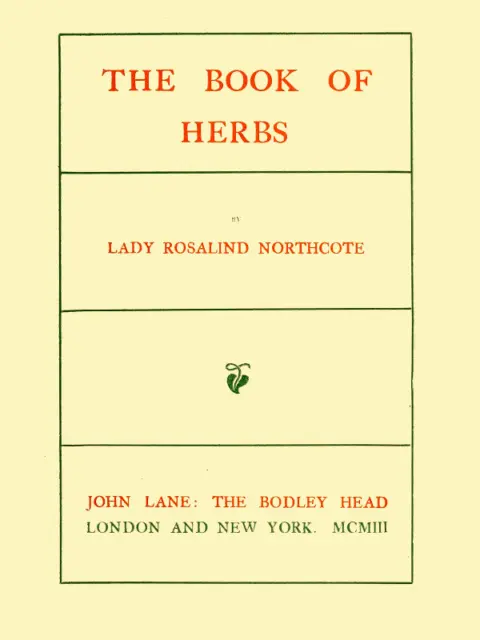
THE CLASSIC COLLECTION · 1903
"The Book of Herbs" by Lady Rosalind Northcote is a practical gardening handbook written in the early 20th century. The book delves into the various types of herbs, their uses, and their significance across history, with a particular focus on those commonly found in British gardens. Northcote aims to not only educate readers on the cultivation of herbs but also to revive knowledge and appreciation for these plants, many of which have fallen out of favor. At the start of the book, the author introduces the concept of herbs, emphasizing the difficulty in defining what qualifies as a herb. She suggests that herbs encompass aromatic plants suitable for consumption, while acknowledging that some do not fit neatly into this category. The opening portion also hints at the rich historical and cultural significance of herbs, with references to their use in cooking, medicine, and various rituals. Northcote highlights the enduring appeal of herbs and underscores the need for a rediscovery of traditional knowledge associated with these plants, setting the stage for a comprehensive exploration that follows.
Introduction adapted from the source catalogue; source summaries may be automatically generated.
Free to read · English · 62,033 words · No account needed
MAKE TIME FOR A GOOD BOOK
On by default. Untick to stop anonymous reading totals. Each page counts after 10 seconds in view. How this works.
Anonymous counting is on unless you have switched it off.
Other English-grown plants in the Pharmacopœia are: Anise, Artemisia maritima (Wormwood), Uvæ Ursi (Bearberries), Coriander, Caraway, Dill, Fennel, Flax (Linseed), Henbane, Wych-Hazel, Horse-Radish, Liquorice, Lavender, Mint, Mezereon, Musk, Mustard, Arnica, Pyrethrum, Rosemary, Squills, Saffron and Winter-green. In the making of Thymol, a preparation in common hospital use, Monarda punctata (Bergamot), Oil of Thyme and Carum copticus are used.
The following plants are not yet to be found in the Pharmacopœia, which includes those only that have been tried by very long experience, but leading physicians have prescribed these drugs with success. Convalleria, from Lily of the Valley; Salix nigra, from the Willow; Savin, Juniper; Rhus, Sumach; Aletris, Star-Grass; Lycopodium, Club-Moss; Grindelia; from Larkspur, Oil of Stavesacre; and from Broom, Spartein.
There are two plants that I do not like to omit, for their history’s sake, though their power to do good is no longer believed in, Plantain and Lungwort. The first was considered good for wounds in the days of Chaucer, and Shakespeare mentions it.
Romeo. Your plantain leaf is excellent for that.
Benvolio. For what, I pray thee?
Romeo. For your broken shin.
Romeo and Juliet, I. 2, 51.
Lungwort (Pulmonaria officinalis) owes its name and its reputation to the white spots on the leaves, which were thought to be the “signature,” showing that it would cure infirmities and ulcers of the lungs. It is remarkable how many popular names this flower has. Gerarde tells us that the leaves are used among pot-herbes, and calls it Cowslips of Jerusalem, Wild Comfrey and Sage of Bethlem; and other country names are, Beggar’s Basket, Soldiers and Sailors, Adam and Eve, and in Dorset, Mary’s Tears. The name Adam and Eve arose from the fact that some of the flowers are red and others blue: red, in earlier days, being usually associated with men and blue with women. One of Drayton’s prettiest verses alludes to it.
“Maids, get the choicest flowers, a garland and entwine; Nor pink, nor pansies, let there want, be sure of eglantine. See that there be store of lilies, (Call’d of shepherds daffadillies) With roses, damask, white, and red, the dearest fleur-de-lis, The cowslip of Jerusalem, and clove of Paradise.”
Eclogue III.
Your reading position is saved on this browser. Take it to another device with a library code. Reading pages adapt to text, rather than matching a printed edition.
BEHIND THE BOOK
This eBook is for the use of anyone anywhere in the United States and most other parts of the world at no cost and with almost no restrictions whatsoever. You may copy it, give it away or re-use it under the terms of the Project Gutenberg License included with this eBook or online at www.gutenberg.org. If you are not located in the United States, you will have to check the laws of the country where you are located before using this eBook. Read the source licence.
The original source file, including credits and licence, is retained by this library. Request an original-format copy at no charge. Please include the book title and Project Gutenberg identifier #60050.
KEEP YOUR CURIOSITY GOING
Maurice Baring
Francis Greenleaf Allinson & Anne C. E. (Anne Crosby Emery) Allinson
Stuart Dodgson Collingwood
Percy Keese Fitzhugh
Mary Macleod & Edmund Spenser

Cooke Don-Carlos