
Dead letters
Maurice Baring
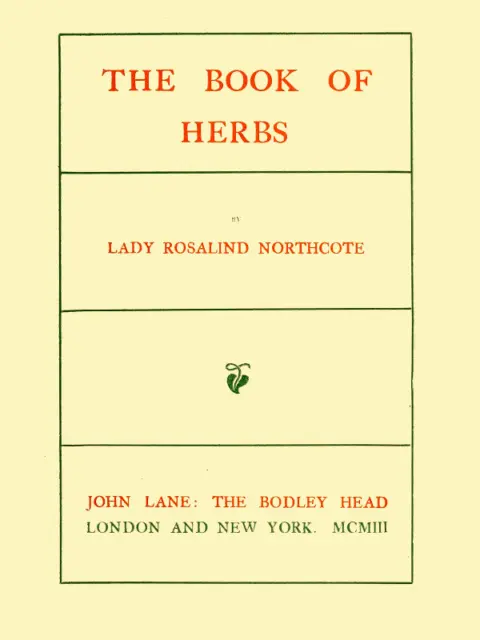
THE CLASSIC COLLECTION · 1903
"The Book of Herbs" by Lady Rosalind Northcote is a practical gardening handbook written in the early 20th century. The book delves into the various types of herbs, their uses, and their significance across history, with a particular focus on those commonly found in British gardens. Northcote aims to not only educate readers on the cultivation of herbs but also to revive knowledge and appreciation for these plants, many of which have fallen out of favor. At the start of the book, the author introduces the concept of herbs, emphasizing the difficulty in defining what qualifies as a herb. She suggests that herbs encompass aromatic plants suitable for consumption, while acknowledging that some do not fit neatly into this category. The opening portion also hints at the rich historical and cultural significance of herbs, with references to their use in cooking, medicine, and various rituals. Northcote highlights the enduring appeal of herbs and underscores the need for a rediscovery of traditional knowledge associated with these plants, setting the stage for a comprehensive exploration that follows.
Introduction adapted from the source catalogue; source summaries may be automatically generated.
Free to read · English · 62,033 words · No account needed
MAKE TIME FOR A GOOD BOOK
On by default. Untick to stop anonymous reading totals. Each page counts after 10 seconds in view. How this works.
Anonymous counting is on unless you have switched it off.
Many herbs have been expunged from modern Pharmacopœias. Perhaps we have no use for them now that we, in England, no longer live in perpetual terror of the bitings of sea-hares, scorpions or tarantulas, as our forefathers seem to have done! In Harrison’s “Description of England,” the habit of preferring foreign, to native herbs, is rebuked. “But herein (the cherishing of foreign herbs) I find some cause of just complaint, for that we extoll their uses so farre that we fall into contempt of our owne, which are, in truth, more beneficiall and apt for us than such as grow elsewhere, sith (as I said before) everie region hath abundantly within his own limits whatsoever is needfull and most convenient for them that dwell therein.” Probably there are to-day some thinkers of this stamp, as well as others who will hold anything valuable as long as it has been fetched from “overseas.”
Russell gives instructions, in his “Boke of Nurture,” how to “make a Bath medicinable,” by adding herbs,--mallow, hollyhocks and fennel being among the number. And he directs that herbs “sweet and greene” should be hanged round the room “when the Master will have a bath”; a proceeding which was evidently something of a ceremony.
To-day, there is an unfortunate tendency among the poor, to desert herbs, not for “doctor’s medicine,” but for any quackery they may chance to see “on the paper” and some of these remedies are advertised to cure nearly as many and diverse diseases, as any of the compounds prescribed by the Ancients. Consequently, one usually hears of the uses of herbs in the past tense. There is a curious poem (published at Ipswich, 1796) called the “Poor Phytologist, or the Author Gathering Herbs,” by James Chambers, Itinerant Poet, which gives the names and virtues of the simples most prized at that date. He was a pedlar, who wandered about the country, always accompanied by several dogs, and he added to his “precarious mode of existence, the art of making nets and composing acrostics.” I have quoted some of his lines at the beginning of this chapter, but few of the herbs he mentions are in popular use now, at least in the west of England. Betony occurs in some old village recipes still employed, though its vaunted powers have been declared vain by science. Amongst those that I have known, or have heard of, through personal friends, as being still, or quite recently in use, are the following:--Dandelion, Centaury, Meadow-Sweet and Wild-Sage are used as “bitters.” By Wild-Sage, Wood-Sage is usually, if not always, meant. Dandelion is, of course, in the British Pharmacopœia; and Wood-Sage, though not officinal, is asked for by some chemists. Bear’s foot (Hellebore) has five finger-like leaves, but one finger is bad and must be torn off. Angelica is a wonderful herb; Parkinson put it in the fore-front of all medicinal plants and it holds almost as high a place among village herbalists to-day. Among many other virtues, the dried leaves are said to have great power to reduce inflammation if steeped in hot water and applied to the affected part. Mallows, especially Marsh-Mallows, retain their old reputation for relieving the same ill and the well-known Pâtés de Guimauve are made from their roots. Elder, beloved by all herbalists, still keeps its place in the British Pharmacopœia, and the cooling effects of Elder-Flower Water, none can deny. In the country, Elder leaves and buds are most highly valued and are used in drinks, poultices and ointments. Hyssop, or as some call it I-sop, is sometimes used. Primrose, Poor Man’s Friend, and Comfrey are together made into an ointment, but White Comfrey should be used when the ointment is for a woman, Red-flowered Comfrey when it is for a man. “Poor Man’s Friend” in this case is Hedge-Garlic, but the name is sometimes given to Swine’s Cress (Lapsana Communis). The juice of House-Leek, mixed with cream, relieves inflammation and particularly the irritation which follows vaccination in an arm “taking beautifully.” Probatum est. Penny-pies or Penny-wort (Cotyledon Umbilicus) is said to be equally efficacious, especially used with cream, and when simmered with the “sides of the pan,” have been known to heal, where linseed poultices failed to do good. When the leaf of Penny-wort is applied to a wound, one side draws, the other side heals. Wormwood is often in request by brewers. Marigold-tea is a widely administered remedy for the measles, and is one of the few remedies which everybody seems to know. Very often families appear to have their own special formula, and even where the chief herbs in different prescriptions to relieve the same ailment are identical, the lesser herbs vary. Saffron was also recommended for measles; both probably on the “Doctrine of Colour Analogy” referred to the rash. An old Herbalist told me that he considered Marigolds nearly as good as Saffron and “more home-grown, so to speak.” Dr Primrose, a physician in the reign of Charles II., who wrote a book on “Popular Errors in Physick,” inveighs against the custom then in vogue of covering “the sick [with measles or small-pox] with red cloaths, for they are thought by the affinitie of the colour to draw the blood out to them, or at least some suppose that it is done by force of imagination. And not onely the people, but also very many physicians use them.” Marigold-tea is at anyrate a better survival as “treatment” than this system! Meadow-Saffron is still officinal, and is well known in the form it is usually dispensed, Tincture of Colchicum. Broom has a place in the pharmacopœia, and is also a popular remedy. Furze is not officinal, but a preparation made from it, Ulexine, is mentioned in a well-known medical dictionary. An infusion of Furze-blossom used to be given to children to drink in scarlet fever. Camomile is officinal, and the great authority, Dr Schimmelbusch recently recommended it as a mouth-wash, for disinfecting the muscous membrane after cases of operation in the mouth. In a fomentation Camomile heads are a recognised anodyne; and Wild Camomile and Red Pimpernel are given locally for asthma, it is said, with great success. Boy’s love, (Southernwood), Plantain leaves, Black Currant leaves, Elder buds, Angelica and Parsley, chopped, pounded, and simmered with clarified butter, make an ointment for burns or raw surfaces. A maker of this particular ointment near Exeter, died a year or two ago, but up to her death it was much in request. Butter is always better for making ointments than lard, because cows feed on herbs, and all herbs are good for something. Sage poultices and sage gargle are very good for sore throats, better than some of the gargles that “the gentlemen” prescribe (so a Herbalist told me), and red sage is better than green. Rosemary has long been celebrated for making the hair grow. Water-cress is very good for the blood, and the expressed juice has been known to prove a wonderful cure for rheumatism. A lady told me of a case she knew in Berkshire, where a man was absolutely crippled till he tried this remedy, and afterwards quite recovered his power to move and a very good degree of strength. Water-cress was one of the plants from which Count Mattei extracted his vegetable electricity. Parsley, freshly gathered and laid on the forehead is good for a headache, and if put in a fold of muslin and laid across inflamed eyes, it is said to be beneficial. Endive tea is cooling and is given to “fever” patients, and the dry leaves of lovage infused in white wine were good for ague. An infusion of Raspberry leaves, Agrimony, and Barberry-bark was good for consumptive patients, and Cowslip and Cucumber were made into a wash to make the complexion “splendent,” to use an old expression. Coltsfoot is still given for coughs; Sweet Marjoram was administered for dropsy, Alderberries for boils; Arb-Rabbit (Herb-Robert) made into poultices for “inflammation;” Brook-lime, given for St Anthony’s Fire, and Brown Nut, made into a decoction, was taken hot just before going to bed, for a cold. Groundsel, Docks, Hay-Maids (Ground-Ivy), Feather-Few, Chicken-Weed, Hedge-Garlic or Hedge-Mustard, I have also heard recommended at different times. The Blessed Thistle is a useless ingredient in a good herb-ointment for burns. Amongst the last named plants are several not strictly to be called “herbs,” but they and others I shall mention are “simples,” and as such they fitly find a place among medicinal herbs. Foxglove and Belladonna, of course, are among the most important drugs in the Pharmacopœia, and both the fruits and leaves of Hemlock have also a place there. Foxglove, called in Devonshire, Cowflop, is recommended as an application to heal sores, and one woman told me that it should always be gathered on the north side of the hedge. It is interesting to note that the Italians have a proverb, “Aralda, tutte piaghe salda” (Foxglove heals all sores). Cliders (Goose-grass, Galium aparine) was much given for tumours and cancers, and is praised by other than merely village sages. Dr Fernie quotes the testimony of several doctors who used it with success, and adds, “some of our trading druggists now furnish curative preparations made from the fresh herb.”
Your reading position is saved on this browser. Take it to another device with a library code. Reading pages adapt to text, rather than matching a printed edition.
BEHIND THE BOOK
This eBook is for the use of anyone anywhere in the United States and most other parts of the world at no cost and with almost no restrictions whatsoever. You may copy it, give it away or re-use it under the terms of the Project Gutenberg License included with this eBook or online at www.gutenberg.org. If you are not located in the United States, you will have to check the laws of the country where you are located before using this eBook. Read the source licence.
The original source file, including credits and licence, is retained by this library. Request an original-format copy at no charge. Please include the book title and Project Gutenberg identifier #60050.
KEEP YOUR CURIOSITY GOING
Maurice Baring
Francis Greenleaf Allinson & Anne C. E. (Anne Crosby Emery) Allinson
Stuart Dodgson Collingwood
Percy Keese Fitzhugh
Mary Macleod & Edmund Spenser

Cooke Don-Carlos