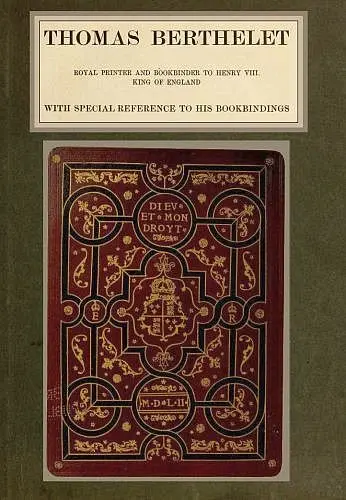
Thomas Berthelet, Royal Printer and Bookbinder to Henry VIII., King of England
Cyril Davenport
THE CLASSIC COLLECTION · 1907
"The Book: Its History and Development" by Cyril Davenport is a historical account written in the early 20th century. The work delves into the evolution of books, covering various aspects such as early record-keeping methods, types of materials used, and the progression of bookbinding techniques throughout different cultures. At the start of the book, Davenport introduces the concept of ancient record-keeping, discussing primitive methods such as rock inscriptions and notches on wood. He emphasizes that the idea of documenting information through signs has appeared worldwide, leading to developments in writing systems. The opening portion suggests that the book will explore how these early forms of recording ultimately contributed to the creation of more sophisticated writing technologies and book formats, illustrating the rich history embedded in our contemporary understanding of books.
Introduction adapted from the source catalogue; source summaries may be automatically generated.
Free to read · English · 61,881 words · No account needed
MAKE TIME FOR A GOOD BOOK
On by default. Untick to stop anonymous reading totals. Each page counts after 10 seconds in view. How this works.
Anonymous counting is on unless you have switched it off.
Besides the engravers whose names I have already mentioned, there are many others whose work appears more particularly in small periodical publications; among these may be noted J. C. Armytage, Geo. Corbould, Charles and J. Heath, James Mitan, John Sharpe, R. J. Baker, W. Greatbach, J. C. Edwards, W. Fry, W. Chevalier, S. Davenport, H. Robins, C. Warren, T. J. Williams, J. Cousins, W. Miller, S. Sangster, R. Rhodes, F. Bacon, R. J. and E. Portbury, T. Willmore, R. Brandard, J. H. Kernot, W. D. Taylor, and G. Hollis.
After about 1850 small line engravings in books began to disappear, and now they are rarely if ever done. In fact, line engraving has been killed by mezzotint and photography, and now takes refuge in its original goldsmiths’ use, or in book plates.
Line engraving in France did not appeal to popular taste until a comparatively late period. The block engravings in the “Horae” of the fifteenth century, although they were line engravings, were cut in the manner of wood blocks, and the method of printing from them was different to that used in the case of ordinary metal engravings. In the seventeenth century there were several beautiful books illustrated by line engravings by Sebastian Leclerc, L. Gaultier, J. Sauné, F. Chauveau, Le Mire and H. J. Duclos.
In the eighteenth century in France the graceful designs of Ch. Eisen and J. H. Fragonard found many worthy interpreters. La Fontaine’s fables and stories provided a suitable literature for these illustrations, and among them may perhaps be found the high water mark of small line engraving. Indeed, the work is all so good that any choice becomes almost invidious; but quite beautiful work was done by J. B. Patas, Choffard, N. Le Mire, De Longueil, L. Bosse, Delvaux, Johannot, Leroux, Lefebre, Ficquet, Mottet, Prevost, J. B. Tillard, J. L. Delignon, C. L. Lingée, Dupréel; and then come L. Halbon, J. Aliamet, J. Dambrun, J. B. Simonnet, P. Trière, C. S. Gaucher, and many more, some of whom worked also in the next century.
In the nineteenth century the French level of small engraved illustrations remained exceptionally high, especially in the earlier half, but many of the plates have much etching mixed up with line work; this may very likely mean that the work was done on steel, which will admit of the production of large editions; but steel is very difficult to engrave, although it is quite easy to etch. Among the line engravers who used accessory etching I have noted Pauquet, Aze, P. Choffard, and De Villiers.
Your reading position is saved on this browser. Take it to another device with a library code. Reading pages adapt to text, rather than matching a printed edition.
Cyril Davenport
Cyril Davenport
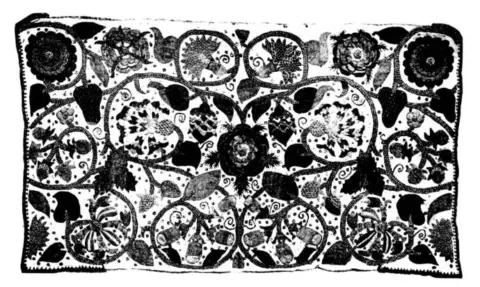
Cyril Davenport
BEHIND THE BOOK
This eBook is for the use of anyone anywhere in the United States and most other parts of the world at no cost and with almost no restrictions whatsoever. You may copy it, give it away or re-use it under the terms of the Project Gutenberg License included with this eBook or online at www.gutenberg.org. If you are not located in the United States, you will have to check the laws of the country where you are located before using this eBook. Read the source licence.
The original source file, including credits and licence, is retained by this library. Request an original-format copy at no charge. Please include the book title and Project Gutenberg identifier #52932.
KEEP YOUR CURIOSITY GOING
Cécile Tormay

Moritz Busch
John L. Ransom
Frances Wright
Cécile Tormay

Mabel Potter Daggett