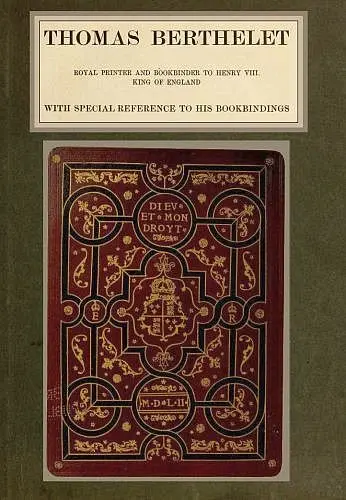
Thomas Berthelet, Royal Printer and Bookbinder to Henry VIII., King of England
Cyril Davenport
THE CLASSIC COLLECTION · 1907
"The Book: Its History and Development" by Cyril Davenport is a historical account written in the early 20th century. The work delves into the evolution of books, covering various aspects such as early record-keeping methods, types of materials used, and the progression of bookbinding techniques throughout different cultures. At the start of the book, Davenport introduces the concept of ancient record-keeping, discussing primitive methods such as rock inscriptions and notches on wood. He emphasizes that the idea of documenting information through signs has appeared worldwide, leading to developments in writing systems. The opening portion suggests that the book will explore how these early forms of recording ultimately contributed to the creation of more sophisticated writing technologies and book formats, illustrating the rich history embedded in our contemporary understanding of books.
Introduction adapted from the source catalogue; source summaries may be automatically generated.
Free to read · English · 61,881 words · No account needed
MAKE TIME FOR A GOOD BOOK
On by default. Untick to stop anonymous reading totals. Each page counts after 10 seconds in view. How this works.
Anonymous counting is on unless you have switched it off.
It has also opened up several new industries, and now photo-lithographs, collotypes, half-tone blocks, and prints from line blocks made by the swelled gelatine or other processes, can be so wonderfully like the original, that a page of old printing made by one or other of these methods will often deceive an ordinary purchaser. There are many such facsimiles in the market, and the best advice I can give as to them is that very great attention should be given to the paper on which they are done, as this will often give the secret away. The texture and appearance of old paper is worthy of careful study, because nearly all the photo-mechanical processes need a paper which is radically different to the thick good rag-made papers which were used before cheap modern papers were thought of.
Type founding in England was first carried on in the sixteenth
century, when John Day made some Anglo-Saxon types for Archbishop
Parker.
Moxon, who wrote the “Mechanics of Printing” in 1693, issued the first English specimen sheet of types in 1669, and in 1776 William Caslon, “Letter-founder of London,” issued a specimen of his printing types.
John Baskerville, who lived and worked about the same period, was also a very eminent typefounder, but Baskerville’s types were too thin in the up-strokes to be considered equal to Caslon’s. Since that time such sheets of types have become common.
Late in the nineteenth century William Morris revived several of the old English block-letter types, and called them by the old names, “Chaucer,” “Golden,” “Troy.”
AMERICAN ART REVIEW, I.--1880, pp. 75-80. Boston.
BERLAN, F.--La invenzione della stampa a tipo mobile fuso rivendicata all’Italia. Firenze, 1882.
BLADES, W.--Who was the inventor of Printing? London, 1887.
BOUCHOT, H.--Le Livre. Paris, 1886.
BOUCHOT, H.--L’Œuvre de Gutenberg. Paris, 1888.
BREITKOPF, J. G. L.--Versuch die einfuhrung des Leinenpapieres, &c.
Leipzig, 1784-1801.
BUCHER, B.--Die Faiencen von Oiron. Wien, 1879.
DEGEORGE, L.--L’Imprimerie en Europe aux XV^e et XVI^e siécles.
Paris, 1892.
DELANGE, H. & C.--Recueil de ... la Faience dite de Henri II. Paris,
1861.
DELON, C.--Gutenberg et l’invention de l’Imprimerie. Paris, 1881.
DUPONT, P.--Histoire de l’Imprimerie. Paris, 1883.
ENCYCLOPÆDIA BRITANNICA.--Typography and Printing. By JOHN SOUTHWARD.
ENTSCHEDE, C.--L. J. Coster de uitvinder van de boekdrukkunst.
Haarlem, 1904.
FAULMANN, C.--Illustrirte geschichte der Buchdruckerkunst. Wien, 1881.
FILLON, B.--Les Faïences d’Oiron. Paris, 1862.
FOURNIER, P. S.--Manuel typographique. Paris, 1764-66.
GOEBEL, T.--Fr. Koenig und die Erfindung der Schnellpresse. Stutt.,
1883.
HESSELS, J. H.--Gutenberg. London, 1882.
HESSELS, J. H.--Haarlem the birthplace of Printing. London, 1887.
HODGKIN, J. E.--Rariora. London, 1902.
Your reading position is saved on this browser. Take it to another device with a library code. Reading pages adapt to text, rather than matching a printed edition.
Cyril Davenport
Cyril Davenport
Cyril Davenport
BEHIND THE BOOK
This eBook is for the use of anyone anywhere in the United States and most other parts of the world at no cost and with almost no restrictions whatsoever. You may copy it, give it away or re-use it under the terms of the Project Gutenberg License included with this eBook or online at www.gutenberg.org. If you are not located in the United States, you will have to check the laws of the country where you are located before using this eBook. Read the source licence.
The original source file, including credits and licence, is retained by this library. Request an original-format copy at no charge. Please include the book title and Project Gutenberg identifier #52932.
KEEP YOUR CURIOSITY GOING
Cécile Tormay

Moritz Busch
John L. Ransom
Frances Wright
Cécile Tormay

Mabel Potter Daggett