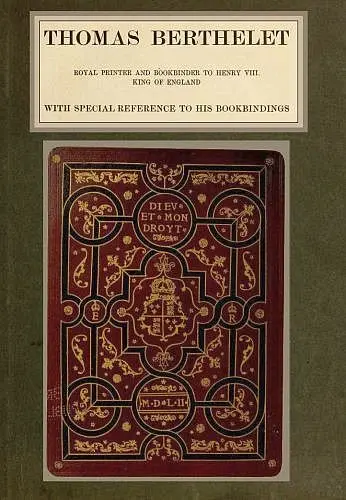
Thomas Berthelet, Royal Printer and Bookbinder to Henry VIII., King of England
Cyril Davenport
THE CLASSIC COLLECTION · 1907
"The Book: Its History and Development" by Cyril Davenport is a historical account written in the early 20th century. The work delves into the evolution of books, covering various aspects such as early record-keeping methods, types of materials used, and the progression of bookbinding techniques throughout different cultures. At the start of the book, Davenport introduces the concept of ancient record-keeping, discussing primitive methods such as rock inscriptions and notches on wood. He emphasizes that the idea of documenting information through signs has appeared worldwide, leading to developments in writing systems. The opening portion suggests that the book will explore how these early forms of recording ultimately contributed to the creation of more sophisticated writing technologies and book formats, illustrating the rich history embedded in our contemporary understanding of books.
Introduction adapted from the source catalogue; source summaries may be automatically generated.
Free to read · English · 61,881 words · No account needed
MAKE TIME FOR A GOOD BOOK
On by default. Untick to stop anonymous reading totals. Each page counts after 10 seconds in view. How this works.
Anonymous counting is on unless you have switched it off.
There is, however, a plan of preserving prints on clay, and this is to fasten down the printed portion on a piece of sound paper from the beginning. This is already done to some extent, and it should be universal in the case of isolated plates, but when a book is all printed on clay paper, as many fine and valuable books unfortunately are, it is difficult to say what is best to be done. The only real remedy seems to be a refusal on the part of purchasers to buy such books. But purchasers do not always know when they are buying clay instead of paper. It is, however, not difficult to tell, as the clay-laden paper feels very smooth and soft to the touch of a dry finger. This peculiarity can be easily detected in one or other of the American magazines, Harper’s or Scribner’s, and the difference between the feel of a page holding an impression from a fine half-tone block, and that having only text, will at once be evident.
If a mark may be made on a suspected sheet, a drop of water should be put upon one corner, left a second or two, and then dried off with blotting-paper. Now a light scrape with a knife over the damped place will remove a layer of white clay if it is there.
There is no doubt that the large majority of our modern books will not be in readable condition in about a hundred years’ time from the date of their publishing.
ARTS, SOCIETY OF.--Report on the Deterioration of Paper. London, 1898.
BLADES, W.--(Athenæum, March 30th, 1889, p. 409. Paper on Watermarks).
BLANCHET, A.--Essai sur l’histoire des Papier. Paris, 1890.
BREITKOPF.--Versuch die Einfuhrung des Leinenpapieres. Leipzig,
1784-1801.
BRIQUET, C. M.--La Legende Paléographique du Papier de Coton. Genève,
1884.
BRIQUET, C. M.--Recherches sur les Papiers du x^e au XIV^e siècles.
Paris, 1886.
CAMPREDON, E.--Le Papier. Paris, 1901.
CHARPENTIER, P.--Le Papier. 1890. (Frémy, E.)
DUNBAR, J.--Notes on the Manufacture of Wood Pulp Papers. Leith, 1892.
ERFURT, J.--The Dyeing of Paper Pulp. London, 1901.
EVANS, L.--Ancient Paper Making. London, 1896.
GIRARD, A.--Le Papier. Lille, 1892.
GOODCHILD, G. F., and TWENEY, C. F.--A Technological and Scientific
Dictionary. London.
GRIFFIN, R. B., and LITTLE, A. D.--The Chemistry of Paper Making. New
York, 1894.
HERRING, R.--Paper and Paper Making. London, 1855.
HOERNLE, A. F. R.--Who was the inventor of Rag Paper? (Royal Asiatic Society Journal, October, 1903).
HOYER, E.--Die fabrikation des Papiers, 1886. (Bolley, P. A.)
KARABACEK, J.--Mittheilungen aus der Sammlung der Papyrus Erz. Rainer.
Bd. II., III., 1887.
KAY, J.--Paper. London, 1893.
Your reading position is saved on this browser. Take it to another device with a library code. Reading pages adapt to text, rather than matching a printed edition.
Cyril Davenport
Cyril Davenport
Cyril Davenport
BEHIND THE BOOK
This eBook is for the use of anyone anywhere in the United States and most other parts of the world at no cost and with almost no restrictions whatsoever. You may copy it, give it away or re-use it under the terms of the Project Gutenberg License included with this eBook or online at www.gutenberg.org. If you are not located in the United States, you will have to check the laws of the country where you are located before using this eBook. Read the source licence.
The original source file, including credits and licence, is retained by this library. Request an original-format copy at no charge. Please include the book title and Project Gutenberg identifier #52932.
KEEP YOUR CURIOSITY GOING
Cécile Tormay

Moritz Busch
John L. Ransom
Frances Wright
Cécile Tormay

Mabel Potter Daggett