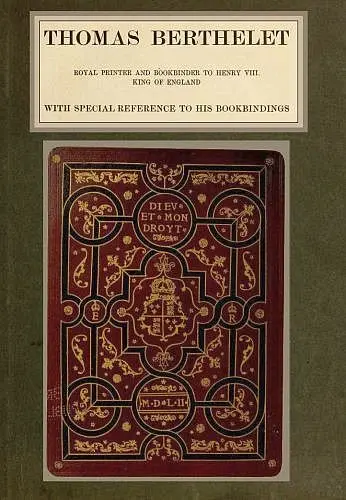
Thomas Berthelet, Royal Printer and Bookbinder to Henry VIII., King of England
Cyril Davenport

THE CLASSIC COLLECTION · 1907
"The Book: Its History and Development" by Cyril Davenport is a historical account written in the early 20th century. The work delves into the evolution of books, covering various aspects such as early record-keeping methods, types of materials used, and the progression of bookbinding techniques throughout different cultures. At the start of the book, Davenport introduces the concept of ancient record-keeping, discussing primitive methods such as rock inscriptions and notches on wood. He emphasizes that the idea of documenting information through signs has appeared worldwide, leading to developments in writing systems. The opening portion suggests that the book will explore how these early forms of recording ultimately contributed to the creation of more sophisticated writing technologies and book formats, illustrating the rich history embedded in our contemporary understanding of books.
Introduction adapted from the source catalogue; source summaries may be automatically generated.
Free to read · English · 61,881 words · No account needed
MAKE TIME FOR A GOOD BOOK
On by default. Untick to stop anonymous reading totals. Each page counts after 10 seconds in view. How this works.
Anonymous counting is on unless you have switched it off.
In the sixteenth and seventeenth centuries several small French and Dutch books were prettily ornamented with vellum cut in openwork patterns. Underneath the open places bits of coloured silk are laid. They are dainty but not very successful, as small edges and points of the vellum are apt to curl up and catch.
James Edwards, of Halifax, invented a curious way of making vellum transparent, and patented it in 1785. The vellum had to be soaked in pearlash and subjected to various processes, pressure among them, and cut very thin indeed, so as to be more like goldbeater’s skin than anything else. Then the books were covered with fine white paper and painted, generally in monotone, but sometimes in colour, and over this painting the transparent vellum was skilfully fixed. The result is that, except when the thin vellum is cracked or seen through, the painting underneath is as fresh as ever it was; but it is to be presumed that there is not much wearing strength in Edwards’ vellum, chiefly because of its extreme thinness. But as a rule any fine examples of his work, especially as they look dainty and precious, have always been well kept and highly valued, and are in good and clean condition. Some modern binders have essayed Edwards’ plan with a certain measure of success.
Impressions of designs in low relief were made on thin leather bindings by means of engraved cylinders in the earlier half of the nineteenth century. They were chiefly used in the small and beautifully illustrated periodicals which were so popular in England--The Age, Friendship’s Offering, and many more--issued during the earlier half of the nineteenth century and a little after it. Charming designs in cameo are often found in these cases, on paste-boards covered with thin leather, but they are nearly always rubbed badly in projecting places. Some of the best of these designs are by Remnant and Edmonds, Smith Elder & Co., and De La Rue & Co.
BAGFORD’S Notes on Bookbinding. (Bibliographical Soc. Proceedings, Nov.
16, 1903.)
BICKELL, L.--Buchereinbände des XV. bis, XVIII. Jahrhunderts aus hessischen Bibliotheken. Leipzig, 1892.
BOUCHOT, H.--Les reluires d’Art à la Bibliothèque Nationale. Paris,
1888.
DAVENPORT, CYRIL.--Cantor Lectures on Decorative Bookbinding. London,
1898.
DAVENPORT, CYRIL.--Early London Bookbindings. London. (The Queen,
1891.)
DUFF, E. G.--Early Stamped Bindings. (Prideaux, S. T.) London, 1893.
GIBSON, S.--Early Oxford Bindings. London, 1903.
GIBSON, S.--Some Notable Bodleian Bindings. Oxford, 1901-4.
GRAY, G. J.--The Earlier Cambridge Bookbinders. London, 1904.
GRAY, G. J.--A Note upon Early Cambridge Binders of the Sixteenth
Century. Cambridge, 1900.
GROLIER CLUB, New York.--Catalogue of Decorated Early English Bookbindings exhibited ... 1899. New York, 1899.
Your reading position is saved on this browser. Take it to another device with a library code. Reading pages adapt to text, rather than matching a printed edition.
Cyril Davenport
Cyril Davenport
Cyril Davenport
BEHIND THE BOOK
This eBook is for the use of anyone anywhere in the United States and most other parts of the world at no cost and with almost no restrictions whatsoever. You may copy it, give it away or re-use it under the terms of the Project Gutenberg License included with this eBook or online at www.gutenberg.org. If you are not located in the United States, you will have to check the laws of the country where you are located before using this eBook. Read the source licence.
The original source file, including credits and licence, is retained by this library. Request an original-format copy at no charge. Please include the book title and Project Gutenberg identifier #52932.
KEEP YOUR CURIOSITY GOING
Cécile Tormay

Moritz Busch
John L. Ransom
Frances Wright
Cécile Tormay

Mabel Potter Daggett