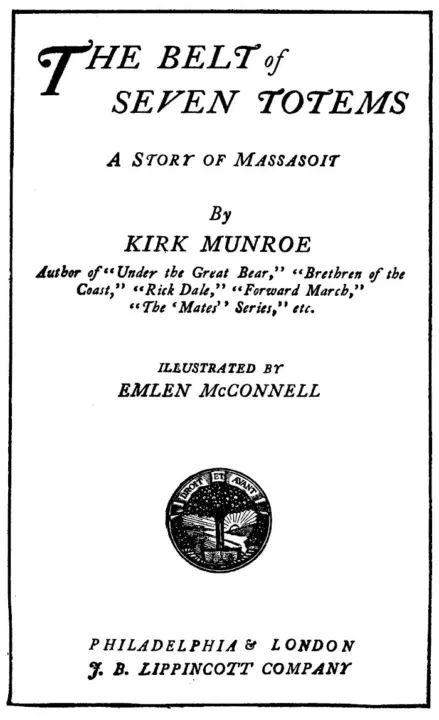
The Belt of Seven Totems: A Story of Massasoit
Kirk Munroe
THE CLASSIC COLLECTION · 1904
"The Blue Dragon: A Tale of Recent Adventure in China" by Kirk Munroe is a novel written in the early 20th century. The story centers around a young Chinese boy named Joseph Lee, who has traveled to America for education, only to face prejudice and hostility from American youths shortly after his arrival. The narrative explores themes of cultural clash, identity, and the journey toward acceptance as Jo navigates the challenges of his new environment. At the start of the tale, Jo faces a hostile reception in the manufacturing village of Hatton, where he encounters a group of boys who mock and assault him due to his Chinese heritage. The narrative vividly depicts the events of his first morning as he is tormented by the local children, creating a sense of both sympathy for Jo and urgency for intervention. Amidst the chaos, Rob Hinckley, the son of the village's parson and one of Jo's initial supporters, enters the fray to defend him, ultimately leading to a clash between the boys. This conflict sets off a series of events that questions the nature of friendship, loyalty, and the challenges faced by immigrants in a new land, laying the groundwork for Jo's transformative experience in America.
Introduction adapted from the source catalogue; source summaries may be automatically generated.
Free to read · English · 64,539 words · No account needed
MAKE TIME FOR A GOOD BOOK
On by default. Untick to stop anonymous reading totals. Each page counts after 10 seconds in view. How this works.
Anonymous counting is on unless you have switched it off.
"What kind of boys were they?"
"Just the very kind that tie fire-crackers to poor dogs' tails, and kill pussy-cats with stones, and--swear."
This last word the witness uttered with some hesitation and in a low
tone.
"Would you know any of those boys again if you should see them?"
"Yes, I'd know the two I see sitting over there," replied Annabel, at the same time pointing to a group of the Hatton muckers who had been retained in court as witnesses.
"How can you identify them?"
"Because the little one has such very red hair, and so many freckles, and the other is so big and ugly looking; besides, he is the one who knocked the Chinese boy down."
"How did he do that?"
"He butted him in the back with his head, while the little, speckled one was pulling at his pig-tail in front, and they all went down together."
"Now tell me, Miss Lorimer, what the Chinese boy did all this time? Was he very fierce, and did he strike at his assailants as if he were trying to kill them?"
"Oh no, indeed! I'm sure he didn't, because I hoped all the time he would. He only seemed horribly frightened, and kept trying to get away; only they wouldn't let him."
"Did you see any of the other boys throw anything at him?"
"Yes, mud--lots of it--and stones; and they tore his clothes until he
was a sight."
"Please tell the court what happened after the Chinese boy had been
knocked down."
"I object to that expression," interposed the district attorney, who was conducting the case for the State; "the witness has expressly stated that the fall in question was caused by a push and not by a blow. She also has testified that three individuals went to the ground at the same time, and we already know from recorded testimony in this case, that the greatest sufferer from the effects of this fall was not the Chinaman, but the very smallest and weakest of those whom my learned friend is pleased to stigmatize as 'assailants,' although it has been repeatedly and conclusively proved during this trial that they were the assailed. Therefore I object to the expression 'knocked down.'"
"Objection admitted," growled the judge.
"Very well," said Jo's lawyer, "since the expression 'knocked down' is objectionable, it is withdrawn; and you may tell us, Miss Lorimer, what happened after my young client was hurled to the ground."
"Your honor, I object," broke in the district attorney.
"Objection overruled," said the judge, sharply, "and I insist that the testimony of this young lady must not be interrupted by squabbles over technicalities."
Your reading position is saved on this browser. Take it to another device with a library code. Reading pages adapt to text, rather than matching a printed edition.
BEHIND THE BOOK
This eBook is for the use of anyone anywhere in the United States and most other parts of the world at no cost and with almost no restrictions whatsoever. You may copy it, give it away or re-use it under the terms of the Project Gutenberg License included with this eBook or online at www.gutenberg.org. If you are not located in the United States, you will have to check the laws of the country where you are located before using this eBook. Read the source licence.
The original source file, including credits and licence, is retained by this library. Request an original-format copy at no charge. Please include the book title and Project Gutenberg identifier #42886.
KEEP YOUR CURIOSITY GOING
Wilfrid Scawen Blunt
Wilfrid Scawen Blunt

E. W. (Edgar Watson) Howe
Cécile Tormay

Moritz Busch
Coulson Kernahan