THE CLASSIC COLLECTION✦Love Letters of Nathaniel Hawthorne, Volume 2 (of 2)CLASSIC FREE BOOKS
Love Letters of Nathaniel Hawthorne, Volume 2 (of 2)
Nathaniel Hawthorne
THE CLASSIC COLLECTION · 1852
"The Blithedale Romance" by Nathaniel Hawthorne is a novel published in 1852. Set in a utopian socialist farming commune modeled on Brook Farm, the story follows Miles Coverdale as he observes the clash between lofty communal ideals and messy human realities. Romantic entanglements develop among residents including the enchanting Zenobia, the frail Priscilla, and the reformer Hollingsworth. As friendships fracture and secrets emerge about mysterious pasts, the community's noble experiment spirals toward tragedy, revealing the limits of idealism when confronted with jealousy, ambition, and unrequited love.
Introduction adapted from the source catalogue; source summaries may be automatically generated.
Free to read · English · 76,186 words · No account needed
MAKE TIME FOR A GOOD BOOK
On by default. Untick to stop anonymous reading totals. Each page counts after 10 seconds in view. How this works.
Anonymous counting is on unless you have switched it off.
One hope I had, and that too was mingled half with fear. She knelt as if in prayer. With the last, choking consciousness, her soul, bubbling out through her lips, it may be, had given itself up to the Father, reconciled and penitent. But her arms! They were bent before her, as if she struggled against Providence in never-ending hostility. Her hands! They were clenched in immitigable defiance. Away with the hideous thought. The flitting moment after Zenobia sank into the dark pool--when her breath was gone, and her soul at her lips was as long, in its capacity of God's infinite forgiveness, as the lifetime of the world!
Foster bent over the body, and carefully examined it.
"You have wounded the poor thing's breast," said he to Hollingsworth,
"close by her heart, too!"
"Ha!" cried Hollingsworth with a start.
And so he had, indeed, both before and after death!
"See!" said Foster. "That's the place where the iron struck her. It looks cruelly, but she never felt it!"
He endeavored to arrange the arms of the corpse decently by its side. His utmost strength, however, scarcely sufficed to bring them down; and rising again, the next instant, they bade him defiance, exactly as before. He made another effort, with the same result.
"In God's name, Silas Foster," cried I with bitter indignation, "let
that dead woman alone!"
"Why, man, it's not decent!" answered he, staring at me in amazement. "I can't bear to see her looking so! Well, well," added he, after a third effort, "'tis of no use, sure enough; and we must leave the women to do their best with her, after we get to the house. The sooner that's done, the better."
We took two rails from a neighboring fence, and formed a bier by laying across some boards from the bottom of the boat. And thus we bore Zenobia homeward. Six hours before, how beautiful! At midnight, what a horror! A reflection occurs to me that will show ludicrously, I doubt not, on my page, but must come in for its sterling truth. Being the woman that she was, could Zenobia have foreseen all these ugly circumstances of death,--how ill it would become her, the altogether unseemly aspect which she must put on, and especially old Silas Foster's efforts to improve the matter,--she would no more have committed the dreadful act than have exhibited herself to a public assembly in a badly fitting garment! Zenobia, I have often thought, was not quite simple in her death. She had seen pictures, I suppose, of drowned persons in lithe and graceful attitudes. And she deemed it well and decorous to die as so many village maidens have, wronged in their first love, and seeking peace in the bosom of the old familiar stream,--so familiar that they could not dread it,--where, in childhood, they used to bathe their little feet, wading mid-leg deep, unmindful of wet skirts. But in Zenobia's case there was some tint of the Arcadian affectation that had been visible enough in all our lives for a few months past.
Your reading position is saved on this browser. Take it to another device with a library code. Reading pages adapt to text, rather than matching a printed edition.
Nathaniel Hawthorne
Nathaniel Hawthorne
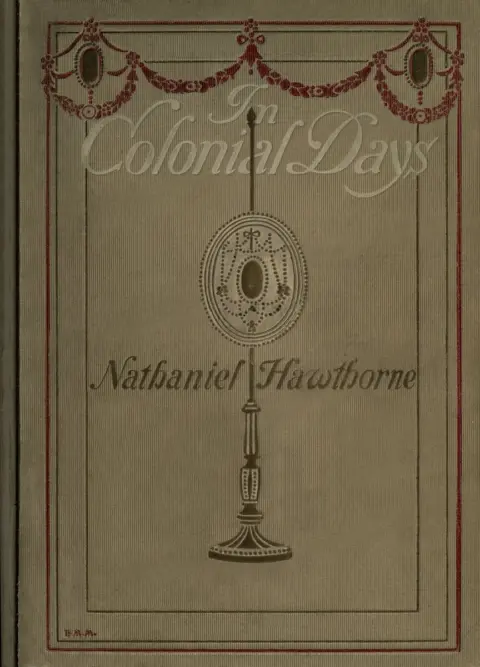
Nathaniel Hawthorne

Rebecca Harding Davis & Thomas De Quincey & Charles Dickens & Nathaniel Hawthorne & Edward Bulwer Lytton, Baron Lytton & Edgar Allan Poe & Harriet Elizabeth Prescott Spofford
BEHIND THE BOOK
This eBook is for the use of anyone anywhere in the United States and most other parts of the world at no cost and with almost no restrictions whatsoever. You may copy it, give it away or re-use it under the terms of the Project Gutenberg License included with this eBook or online at www.gutenberg.org. If you are not located in the United States, you will have to check the laws of the country where you are located before using this eBook. Read the source licence.
The original source file, including credits and licence, is retained by this library. Request an original-format copy at no charge. Please include the book title and Project Gutenberg identifier #2081.
KEEP YOUR CURIOSITY GOING
Coulson Kernahan

Maurice Baring
Frances Wright
Cécile Tormay

Frederic Jesup Stimson

W. H. P. (William Henry Pope) Jarvis