THE CLASSIC COLLECTION✦Love Letters of Nathaniel Hawthorne, Volume 2 (of 2)CLASSIC FREE BOOKS
Love Letters of Nathaniel Hawthorne, Volume 2 (of 2)
Nathaniel Hawthorne
THE CLASSIC COLLECTION · 1852
"The Blithedale Romance" by Nathaniel Hawthorne is a novel published in 1852. Set in a utopian socialist farming commune modeled on Brook Farm, the story follows Miles Coverdale as he observes the clash between lofty communal ideals and messy human realities. Romantic entanglements develop among residents including the enchanting Zenobia, the frail Priscilla, and the reformer Hollingsworth. As friendships fracture and secrets emerge about mysterious pasts, the community's noble experiment spirals toward tragedy, revealing the limits of idealism when confronted with jealousy, ambition, and unrequited love.
Introduction adapted from the source catalogue; source summaries may be automatically generated.
Free to read · English · 76,186 words · No account needed
MAKE TIME FOR A GOOD BOOK
On by default. Untick to stop anonymous reading totals. Each page counts after 10 seconds in view. How this works.
Anonymous counting is on unless you have switched it off.
Then there was a fine old cheese, in which you could almost discern the mites; and some sardines, on a small plate, very richly done, and looking as if oozy with the oil in which they had been smothered. All these things were so perfectly imitated, that you seemed to have the genuine article before you, and yet with an indescribable, ideal charm; it took away the grossness from what was fleshiest and fattest, and thus helped the life of man, even in its earthliest relations, to appear rich and noble, as well as warm, cheerful, and substantial. There were pictures, too, of gallant revellers, those of the old time, Flemish, apparently, with doublets and slashed sleeves, drinking their wine out of fantastic, long-stemmed glasses; quaffing joyously, quaffing forever, with inaudible laughter and song; while the champagne bubbled immortally against their moustaches, or the purple tide of Burgundy ran inexhaustibly down their throats.
But, in an obscure corner of the saloon, there was a little Picture excellently done, moreover of a ragged, bloated, New England toper, stretched out on a bench, in the heavy, apoplectic sleep of drunkenness. The death-in-life was too well portrayed. You smelt the fumy liquor that had brought on this syncope. Your only comfort lay in the forced reflection, that, real as he looked, the poor caitiff was but imaginary, a bit of painted canvass, whom no delirium tremens, nor so much as a retributive headache, awaited, on the morrow.
By this time, it being past eleven o'clock, the two bar-keepers of the saloon were in pretty constant activity. One of these young men had a rare faculty in the concoction of gin-cocktails. It was a spectacle to behold, how, with a tumbler in each hand, he tossed the contents from one to the other. Never conveying it awry, nor spilling the least drop, he compelled the frothy liquor, as it seemed to me, to spout forth from one glass and descend into the other, in a great parabolic curve, as well-defined and calculable as a planet's orbit. He had a good forehead, with a particularly large development just above the eyebrows; fine intellectual gifts, no doubt, which he had educated to this profitable end; being famous for nothing but gin-cocktails, and commanding a fair salary by his one accomplishment. These cocktails, and other artificial combinations of liquor, (of which there were at least a score, though mostly, I suspect, fantastic in their differences,) were much in favor with the younger class of customers, who, at farthest, had only reached the second stage of potatory life. The staunch, old soakers, on the other hand men who, if put on tap, would have yielded a red alcoholic liquor, by way of blood usually confined themselves to plain brandy-and-water, gin, or West India rum; and, oftentimes, they prefaced their dram with some medicinal remark as to the wholesomeness and stomachic qualities of that particular drink. Two or three appeared to have bottles of their own behind the counter; and, winking one red eye to the bar-keeper, he forthwith produced these choicest and peculiar cordials, which it was a matter of great interest and favor, among their acquaintances, to obtain a sip of.
Your reading position is saved on this browser. Take it to another device with a library code. Reading pages adapt to text, rather than matching a printed edition.
Nathaniel Hawthorne
Nathaniel Hawthorne
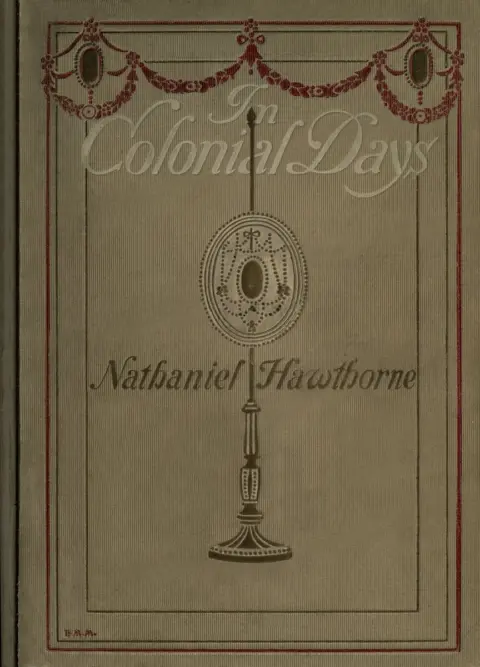
Nathaniel Hawthorne

Rebecca Harding Davis & Thomas De Quincey & Charles Dickens & Nathaniel Hawthorne & Edward Bulwer Lytton, Baron Lytton & Edgar Allan Poe & Harriet Elizabeth Prescott Spofford
BEHIND THE BOOK
This eBook is for the use of anyone anywhere in the United States and most other parts of the world at no cost and with almost no restrictions whatsoever. You may copy it, give it away or re-use it under the terms of the Project Gutenberg License included with this eBook or online at www.gutenberg.org. If you are not located in the United States, you will have to check the laws of the country where you are located before using this eBook. Read the source licence.
The original source file, including credits and licence, is retained by this library. Request an original-format copy at no charge. Please include the book title and Project Gutenberg identifier #2081.
KEEP YOUR CURIOSITY GOING
Coulson Kernahan

Maurice Baring
Frances Wright
Cécile Tormay

Frederic Jesup Stimson

W. H. P. (William Henry Pope) Jarvis