THE CLASSIC COLLECTION✦The scarab murder caseCLASSIC FREE BOOKS
The scarab murder case
S. S. Van Dine
THE CLASSIC COLLECTION · 1929
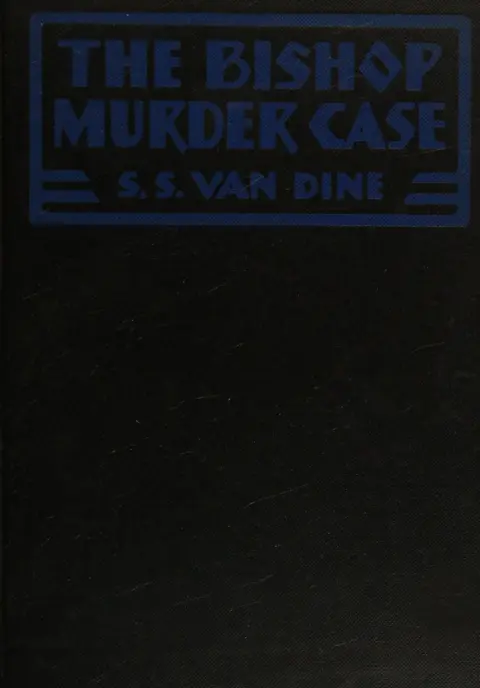
"The Bishop murder case" by S. S. Van Dine is a mystery novel published in 1929. Detective Philo Vance investigates a series of murders in a wealthy New York neighborhood, each accompanied by cryptic notes signed "The Bishop" and containing verses from Mother Goose nursery rhymes. As victims fall according to the rhymes' dark patterns, Vance must decode the killer's twisted game before more lives are claimed. Believed to be the first nursery-rhyme mystery, it established a popular template for Golden Age detective fiction.
Introduction adapted from the source catalogue; source summaries may be automatically generated.
Free to read · English · 88,704 words · No account needed
MAKE TIME FOR A GOOD BOOK
On by default. Untick to stop anonymous reading totals. Each page counts after 10 seconds in view. How this works.
Anonymous counting is on unless you have switched it off.
“It strikes me,” he said, “as a piece of juvenile melodrama. It isn’t likely that the person who killed Robin would adopt a vague pseudonym and write notes about his crime. I’m not acquainted with criminals, but such conduct doesn’t impress me as logical.”
“But the crime itself was illogical,” ventured Vance pleasantly.
“One can’t speak of a thing being illogical, sir,” returned the professor tartly, “when one is ignorant of the very premises of a syllogism.”
“Exactly.” Vance’s tone was studiously courteous. “Therefore, the note itself may not be without logic.”
Markham tactfully changed the subject.
“What I came particularly to tell you, professor, is that Mr. Sperling called a short time ago and, when informed of Mr. Robin’s death, confessed to having done it himself. . . .”
“Raymond confessed!” gasped Miss Dillard.
Markham looked at the girl sympathetically.
“To be quite frank, I didn’t believe Mr. Sperling. Some mistaken idea of chivalry undoubtedly led him to admit the crime.”
“‘Chivalry’?” she repeated, leaning forward tensely. “What exactly do you mean by that, Mr. Markham?”
It was Vance who answered.
“The bow that was found on the range was a woman’s bow.”
“Oh!” The girl covered her face with her hands, and her body shook
with sobs.
Professor Dillard regarded her helplessly; and his impotency took the
form of irritation.
“What flummery is this, Markham?” he demanded. “Any archer can shoot with a woman’s bow. . . . That unutterable young idiot! Why should he make Belle miserable by his preposterous confession! . . . Markham, my friend, do what you can for the boy.”
Markham gave his assurances, and we rose to go.
“By the by, Professor Dillard,” said Vance, pausing at the door; “I trust you won’t misunderstand me, but there’s a bare possibility that it was some one with access to this house who indulged in the practical joke of typing that note. Is there, by any chance, a typewriter on the premises?”
It was patent that the professor resented Vance’s question, but he
answered civilly enough.
“No,—nor has there ever been one to my knowledge. I threw my own machine away ten years ago when I left the university. An agency does whatever typing I need.”
“And Mr. Arnesson?”
“He never uses a typewriter.”
As we descended the stairs we met Arnesson returning from Drukker’s.
“I’ve placated our local Leipnitz,” he announced, with an exaggerated sigh. “Poor old Adolph! The world is too much with him. When he’s wallowing in the relativist formulas of Lorentz and Einstein he’s serene. But when he’s dragged down to actuality he disintegrates.”
Your reading position is saved on this browser. Take it to another device with a library code. Reading pages adapt to text, rather than matching a printed edition.
BEHIND THE BOOK
This eBook is for the use of anyone anywhere in the United States and most other parts of the world at no cost and with almost no restrictions whatsoever. You may copy it, give it away or re-use it under the terms of the Project Gutenberg License included with this eBook or online at www.gutenberg.org. If you are not located in the United States, you will have to check the laws of the country where you are located before using this eBook. Read the source licence.
The original source file, including credits and licence, is retained by this library. Request an original-format copy at no charge. Please include the book title and Project Gutenberg identifier #75157.
KEEP YOUR CURIOSITY GOING
Coulson Kernahan

Maurice Baring
Frances Wright
Cécile Tormay

Frederic Jesup Stimson

W. H. P. (William Henry Pope) Jarvis