THE CLASSIC COLLECTION✦The scarab murder caseCLASSIC FREE BOOKS
The scarab murder case
S. S. Van Dine
THE CLASSIC COLLECTION · 1929
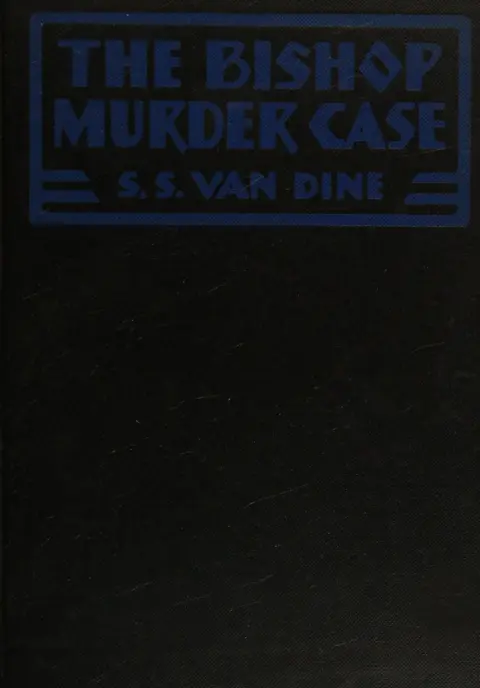
"The Bishop murder case" by S. S. Van Dine is a mystery novel published in 1929. Detective Philo Vance investigates a series of murders in a wealthy New York neighborhood, each accompanied by cryptic notes signed "The Bishop" and containing verses from Mother Goose nursery rhymes. As victims fall according to the rhymes' dark patterns, Vance must decode the killer's twisted game before more lives are claimed. Believed to be the first nursery-rhyme mystery, it established a popular template for Golden Age detective fiction.
Introduction adapted from the source catalogue; source summaries may be automatically generated.
Free to read · English · 88,704 words · No account needed
MAKE TIME FOR A GOOD BOOK
On by default. Untick to stop anonymous reading totals. Each page counts after 10 seconds in view. How this works.
Anonymous counting is on unless you have switched it off.
“You say you know who the Bishop is, Mr. Vance. That being the case,
why all this palaver?”
“There was no great haste.” Vance was almost casual. “And there was the hope of tying up a few loose ends,—hung juries are so unsatisfact’ry, don’t y’ know. . . . Then again, this port is excellent.”
“The port? . . . Ah yes.” Arnesson glanced at our glasses, and turned an injured look on the professor. “Since when have I been a teetotaler, sir?”
The other gave a start, hesitated, and rose.
“I’m sorry, Sigurd. It didn’t occur to me . . . you never drink in the forenoon.” He went to the sideboard and, filling another glass, placed it, with an unsteady hand, before Arnesson. Then he refilled the other glasses.
No sooner had he resumed his seat than Vance uttered an exclamation of surprise. He had half risen and was leaning forward, his hands resting on the edge of the table, his eyes fixed with astonishment on the mantel at the end of the room.
“My word! I never noticed that before. . . . Extr’ordin’ry!”
So unexpected and startling had been his action, and so tense was the atmosphere, that involuntarily we swung about and looked in the direction of his fascinated gaze.
“A Cellini plaque!” he exclaimed. “The Nymph of Fontainebleau! Berenson told me it was destroyed in the seventeenth century. I’ve seen its companion piece in the Louvre. . . .”
A red flush of angry indignation mounted to Markham’s cheeks; and for myself I must say that, familiar as I was with Vance’s idiosyncrasies and intellectual passion for rare antiques, I had never before known him to exhibit such indefensible bad taste. It seemed unbelievable that he would have let himself be distracted by an objet-d’art in such a tragic hour.
Professor Dillard frowned at him with consternation.
“You’ve chosen a strange time, sir, to indulge your enthusiasm for art,” was his scathing comment.
Vance appeared abashed and chagrined. He sank back in his seat,
avoiding our eyes, and began turning the stem of his glass between his
fingers.
“You are quite right, sir,” he murmured. “I owe you an apology.”
“The plaque, incidentally,” the professor added, by way of mitigating the severity of his rebuke, “is merely a copy of the Louvre piece.”
Vance, as if to hide his confusion, raised his wine to his lips. It was a highly unpleasant moment: every one’s nerves were on edge; and, in automatic imitation of his action, we lifted our glasses too.
Your reading position is saved on this browser. Take it to another device with a library code. Reading pages adapt to text, rather than matching a printed edition.
BEHIND THE BOOK
This eBook is for the use of anyone anywhere in the United States and most other parts of the world at no cost and with almost no restrictions whatsoever. You may copy it, give it away or re-use it under the terms of the Project Gutenberg License included with this eBook or online at www.gutenberg.org. If you are not located in the United States, you will have to check the laws of the country where you are located before using this eBook. Read the source licence.
The original source file, including credits and licence, is retained by this library. Request an original-format copy at no charge. Please include the book title and Project Gutenberg identifier #75157.
KEEP YOUR CURIOSITY GOING
Coulson Kernahan

Maurice Baring
Frances Wright
Cécile Tormay

Frederic Jesup Stimson

W. H. P. (William Henry Pope) Jarvis