THE CLASSIC COLLECTION✦An outlaw’s diary: the CommuneCLASSIC FREE BOOKS
An outlaw’s diary: the Commune
Cécile Tormay
THE CLASSIC COLLECTION · 1926
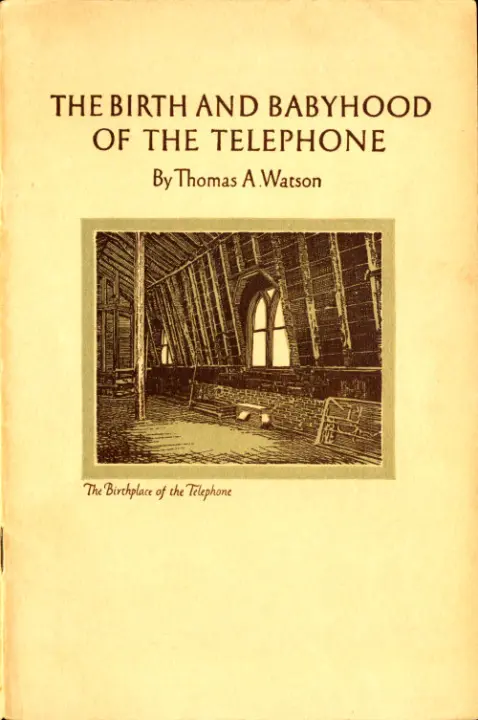
"The Birth and Babyhood of the Telephone" by Thomas Augustus Watson is a personal account detailing the early development of the telephone, written in the early 20th century. As a memoir, it likely reflects on the late 19th century, particularly the years 1874 to 1880 when significant breakthroughs in telecommunication took place. The book is centered around Watson's experiences as Alexander Graham Bell's assistant, offering insights into the historical context and technical challenges faced during the inception of the telephone. In this memoir, Watson recounts his journey from a young apprentice in an electrical workshop to becoming an integral part of Bell's experiments that would lead to the invention of the telephone. The narrative features the trials and errors associated with early telephony, including the development of various telephonic devices and instruments. Watson provides a detailed description of their groundbreaking experiments, culminating in the momentous occasion when he heard Bell's voice for the first time through a wire, signifying the birth of the telephone. The book not only serves as a historical record but also highlights the enthusiasm and determination of the pioneers who laid the groundwork for modern communication.
Introduction adapted from the source catalogue; source summaries may be automatically generated.
Free to read · English · 14,322 words · No account needed
MAKE TIME FOR A GOOD BOOK
On by default. Untick to stop anonymous reading totals. Each page counts after 10 seconds in view. How this works.
Anonymous counting is on unless you have switched it off.
The next morning a poem appeared in the Lawrence paper. The writer must have sat up all night to write it. It was entitled “Waiting for Watson,” and as I am very proud of the only poem I ever had written about me, I am going to ask your permission to read it. Please notice the great variety of human feeling the poet put into it. It even suggests missiles, though it flings none.
Lawrence, Mass., Daily American, Tuesday, May 29, 1877.
To the great hall we strayed,
Fairly our fee we paid,
Seven hundred there delayed,
But, where was Watson?
Was he out on his beer?
Walked he off on his ear?
Something was wrong, ’tis clear.
What was it, Watson?
Seven hundred souls were there,
Waiting with stony stare,
In that expectant air—
Waiting for Watson.
Oh, how our ears we strained,
How our hopes waxed and waned,
Patience to dregs we drained,
Yes, we did, Watson!
Softly the bandmen played,
Rumbled the Night Brigade,
For this our stamps we paid,
Only this, Watson!
But, Hope’s by fruitage fed,
Promise and Act should wed,
Faith without works is dead,
Is it not, Watson?
Give but one lusty groan,
For bread we’ll take a stone,
Ring your old telephone!
Ring, brother Watson.
Doubtless ’tis very fine,
When, all along the line,
Things work most superfine—
Doubtless ’tis Watson.
Let’s hear the thrills and thrums,
That your skilled digit drums,
Striking our tympanums—
Music from Watson.
We know that, every day,
Schemes laid to work and pay,
Fail and “gang aft a-gley”—
Often, friend Watson.
And we’ll not curse, or fling,
But, next time, do the thing
And we’ll all rise and sing,
“Bully for Watson!”
Or, by the unseen powers,
Hope in our bosom sours,
No telephone in ours—
“Please, Mr. Watson.”
The Telephone.
The proprietors of the Telephone, the invention of Alexander Graham Bell, for which patents have been issued by the United States and Great Britain, are now prepared to furnish Telephones for the transmission of articulate speech through instruments not more than twenty miles apart. Conversation can be easily carried on after slight practice and with the occasional repetition of a word or sentence. On first listening to the Telephone, though the sound is perfectly audible, the articulation seems to be indistinct; but after a few trials the ear becomes accustomed to the peculiar sound and finds little difficulty in understanding the words.
The Telephone should be set in a quiet place, where there is no noise which would interrupt ordinary conversation.
The advantages of the Telephone over the Telegraph for local business
are
Your reading position is saved on this browser. Take it to another device with a library code. Reading pages adapt to text, rather than matching a printed edition.
BEHIND THE BOOK
This eBook is for the use of anyone anywhere in the United States and most other parts of the world at no cost and with almost no restrictions whatsoever. You may copy it, give it away or re-use it under the terms of the Project Gutenberg License included with this eBook or online at www.gutenberg.org. If you are not located in the United States, you will have to check the laws of the country where you are located before using this eBook. Read the source licence.
The original source file, including credits and licence, is retained by this library. Request an original-format copy at no charge. Please include the book title and Project Gutenberg identifier #54506.
KEEP YOUR CURIOSITY GOING
Cécile Tormay

Moritz Busch
John L. Ransom
Frances Wright
Cécile Tormay

Mabel Potter Daggett