THE CLASSIC COLLECTION✦The InsectCLASSIC FREE BOOKS
The Insect
Jules Michelet
THE CLASSIC COLLECTION · 1856
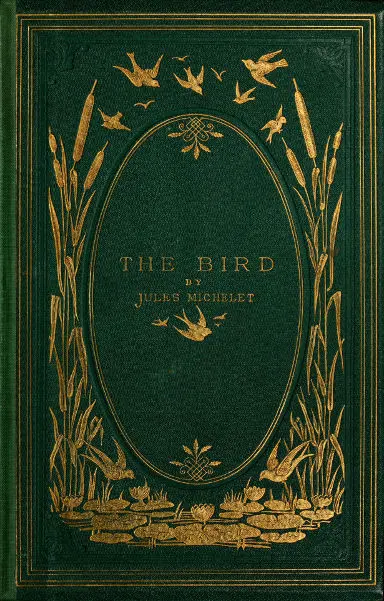
"The Bird" by Jules Michelet is a natural history work written in the mid-19th century. The book serves as an eloquent and poetic exploration of birds and their relationships with humans and nature, emphasizing the beauty and significance of avian life. Michelet discusses various aspects of bird life, their habits, and their importance in ecosystems, manifesting a profound admiration for their existence. At the start of the text, Michelet reflects on his motivation to study nature and the profound influence of personal experiences that shaped his perspective. He shares a tender narrative that outlines his beginnings, familial ties, and his connection with nature, specifically birds. The opening portion reveals his intimate conversations with loved ones and mesmerizing anecdotes about the vibrant birdlife around him, setting an emotional and philosophical tone for the exploration to come. Through these reflections, the reader gets a sense of Michelet's passionate advocacy for birds and his plea for a harmonious coexistence with all living beings.
Introduction adapted from the source catalogue; source summaries may be automatically generated.
Free to read · English · 70,339 words · No account needed
MAKE TIME FOR A GOOD BOOK
On by default. Untick to stop anonymous reading totals. Each page counts after 10 seconds in view. How this works.
Anonymous counting is on unless you have switched it off.
France is not cruel. Why, then, this love of murder, this extermination
of the animal world?
It is the impatient people, the young people, the childish people, in a rude and restless childhood. If they cannot be doing in creating, they will be doing by destroying.
But what they most fatally injure is--themselves! A violent education, stormily impassioned in love or severity, crushes in the child, withers, chokes up the first moral flower of natural sensitiveness, all that was purest of the maternal milk, the germ of universal love which rarely blooms again.
Among too many children we are saddened by their almost incredible sterility. A few recover from it in the long circle of life, when they have become experienced and enlightened men. But the first freshness of the heart? It shall return no more.[29]
How is it that this nation, otherwise born under such felicitous circumstances, is, with rare and local exceptions, accursed with so singular an incapacity for harmony? It has its own peculiar songs, its charming little melodies of vivacity and mirth. But it needs a prolonged effort, a special education, to attain to harmony.
Page 158. Flattening of the brain.--The weight of the brain, compared with that of the body, is, in the
Ostrich, in the ratio of 1 to 1200 Goose, 1 to 360 Duck, 1 to 257 Eagle, 1 to 160 Plover, 1 to 122 Falcon, 1 to 102 Paroquet, 1 to 45 Robin, 1 to 32 Jay, 1 to 28 Chaffinch, cock, sparrow, goldfinch, 1 to 25 Hooded tomtit, 1 to 16 Blue-cap tomtit, 1 to 12
(Estimate of Haller and Leuret.)
Page 158. The noble falcon.--The noble birds (the falcon, gerfalcon, saker) are those which hold their prey by the talon, and kill it with the bill: their bill, for this purpose, is toothed. The ignoble birds (the eagle, the kite, &c.) are for the most part swift of flight (voiliers): these employ their talons to rend and choke their victims. The rameurs rise with difficulty, which enables the voiliers to escape them the more easily. The tactics of the former are to feign, in the first place, to rise to a great height; and then, by suffering themselves to drop, they disconcert the manoeuvres of the voiliers. (Huber, Vol des Oiseaux de Proie, 1784, 4to. He was the first of that clever lineage, Huber of the birds, Huber of the bees, Huber of the ants.)
Your reading position is saved on this browser. Take it to another device with a library code. Reading pages adapt to text, rather than matching a printed edition.
BEHIND THE BOOK
This eBook is for the use of anyone anywhere in the United States and most other parts of the world at no cost and with almost no restrictions whatsoever. You may copy it, give it away or re-use it under the terms of the Project Gutenberg License included with this eBook or online at www.gutenberg.org. If you are not located in the United States, you will have to check the laws of the country where you are located before using this eBook. Read the source licence.
The original source file, including credits and licence, is retained by this library. Request an original-format copy at no charge. Please include the book title and Project Gutenberg identifier #43341.
KEEP YOUR CURIOSITY GOING

Charles G. (Charles Griffith) Ross
Hannah Webster Foster

Emily Lawless
Edwin Hamlin Carr

Charles De Lano Hine
Andrew Ure