THE CLASSIC COLLECTION✦The InsectCLASSIC FREE BOOKS
The Insect
Jules Michelet
THE CLASSIC COLLECTION · 1856
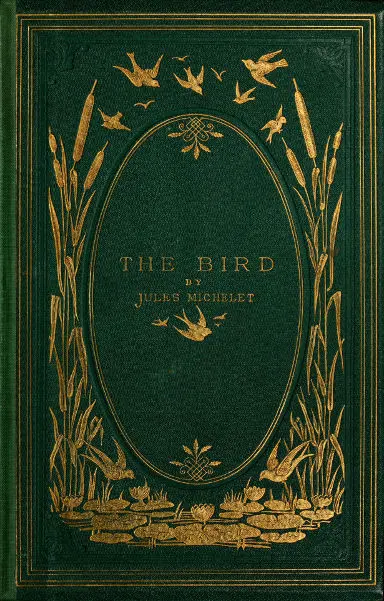
"The Bird" by Jules Michelet is a natural history work written in the mid-19th century. The book serves as an eloquent and poetic exploration of birds and their relationships with humans and nature, emphasizing the beauty and significance of avian life. Michelet discusses various aspects of bird life, their habits, and their importance in ecosystems, manifesting a profound admiration for their existence. At the start of the text, Michelet reflects on his motivation to study nature and the profound influence of personal experiences that shaped his perspective. He shares a tender narrative that outlines his beginnings, familial ties, and his connection with nature, specifically birds. The opening portion reveals his intimate conversations with loved ones and mesmerizing anecdotes about the vibrant birdlife around him, setting an emotional and philosophical tone for the exploration to come. Through these reflections, the reader gets a sense of Michelet's passionate advocacy for birds and his plea for a harmonious coexistence with all living beings.
Introduction adapted from the source catalogue; source summaries may be automatically generated.
Free to read · English · 70,339 words · No account needed
MAKE TIME FOR A GOOD BOOK
On by default. Untick to stop anonymous reading totals. Each page counts after 10 seconds in view. How this works.
Anonymous counting is on unless you have switched it off.
Page 64. Training for flight (see also p. 84).--Is it wrong for man, in his reveries, to beguile himself into a belief that he will one day be more than man, to attribute to himself wings? Dream or presentiment, it matters not.
It is certain that a power of flight such as the bird possesses is truly a sixth sense. It would be absurd to see in it only an auxiliary of touch. (See, among other works, Huber, Vol des oiseaux de proie, 1784).
The wing is so rapid and so infallible only because it is aided by a visual faculty which has not its equal in all creation.
The bird, we must confess, lives wholly in the air, in the light. If there be a sublime life, a life of fire, it is this.
Who surveys and descries all earth? Who measures it with his glance and his wing? Who knows all its paths? And not in any beaten route, but at the same time in every direction: for where is not the bird's track?
His relations with heat, electricity, and magnetism, all the imponderable forces, are scarcely known to us; we see them, however, in his singular meteorological prescience.
If we had seriously studied the matter, we should have had the balloon for some thousands of years; but even with the balloon, and the balloon capable of being steered, we should still be enormously behind the bird. To imitate its mechanism, and exactly reproduce its details, is not to possess the agreement, the ensemble, the unity of action, which moves the whole with so much facility and with such terrible swiftness.
Let us renounce, for this life at least, these higher gifts, and confine ourselves to examine the two machines--our own and the bird's--in those points where they differ least.
The human machine is superior in what is its smallest peculiarity, its susceptibility of adaptation to the most diverse purposes, and, above all, in its omnipuissance of the hand.
On the other hand, he has far less unity and centralization. Our inferior limbs, our thighs, and legs, which are very long, perform eccentric movements far from the central point of action. Circulation is very slow; a thing perceptible in those last moments, when the body is dead at the feet before the heart has ceased to throb.
The bird, almost spherical in form, is certainly the apex, divine and sublime, of living centralization. We can neither see nor imagine a higher degree of unity. From his excess of concentration he derives his great personal force, but it implies his extreme individuality, his isolation, his social weakness.
Your reading position is saved on this browser. Take it to another device with a library code. Reading pages adapt to text, rather than matching a printed edition.
BEHIND THE BOOK
This eBook is for the use of anyone anywhere in the United States and most other parts of the world at no cost and with almost no restrictions whatsoever. You may copy it, give it away or re-use it under the terms of the Project Gutenberg License included with this eBook or online at www.gutenberg.org. If you are not located in the United States, you will have to check the laws of the country where you are located before using this eBook. Read the source licence.
The original source file, including credits and licence, is retained by this library. Request an original-format copy at no charge. Please include the book title and Project Gutenberg identifier #43341.
KEEP YOUR CURIOSITY GOING

Charles G. (Charles Griffith) Ross
Hannah Webster Foster

Emily Lawless
Edwin Hamlin Carr

Charles De Lano Hine
Andrew Ure