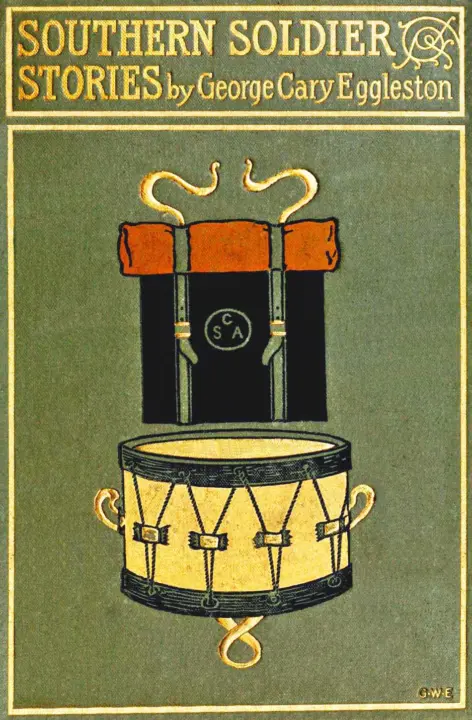
Southern Soldier Stories
George Cary Eggleston
THE CLASSIC COLLECTION · 1875
"The Big Brother: A Story of Indian War" by George Cary Eggleston is a historical novel written in the late 19th century. Set during the summer of 1813, the story revolves around the hostilities between American settlers and Creek Indians in the southern United States. The narrative centers around the Hardwicke family, particularly the eldest son, Sam, and his siblings, who find themselves navigating the dangers presented by the brewing conflict. At the start of the novel, readers are introduced to the backdrop of escalating tensions in the region, as the Creek Indians, incited by external forces and prophetic figures, prepare for brutal warfare against the settlers. The narrative quickly shifts focus to the Hardwicke family, with Sam, the eldest son, characterized as knowledgeable and resourceful. As the initial eruptions of violence unfold, Sam demonstrates his courage and determination to protect his younger siblings, Judith and Tommy, amidst the chaos and terror of their environment. The opening chapters depict the urgency of their situation as they take refuge in a fort, setting the stage for a gripping tale of survival, family loyalty, and the harsh realities of frontier life during wartime.
Introduction adapted from the source catalogue; source summaries may be automatically generated.
Free to read · English · 34,876 words · No account needed
MAKE TIME FOR A GOOD BOOK
On by default. Untick to stop anonymous reading totals. Each page counts after 10 seconds in view. How this works.
Anonymous counting is on unless you have switched it off.
[Footnote 1: For these speeches of Weatherford's and for other historical details I am indebted to a valuable and interesting book, "Romantic Passages in South Western History," by A. B. Mull, Mobile, S. H. Goetzsl & Co. publishers, which is now, unfortunately out of print. The speeches are well authenticated I believe.]
Jackson was too generous and too brave a man to remain unmoved under such a speech from a man who thus placed his own life in jeopardy for the sake of his people. He bade the chieftain return home, and promised peace to his people, a promise faithfully kept to this day. All this however occurred nearly two months after the time of which I write, and it is introduced here merely by way of explaining the things which happened to Sam on the morning of the rash resumption of his journey.
This man Weatherford, the fiercest enemy the whites had, with a party of about twenty-five Indians, bivouacked, the night before, in the edge of the woods, and when Sam mounted his horse that morning the Indians were lying asleep immediately in his path as he rode blindly out of the thicket. The first intimation he had of their presence was a grunt from a big savage who lay almost under his horse's feet. Coming to himself in an instant, Sam took in the whole situation at a glance, and with the rapidity and precision which people who are accustomed to the dangers and difficulties of frontier life always acquire, he mentally weighed all the facts bearing upon the question of what to do, and decided. He saw before him the savages, rising from the ground at sight of him. He saw their horses browsing at some little distance from them. He saw a rifle, on which hung a powder-horn and a bullet-pouch, standing against a bush. He saw that he had already aroused the foe, and that he must stand a chase. His first impulse was to turn around and ride back, in the direction whence he had come; but in that direction lay the thicket through which he could not ride rapidly, and so if he should take that course, he would lose the advantage which he hoped to gain from the fleetness of his particularly good horse. Besides, in the thicket he must of course leave a trail easily followed. Just beyond the group of Indians he saw the open fields, and he made up his mind at once that he would push his horse into a run, dash right through the camp of the savages, pick up the convenient rifle if possible, and reaching the open country make all the speed he could. In this he knew he would have an advantage, inasmuch as he would get a good many hundred yards away before the savages could catch and mount their horses for the purpose of pursuing him, and he even hoped that they, seeing how far he was in advance of them, would abandon the idea of pursuit altogether. All this thinking, and weighing of chances, and deciding was the work of a single half second, and the plan, once formed, was executed instantly. Without pausing or turning he pushed his horse at a full run through the group of savages, receiving a glancing blow from a war club and dodging several others as he went. He succeeded in getting possession of the rifle which stood by the bush, and reached the field before a gun could be aimed at him. It was now his purpose to get so far ahead as to discourage pursuit, and with this object in view he continued to urge his horse forward at his best speed. This hope was a vain one, as he soon discovered. The Indians, infuriated by his boldness, mounted their horses and gave chase immediately. Sam had an excellent habit, as we know, of keeping his wits about him, and of preparing carefully for difficulties likely to come. The first thing to be done was to escape, if possible, and so he continued to press his high-spirited colt forward, while he debated the probabilities of being overtaken, and discussed with himself the resources at his command if the savages should come up with him. He was armed now, at any rate, and if running should prove of no avail, he could and would sell his life very dearly. Indeed the possession of the rifle roused all the spirit of battle there was in him, and great as the odds were against him, he was sorely tempted to pause long enough to shoot once at least. He remembered Tom and Judie and Joe, however, and their dependence upon him for guidance and protection, and for their sake more than for his own, suppressed the impulse and continued his flight. The Indians were nearly half a mile behind him, and, as nearly as he could tell, were not gaining upon him very rapidly. His colt seemed equal to a long continued race, and as yet showed no sign of faltering or fatigue. The question had now resolved itself, Sam thought, into one of endurance. How long the Indians would continue a pursuit in which he had the advantage of half a mile the start, he had no way of determining, but that his horse's endurance was as great at least as their perseverance, he had every reason to hope.
Your reading position is saved on this browser. Take it to another device with a library code. Reading pages adapt to text, rather than matching a printed edition.
George Cary Eggleston
George Cary Eggleston
George Cary Eggleston
George Cary Eggleston
BEHIND THE BOOK
This eBook is for the use of anyone anywhere in the United States and most other parts of the world at no cost and with almost no restrictions whatsoever. You may copy it, give it away or re-use it under the terms of the Project Gutenberg License included with this eBook or online at www.gutenberg.org. If you are not located in the United States, you will have to check the laws of the country where you are located before using this eBook. Read the source licence.
The original source file, including credits and licence, is retained by this library. Request an original-format copy at no charge. Please include the book title and Project Gutenberg identifier #20849.
KEEP YOUR CURIOSITY GOING
Wilfrid Scawen Blunt
Wilfrid Scawen Blunt

E. W. (Edgar Watson) Howe
Cécile Tormay

Moritz Busch
Coulson Kernahan