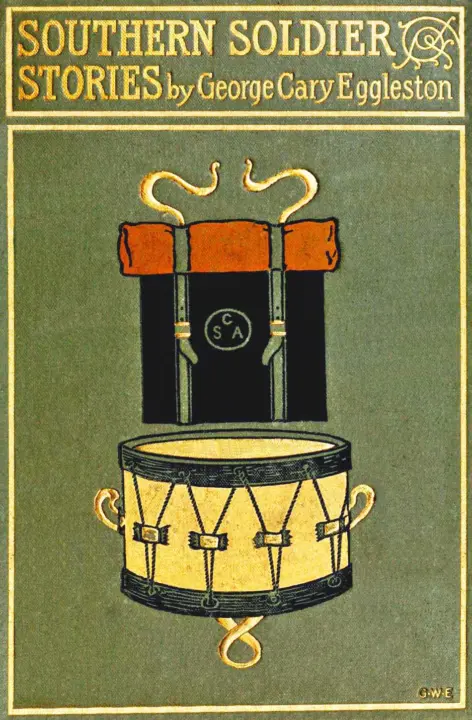
Southern Soldier Stories
George Cary Eggleston
THE CLASSIC COLLECTION · 1875
"The Big Brother: A Story of Indian War" by George Cary Eggleston is a historical novel written in the late 19th century. Set during the summer of 1813, the story revolves around the hostilities between American settlers and Creek Indians in the southern United States. The narrative centers around the Hardwicke family, particularly the eldest son, Sam, and his siblings, who find themselves navigating the dangers presented by the brewing conflict. At the start of the novel, readers are introduced to the backdrop of escalating tensions in the region, as the Creek Indians, incited by external forces and prophetic figures, prepare for brutal warfare against the settlers. The narrative quickly shifts focus to the Hardwicke family, with Sam, the eldest son, characterized as knowledgeable and resourceful. As the initial eruptions of violence unfold, Sam demonstrates his courage and determination to protect his younger siblings, Judith and Tommy, amidst the chaos and terror of their environment. The opening chapters depict the urgency of their situation as they take refuge in a fort, setting the stage for a gripping tale of survival, family loyalty, and the harsh realities of frontier life during wartime.
Introduction adapted from the source catalogue; source summaries may be automatically generated.
Free to read · English · 34,876 words · No account needed
MAKE TIME FOR A GOOD BOOK
On by default. Untick to stop anonymous reading totals. Each page counts after 10 seconds in view. How this works.
Anonymous counting is on unless you have switched it off.
"I reckon I kin, Mas' Sam," said Joe, who, to prove his powers
straightway gave a shrill kildee whistle, which nearly deafened them
all.
"There, that'll do, Joe. Well, let's understand then, that if anyone of us sees Indians, he must whistle like a kildee. If the Indians hear it they'll think nothing of it."
Tom went to the look-out, and seeing no savages anywhere, returned, and the whole party, little Judie excepted, proceeded to the spring. Sam then laid his sticks down in a pile, and taking out his watch removed the crystal. This he filled with clear water from the spring, and holding it over the cotton ravellings, moved it up and down until the sunlight, passing through it, gathered itself into a small bright spot on the cotton. Joe, eager to see, thrust his head over Sam's shoulder, and directly between the glass and the sun.
"Take your head away, Joe, or I'll have to draw the fire right through
it," said Sam, laughing.
"Mercy, Mas' Sam, don't do dat. I'se 'feard o' your witches' ways, anyhow," said Joe, drawing back. The glass was again put in position and the spot of bright sunlight reappeared. Presently a little cloud of smoke rose, and a moment afterwards, the cotton was fairly afire. It was not difficult now to get the light-wood and dry sticks to blazing, and a good fire was soon secured.
"Now boys," said Sam, "I'll go back to the drift-pile and keep a look-out. If you hear the kildee call, run in as quickly as you can. When you get the corn and mussels on, and covered up, come back at once."
No Indians showing themselves anywhere in the neighborhood, the boys got their dinner on or rather in the fire, and then returned to the root cavern to await the completion of the cooking process. When they were all safely stowed away in their places, Tom gave voice to the curiosity with which he was almost bursting.
"Sam," he said, "how did you do that?"
"How did I do what, Tom?"
"How did you make the sun set the cotton on fire?"
"I don't know whether I can make you understand it or not," said Sam, "but I'll try. You know light always goes in straight lines, if left to itself, don't you?"
"No, I didn't know that!
"Yes you did, only you never thought of it. If you want to keep light out of your eyes, you always put your hand between them and the light, because you know the light goes straight and so will not go around your hand."
Your reading position is saved on this browser. Take it to another device with a library code. Reading pages adapt to text, rather than matching a printed edition.
George Cary Eggleston
George Cary Eggleston
George Cary Eggleston
George Cary Eggleston
BEHIND THE BOOK
This eBook is for the use of anyone anywhere in the United States and most other parts of the world at no cost and with almost no restrictions whatsoever. You may copy it, give it away or re-use it under the terms of the Project Gutenberg License included with this eBook or online at www.gutenberg.org. If you are not located in the United States, you will have to check the laws of the country where you are located before using this eBook. Read the source licence.
The original source file, including credits and licence, is retained by this library. Request an original-format copy at no charge. Please include the book title and Project Gutenberg identifier #20849.
KEEP YOUR CURIOSITY GOING
Wilfrid Scawen Blunt
Wilfrid Scawen Blunt

E. W. (Edgar Watson) Howe
Cécile Tormay

Moritz Busch
Coulson Kernahan