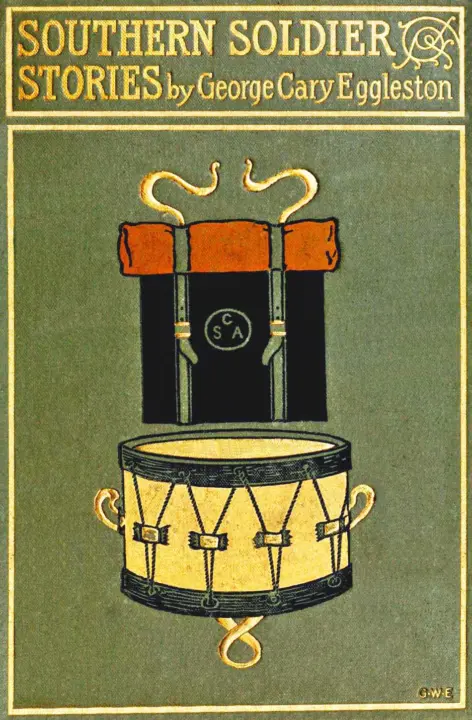
Southern Soldier Stories
George Cary Eggleston
THE CLASSIC COLLECTION · 1875
"The Big Brother: A Story of Indian War" by George Cary Eggleston is a historical novel written in the late 19th century. Set during the summer of 1813, the story revolves around the hostilities between American settlers and Creek Indians in the southern United States. The narrative centers around the Hardwicke family, particularly the eldest son, Sam, and his siblings, who find themselves navigating the dangers presented by the brewing conflict. At the start of the novel, readers are introduced to the backdrop of escalating tensions in the region, as the Creek Indians, incited by external forces and prophetic figures, prepare for brutal warfare against the settlers. The narrative quickly shifts focus to the Hardwicke family, with Sam, the eldest son, characterized as knowledgeable and resourceful. As the initial eruptions of violence unfold, Sam demonstrates his courage and determination to protect his younger siblings, Judith and Tommy, amidst the chaos and terror of their environment. The opening chapters depict the urgency of their situation as they take refuge in a fort, setting the stage for a gripping tale of survival, family loyalty, and the harsh realities of frontier life during wartime.
Introduction adapted from the source catalogue; source summaries may be automatically generated.
Free to read · English · 34,876 words · No account needed
MAKE TIME FOR A GOOD BOOK
On by default. Untick to stop anonymous reading totals. Each page counts after 10 seconds in view. How this works.
Anonymous counting is on unless you have switched it off.
After a time Tom, overcome by weariness, fell asleep, but Sam remained awake all night, trying to staunch the flow of blood from his foot. He knew that if he could go on with the others their chance of safety would be vastly greater than without him, and so he was disposed to leave no effort untried to be in a fit condition to travel the next night. When morning came Sam called Tom and Joe, and directed them to examine his wound, into which he could not see very well.
"Is the blood of a bright red, as it comes out, or a dark red?" he
asked.
"Bright," they both said.
"Then it comes from an artery," he replied. "Are you sure it is bright
red?"
The boys were not quite sure.
"Does it come in a steady stream or in spurts?" he asked.
"It spurts, and stops and spurts again," said Tom.
"It is an artery, then," said Sam. "Look and see if you can find the
place it comes from."
The boys made a careful examination and at last found the artery, a small one, which was cut only about half way across.
"All right," said Sam. "If that's the case, I think I know how to stop the blood. Put your finger in, and break the artery clear in two".
"O Sam, then you'll bleed to death," said Tom.
"No I won't. Do as I tell you."
"Let me cut it, then. It wont hurt you so much."
"No, no, no," cried Sam, staying his hand. "Don't cut it. Tear it, I
tell you, and be quick."
Tom tore it, and the blood stopped almost immediately. Sam then bound the foot up with strips of cloth torn from his clothing, and as he did so said:
"Now I'll tell you both all about this so that you'll know what to do another time. If you know only what to do, you may forget; but if you know why, you'll remember. The blood comes out from the heart to all parts of the body in arteries, and when it leaves the heart it is bright red, because it is clean and pure. Your heart is a sort of force-pump, and every time it beats it forces the blood all over you. The arteries fork and branch out in every direction, until they terminate in millions of little veins smaller than the finest hairs, and these running together make bigger veins, through which the blood is carried to the lungs. In the veins it flows steadily, because the capillary veins, the ones like hairs, are so small that the spurts can't be felt beyond them. The blood in the veins is thick and dark, because it has taken up all the impurities from the system; but when it gets to the lungs your breath takes up all these and carries them off, leaving the blood pure again for another round. Now the arteries are long elastic tubes, that is to say, they will stretch a little, and fly back again, if you pull them, and when one is cut nearly but not quite off, the contraction keeps it wide open. If it is cut or torn entirely in two, the end draws back, and nine times in ten, if the artery is a small one, the drawing back shuts the end up entirely and the blood stops. But it is better to tear it than to cut it, because when torn the edges are jagged and it shrivels up more. I don't quite understand why, myself, but that is what the surgical books say. When anybody is hurt and bleeding badly, the first thing to do is to find out whether it is an artery or a vein that's cut. If the blood is bright and comes out in spurts, it's an artery. If it is dark, and flows steadily, it's a vein. If it's an artery and isn't cut quite in two, tear it in two. If that don't stop it, you must make a knot in a handkerchief and then press your finger above the cut in different places till you find where the artery is by the blood stopping. Then put the knot on that place and tie the handkerchief around the limb. You can stop a vein in the same way and more easily, but if it's a vein you must tie the handkerchief so that the cut place will be between it and the heart. You see the blood comes from the heart in the arteries, and goes back towards the heart in the veins, and so to stop an artery you tie inside, and to stop a vein outside of the cut place."
Your reading position is saved on this browser. Take it to another device with a library code. Reading pages adapt to text, rather than matching a printed edition.
George Cary Eggleston
George Cary Eggleston
George Cary Eggleston
George Cary Eggleston
BEHIND THE BOOK
This eBook is for the use of anyone anywhere in the United States and most other parts of the world at no cost and with almost no restrictions whatsoever. You may copy it, give it away or re-use it under the terms of the Project Gutenberg License included with this eBook or online at www.gutenberg.org. If you are not located in the United States, you will have to check the laws of the country where you are located before using this eBook. Read the source licence.
The original source file, including credits and licence, is retained by this library. Request an original-format copy at no charge. Please include the book title and Project Gutenberg identifier #20849.
KEEP YOUR CURIOSITY GOING
Wilfrid Scawen Blunt
Wilfrid Scawen Blunt

E. W. (Edgar Watson) Howe
Cécile Tormay

Moritz Busch
Coulson Kernahan