THE CLASSIC COLLECTION✦The Shield of LoveCLASSIC FREE BOOKS
The Shield of Love
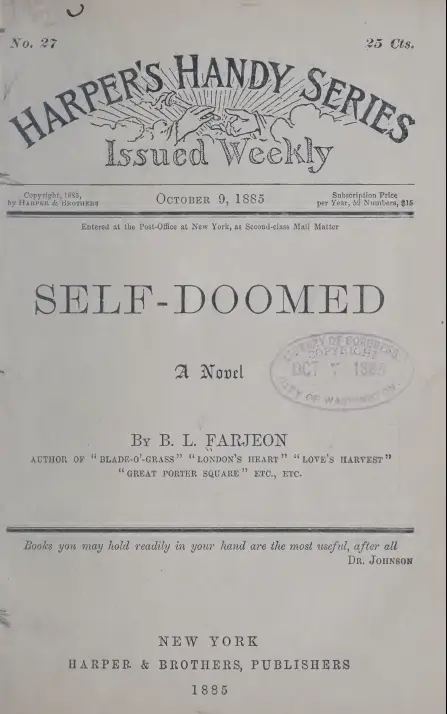
B. L. (Benjamin Leopold) Farjeon
THE CLASSIC COLLECTION · 1896
"The Betrayal of John Fordham" by B. L. Farjeon is a novel written in the late 19th century. The story revolves around John Fordham, a man in his mid-thirties struggling with the heavy burden of guilt and impending doom after committing a crime he cannot fully remember. As he navigates his feelings of despair and his love for a noble woman named Ellen, Fordham wrestles with the consequences of his actions and the malevolent influence of a vengeful enemy. At the start of the novel, the reader is introduced to John Fordham, who recounts a tragic event from two years prior that still haunts him and has left him plagued by guilt. As he reflects on his past, he expresses love for Ellen, who has sacrificed her good name for him, and wrestles with the idea of confessing his crime and taking responsibility for his actions. This opening portion sets the stage for a tense psychological exploration of morality, identity, and the impact of betrayal, hinting at a complex narrative filled with emotional turmoil and the quest for redemption. As the plot begins to unfold, it promises an engaging journey through John's conflicts and relationships as he seeks to reconcile his guilt with the love for his family.
Introduction adapted from the source catalogue; source summaries may be automatically generated.
Free to read · English · 97,836 words · No account needed
MAKE TIME FOR A GOOD BOOK
On by default. Untick to stop anonymous reading totals. Each page counts after 10 seconds in view. How this works.
Anonymous counting is on unless you have switched it off.
I examined my keys, and I fancied I discerned traces of wax upon them. I inquired my way to the nearest locksmith, and giving him the bunch asked whether an impression in wax had been taken of any of them.
"Of a certainty, monsieur," he said, "else I could not have made
them."
"It is you, then, who made the duplicates?"
"Assuredly, it is I, monsieur."
"Of how many?"
"Of two, monsieur."
"Of these two?" indicating the keys of my two trunks.
"Exactly, monsieur."
"From impressions in wax which you received."
"Yes, yes, monsieur," he said, redundantly affirmative. "Have you come to ask for them? But they were delivered and paid for last night."
"By a thin-faced, middle-aged woman, with gray eyes and a white face?"
"The description is perfect. I trust the keys are to your satisfaction, and that they fit the locks."
"They fit admirably," I said, and I gave him good morning.
Annette! She was in my wife's pay; together they had conspired against me. The first practical step towards obtaining access to my boxes was taken when Barbara informed me that she had mislaid one of her keys, and borrowed my bunch; then the impressions in wax, and Annette going to the locksmith to give the order; then the packet containing the keys which Annette had secretly conveyed to my wife while my back was turned; then Barbara's complaint this morning that my cigar made her ill, and my going out to smoke. During my absence my trunk was opened and rifled. The petty little mystery was solved.
It was late when I returned to the hotel. I expected a stormy scene, it being now two hours after the time I had appointed to take Barbara to see the sights of Paris; but she was not in our rooms to reproach me. In the bedroom I noticed that two padlocks had been newly fixed to each of her trunks. I went into the office to make inquiries.
"Madame is out," said the manager.
"On foot?"
"No, monsieur; in the carriage that was ordered."
"Did she go alone?"
"No, monsieur; Annette accompanied her."
"Annette!" I exclaimed. "Has she not her duties to attend to here?"
"She is no longer in our service," was the reply. "She is engaged by madame. It was sudden, but she begged to be allowed to leave. Your wife implored also, monsieur, and as another woman who had been with us before as chambermaid was ready to take her place, we consented--to oblige madame."
"Is Annette a good servant?"
"An excellent domestic."
"Trustworthy, honest, and sober?"
"Perfectly. Madame could not desire a better."
Your reading position is saved on this browser. Take it to another device with a library code. Reading pages adapt to text, rather than matching a printed edition.
B. L. (Benjamin Leopold) Farjeon
B. L. (Benjamin Leopold) Farjeon
B. L. (Benjamin Leopold) Farjeon
B. L. (Benjamin Leopold) Farjeon
BEHIND THE BOOK
This eBook is for the use of anyone anywhere in the United States and most other parts of the world at no cost and with almost no restrictions whatsoever. You may copy it, give it away or re-use it under the terms of the Project Gutenberg License included with this eBook or online at www.gutenberg.org. If you are not located in the United States, you will have to check the laws of the country where you are located before using this eBook. Read the source licence.
The original source file, including credits and licence, is retained by this library. Request an original-format copy at no charge. Please include the book title and Project Gutenberg identifier #45525.
KEEP YOUR CURIOSITY GOING
Coulson Kernahan

Maurice Baring
Frances Wright
Cécile Tormay

Frederic Jesup Stimson

W. H. P. (William Henry Pope) Jarvis