
Love
Elizabeth Von Arnim
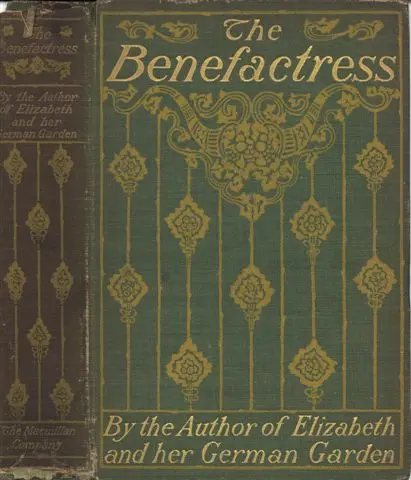
THE CLASSIC COLLECTION · 1901
"The Benefactress" by Elizabeth Von Arnim is a novel written in the late 19th century. The story unfolds through the life of Anna Estcourt, a beautiful yet contemplative young woman entangled in her family's financial struggles and societal expectations. As she navigates her dependent life under the care of her wealthy sister-in-law, Susie, Anna grapples with her desire for independence, or lack thereof, and contemplates the triviality of existence. The opening of the novel introduces Anna at the age of twenty-five, who begins to question the value of her life filled with parties and social obligations as she becomes increasingly disillusioned. Much of her dissatisfaction stems from her sister-in-law's relentless reminders of their dependence on her wealth. Anna's complex feelings about love, marriage, and autonomy are further complicated by her brother Peter's indifferent philosophy and their family dynamics, which illuminate her struggles with identity and societal roles. It becomes apparent that her whimsical aspirations for finding independence clash with the expectations of those around her, setting the stage for Anna’s eventual confrontation with the opportunities and responsibilities that come with her impending inheritance.
Introduction adapted from the source catalogue; source summaries may be automatically generated.
Free to read · English · 115,050 words · No account needed
MAKE TIME FOR A GOOD BOOK
On by default. Untick to stop anonymous reading totals. Each page counts after 10 seconds in view. How this works.
Anonymous counting is on unless you have switched it off.
"Pigs?" repeated Dellwig, lifting up his hands as though mere words were insufficient to express his feelings, "such pigs as the gracious Miss now possesses are nowhere else to be found in Pomerania. They are the pride, and at the same time the envy, of the whole province. 'Let my sausages,' said the Herr Landrath last winter, when the time for killing drew near, 'let my sausages consist solely of the pigs reared at Kleinwalde by my friend the Oberinspector Dellwig.' The Frau Landräthin was deeply injured, for she too breeds and fattens pigs, but not like ours--not like ours."
"Who is the Herr Landrath?" asked Anna absently; but immediately remembering the description of the Amtsvorsteher she added quickly, "Never mind--don't explain. I suppose he is some sort of an official, and I shall not be quite clear about these different officials till I have lived here some time."
"Natürlich, natürlich," agreed Dellwig; and leaving the Landrath unexplained he launched forth into a dissertation on Anna's pigs, whose excellencies, it appeared, were wholly due to the unrivalled skill he had for years displayed in their treatment. "I have no children," he said, with a resigned and pious upward glance, "and my wife's maternal instincts find their satisfaction in tending and fattening these fine animals. She cannot listen to their cries the day they are killed, and withdraws into the cellar, where she prepares the stuffing. The gracious Miss ate the cutlets of one this very day. It was killed on purpose."
"Was it? I wish it hadn't been," said Anna, frowning at the remembrance of that meal. "I--I don't want things killed on my account. I--don't like pig."
"Not like pig?" echoed Dellwig, dropping his lower jaw in his amazement. "Did I understand aright that the gracious one does not eat pig's flesh gladly? And my wife and I who thought to prepare a joy for her!" He clasped his hands together and stared at her in dismay. Indeed, he was so much overcome by this extraordinary and wilful spurning of nature's best gifts that for a moment he was silent, and knew not how he should proceed. Were there not concentrated in the body of a single pig a greater diversity of joys than in any other form of pleasure that he could call to mind? Did it not include, besides the profounder delights of its roasted ribs, such solid satisfactions as hams, sausages, and bacon? Did not its liver, discreetly manipulated, rival the livers of Strasburg geese in delicacy? Were not its brains a source of mutual congratulation to an entire family at supper? Did not its very snout, boiled with peas, make an otherwise inferior soup delicious? The ribs of this particular pig were reposing at that moment in a cool place, carefully shielded from harm by his wife, reserved for the Easter Sunday dinner of their new mistress, who, having begun at her first meal with the lesser joys of cutlets, was to be fed with different parts in the order of their excellence till the climax of rejoicing was reached on Easter Day in the dish of Schweinebraten, and who was now declaring, in a die-away, affected sort of voice, that she did not want to eat pig at all. Where, then, was her vulnerable point? How would he ever be able to touch her, to influence her, if she was indifferent to the chief means of happiness known to the dwellers in those parts? That was the real aim and end of his labours, of the labours, as far as he could see, of everyone else--to make as much money as possible in order to live as well as possible; and what did living well mean if it did not mean the best food? And what was the best food if not pig? Not to be killed on her account! On whose account, then, could they be killed? With an owner always about the place, and refusing to have pigs killed, how would he and his wife be able to indulge, with satisfactory frequency, in their favourite food, or offer it to their expectant friends on Sundays? He mourned old Joachim, who so seldom came down, and when he did ate his share of pork like a man, more sincerely at that moment than he would have thought possible. "Mein seliger Herr," he burst out brokenly, completely upset by the difference between uncle and niece, "mein seliger Herr----" And then, unable to go on, fell to blowing his nose with violence, for there were real tears in his eyes.
Your reading position is saved on this browser. Take it to another device with a library code. Reading pages adapt to text, rather than matching a printed edition.
Elizabeth Von Arnim

Elizabeth Von Arnim
Elizabeth Von Arnim
Elizabeth Von Arnim
BEHIND THE BOOK
This eBook is for the use of anyone anywhere in the United States and most other parts of the world at no cost and with almost no restrictions whatsoever. You may copy it, give it away or re-use it under the terms of the Project Gutenberg License included with this eBook or online at www.gutenberg.org. If you are not located in the United States, you will have to check the laws of the country where you are located before using this eBook. Read the source licence.
The original source file, including credits and licence, is retained by this library. Request an original-format copy at no charge. Please include the book title and Project Gutenberg identifier #30302.
KEEP YOUR CURIOSITY GOING
Coulson Kernahan

Maurice Baring
Frances Wright
Cécile Tormay

Frederic Jesup Stimson

W. H. P. (William Henry Pope) Jarvis