
Love
Elizabeth Von Arnim
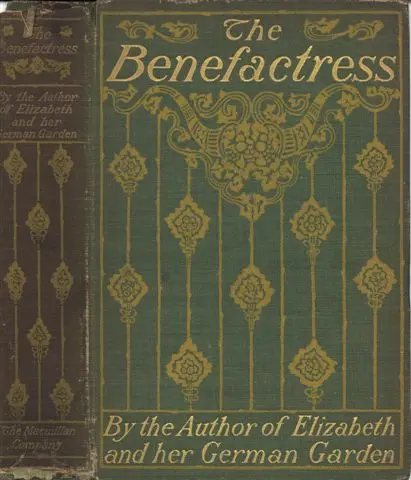
THE CLASSIC COLLECTION · 1901
"The Benefactress" by Elizabeth Von Arnim is a novel written in the late 19th century. The story unfolds through the life of Anna Estcourt, a beautiful yet contemplative young woman entangled in her family's financial struggles and societal expectations. As she navigates her dependent life under the care of her wealthy sister-in-law, Susie, Anna grapples with her desire for independence, or lack thereof, and contemplates the triviality of existence. The opening of the novel introduces Anna at the age of twenty-five, who begins to question the value of her life filled with parties and social obligations as she becomes increasingly disillusioned. Much of her dissatisfaction stems from her sister-in-law's relentless reminders of their dependence on her wealth. Anna's complex feelings about love, marriage, and autonomy are further complicated by her brother Peter's indifferent philosophy and their family dynamics, which illuminate her struggles with identity and societal roles. It becomes apparent that her whimsical aspirations for finding independence clash with the expectations of those around her, setting the stage for Anna’s eventual confrontation with the opportunities and responsibilities that come with her impending inheritance.
Introduction adapted from the source catalogue; source summaries may be automatically generated.
Free to read · English · 115,050 words · No account needed
MAKE TIME FOR A GOOD BOOK
On by default. Untick to stop anonymous reading totals. Each page counts after 10 seconds in view. How this works.
Anonymous counting is on unless you have switched it off.
"Forest! The forest covers two-thirds of the estate. It is the only forest on the entire promontory. Such care as I have bestowed on the forest has seldom been seen. It is grossartig--colossal!" And he lifted his hands the better to express his admiration, and was about to go into lengthy raptures when the map rolled itself up again with loud cracklings, and cut him short. He spread it out once more, and securing its corners began to describe the effects of the various sorts of artificial manure on the different crops, his cleverness in combining them, and his latest triumphant discovery of the superlative mixture that was to strike all Pomerania with awe.
"Ja," said Anna, balancing a paper-knife on one finger, and profoundly bored. "Whose land is that next to mine?" she asked, pointing.
"The land on the north and west belongs to peasants," said Dellwig. "On the east is the sea. On the south it is all Lohm. The gracious one passed through the village of Lohm this afternoon."
"The village where the school is?"
"Quite correct. The pastor, Herr Manske, a worthy man, but, like all pastors, taking ells when he is offered inches, serves both that church and the little one in Kleinwalde village, of which the gracious Miss is patroness. Herr von Lohm, who lives in the house standing back from the road, and perhaps noticed by the gracious Miss, is Amtsvorsteher in both villages."
"What is Amtsvorsteher?" asked Anna, languidly. She was leaning back in her chair, idly balancing the paper-knife, and listening with half an ear only to Dellwig, throwing in questions every now and then when she thought she ought to say something. She did not look at him, preferring much to look at the paper-knife, and he could examine her face at his ease in the shadow of the lamp-shade, her dark eyelashes lowered, her profile only turned to him, with its delicate line of brow and nose, and the soft and gracious curves of the mouth and chin and throat. One hand lay on the table in the circle of light, a slender, beautiful hand, full of character and energy, and the other hung listlessly over the arm of the chair. Anna was very tired, and showed it in every line of her attitude; but Dellwig was not tired at all, was used to talking, enjoyed at all times the sound of his voice, and on this occasion felt it to be his duty to make things clear. So he went into the lengthiest details as to the nature and office of Amtsvorstehers, details that were perfectly incomprehensible and wholly indifferent to Anna, and spared neither himself nor her. While he talked, however, he was criticising her, comparing the laziness of her attitude with the brisk and respectful alertness of other women when he talked. He knew that these other women belonged to a different class; his wife, the parson's wife, the wives of the inspectors on other estates, these were not, of course, in the same sphere as the new mistress of Kleinwalde; but she was only a woman, and dress up a woman as you will, call her by what name you will, she is nothing but a woman, born to help and serve, never by any possibility even equal to a clever man like himself. Old Joachim might have lounged as he chose, and put his feet on the table if it had seemed good to him, and Dellwig would have accepted it with unquestioning respect as an eccentricity of Herrschaften; but a woman had no sort of right, he said to himself, while he so fluently discoursed, to let herself go in the presence of her natural superior. Unfortunately, old Joachim, so level-headed an old gentleman in all other respects, had placed the power over his fortunes in the hands of this weak female leaning back so unbecomingly in her chair, playing with the objects on the table, never raising her eyes to his, and showing indeed, incredible as it seemed, every symptom of thinking of something else. The women of his acquaintance were, he was certain, worth individually fifty such affected, indifferent young ladies. They worked early and late to make their husbands comfortable; they were well practised in every art required of women living in the country; they were models of thrift and diligence; yet, with all their virtues and all their accomplishments, they never dreamed of lounging or not listening when a man was speaking, but sat attentively on the edge of their chairs, straight in the back and seemly, and when he had finished said Jawohl.
Your reading position is saved on this browser. Take it to another device with a library code. Reading pages adapt to text, rather than matching a printed edition.
Elizabeth Von Arnim
Elizabeth Von Arnim
Elizabeth Von Arnim
Elizabeth Von Arnim
BEHIND THE BOOK
This eBook is for the use of anyone anywhere in the United States and most other parts of the world at no cost and with almost no restrictions whatsoever. You may copy it, give it away or re-use it under the terms of the Project Gutenberg License included with this eBook or online at www.gutenberg.org. If you are not located in the United States, you will have to check the laws of the country where you are located before using this eBook. Read the source licence.
The original source file, including credits and licence, is retained by this library. Request an original-format copy at no charge. Please include the book title and Project Gutenberg identifier #30302.
KEEP YOUR CURIOSITY GOING
Coulson Kernahan

Maurice Baring
Frances Wright
Cécile Tormay

Frederic Jesup Stimson

W. H. P. (William Henry Pope) Jarvis