
Love
Elizabeth Von Arnim
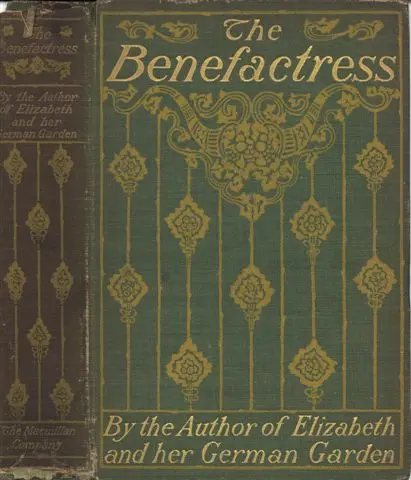
THE CLASSIC COLLECTION · 1901
"The Benefactress" by Elizabeth Von Arnim is a novel written in the late 19th century. The story unfolds through the life of Anna Estcourt, a beautiful yet contemplative young woman entangled in her family's financial struggles and societal expectations. As she navigates her dependent life under the care of her wealthy sister-in-law, Susie, Anna grapples with her desire for independence, or lack thereof, and contemplates the triviality of existence. The opening of the novel introduces Anna at the age of twenty-five, who begins to question the value of her life filled with parties and social obligations as she becomes increasingly disillusioned. Much of her dissatisfaction stems from her sister-in-law's relentless reminders of their dependence on her wealth. Anna's complex feelings about love, marriage, and autonomy are further complicated by her brother Peter's indifferent philosophy and their family dynamics, which illuminate her struggles with identity and societal roles. It becomes apparent that her whimsical aspirations for finding independence clash with the expectations of those around her, setting the stage for Anna’s eventual confrontation with the opportunities and responsibilities that come with her impending inheritance.
Introduction adapted from the source catalogue; source summaries may be automatically generated.
Free to read · English · 115,050 words · No account needed
MAKE TIME FOR A GOOD BOOK
On by default. Untick to stop anonymous reading totals. Each page counts after 10 seconds in view. How this works.
Anonymous counting is on unless you have switched it off.
"Losses!" cried Manske. "On the contrary, it is the best thing that could happen--the very best thing. Those stables have long been almost unfit for use, Herr von Lohm, and I can say from my heart that I was glad to see them go. They were all to pieces even in your father's time."
"Yes, they ought to have been rebuilt long ago, but one has not always the money in one's pocket. Help yourself, my dear pastor."
"Who is the enemy?" broke in Dellwig's harsh voice.
"Ah, who indeed?" said Manske, looking sad. "That is the melancholy side of the affair--that someone, presumably of my parish, should commit such a crime."
"He has done me a great service, anyhow," said Axel, filling the
glasses.
"He has imperilled his immortal soul," said Manske.
"Have you such an enemy?" asked Anna, surprised.
"I did not know it. Most likely it was some poor, half-witted devil, or perhaps--perhaps a child."
"But I saw the blaze immediately after I passed you," said Dellwig. "You were within a stone's throw of the stables, going home. I had hardly reached them when the fire broke out. Did you then see no one on the road?"
"No, I did not," said Axel shortly. There was an aggressive note in Dellwig's voice that made him fear he was going to be very zealous in helping to bring the delinquent to justice.
"It was the supper hour," said Dellwig, musing, "and the men would all be indoors. Had you been to the stables, gnädiger Herr?"
"No, I had not. Take another glass of wine. A cigar? Whoever it was, he has done me a good turn."
"Beyond all doubt he has," said Dellwig, his eyes fixed on Axel with an
odd expression.
"Some of us would have no objection to the same thing happening at our places," remarked one of the farmers jocosely.
"No objection whatever," agreed another with a laugh.
"If the man could be trusted to display the same discrimination
everywhere," said the third.
"Joke not about crime," said Manske, rebuking them.
"The discrimination was certainly remarkable," said Dellwig.
"That is why I think it must have been done by some person more or less imbecile," said Axel; "otherwise one of the good buildings, whose destruction would really have harmed me, would have been chosen."
"He must be hunted down, imbecile or not," said Dellwig.
"I shall do my duty," said Axel stiffly.
"You may rely on my help," said Dellwig.
"You are very good," said Axel.
Your reading position is saved on this browser. Take it to another device with a library code. Reading pages adapt to text, rather than matching a printed edition.
Elizabeth Von Arnim

Elizabeth Von Arnim
Elizabeth Von Arnim
Elizabeth Von Arnim
BEHIND THE BOOK
This eBook is for the use of anyone anywhere in the United States and most other parts of the world at no cost and with almost no restrictions whatsoever. You may copy it, give it away or re-use it under the terms of the Project Gutenberg License included with this eBook or online at www.gutenberg.org. If you are not located in the United States, you will have to check the laws of the country where you are located before using this eBook. Read the source licence.
The original source file, including credits and licence, is retained by this library. Request an original-format copy at no charge. Please include the book title and Project Gutenberg identifier #30302.
KEEP YOUR CURIOSITY GOING
Coulson Kernahan

Maurice Baring
Frances Wright
Cécile Tormay

Frederic Jesup Stimson

W. H. P. (William Henry Pope) Jarvis