THE CLASSIC COLLECTION✦The Recruiting OfficerCLASSIC FREE BOOKS
The Recruiting Officer
George Farquhar
THE CLASSIC COLLECTION · 1707
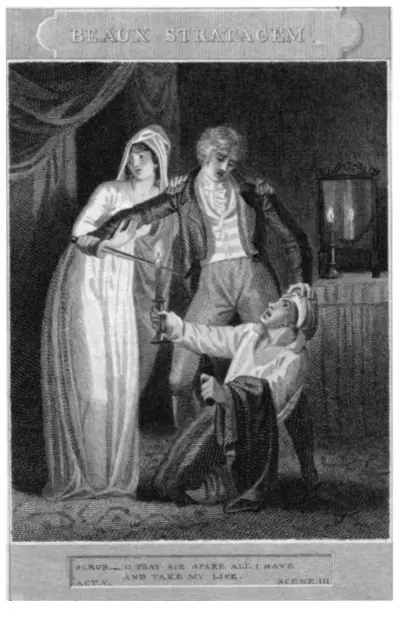
"The Beaux-Stratagem: A comedy in five acts by George Farquhar" is a comedy first produced in 1707. Two impoverished gentlemen, Aimwell and Archer, devise a scheme to marry wealthy heiresses and restore their fortunes. Traveling to Lichfield, they target the beautiful Dorinda, with Archer posing as Aimwell's servant to deceive the locals. Complications arise when Aimwell genuinely falls in love, the innkeeper's daughter pursues Archer, and a band of thieves plots to rob their intended targets, threatening their carefully laid plans.
Introduction adapted from the source catalogue; source summaries may be automatically generated.
Free to read · English · 21,886 words · No account needed
MAKE TIME FOR A GOOD BOOK
On by default. Untick to stop anonymous reading totals. Each page counts after 10 seconds in view. How this works.
Anonymous counting is on unless you have switched it off.
Sul. Lookye, sir, I have nothing to say to your sea of truth; but if a good parcel of land can entitle a man to a little truth, I have as much as any he in the county.
Bon. I never heard your worship, as the saying is, talk so much
before.
Sul. Because I never met with a man that I liked before.
Bon. Pray, sir, as the saying is, let me ask you one question: are not
man and wife one flesh?
Sir C. You and your wife, Mr. Guts, may be one flesh, because you are nothing else----but rational creatures have minds that must be united.
Sul. Minds!
Sir C. Ay, minds, sir; don't you think that the mind takes place of
the body?
Sul. In some people.
Sir C. Then the interest of the master must be consulted before that
of his servant.
Sul. Sir, you shall dine with me to-morrow----Oons, I always thought that we were naturally one.
Sir C. Sir, I know that my two hands are naturally one, because they love one another, kiss one another, help one another in all the actions of life; but I could not say so much if they were always at cuffs.
Sul. Then 'tis plain that we are two.
Sir C. Why don't you part with her, sir?
Sul. Will you take her, sir?
Sir C. With all my heart.
Sul. You shall have her to-morrow morning, and a venison pasty into
the bargain.
Sir C. You'll let me have her fortune too?
Sul. Fortune! why, sir, I have no quarrel to her fortune----I only hate the woman, sir, and none but the woman shall go.
Sir C. But her fortune, sir----
Sul. Can you play at whist, sir?
Sir C. No, truly, sir.
Sul. Not at all-fours?
Sir C. Neither.
Sul. Oons! where was this man bred? [Aside.] Burn me, sir, I can't go home; 'tis but two o'clock.
Sir C. For half an hour, sir, if you please--but you must consider
'tis late.
Sul. Late! that is the reason I can't go to bed--Come,
sir----[Exeunt.
Enter CHERRY; she runs across the Stage, and knocks at AIMWELL'S Chamber Door. Enter AIMWELL.
Aim. What's the matter? you tremble, child; you are frighted!
Cher. No wonder, sir--but, in short, sir, this very minute a gang of rogues are gone to rob my Lady Bountiful's house.
Aim. How!
Cher. I dogged them to the very door, and left them breaking in.
Aim. Have you alarmed any body else with the news?
Your reading position is saved on this browser. Take it to another device with a library code. Reading pages adapt to text, rather than matching a printed edition.
George Farquhar
George Farquhar
BEHIND THE BOOK
This eBook is for the use of anyone anywhere in the United States and most other parts of the world at no cost and with almost no restrictions whatsoever. You may copy it, give it away or re-use it under the terms of the Project Gutenberg License included with this eBook or online at www.gutenberg.org. If you are not located in the United States, you will have to check the laws of the country where you are located before using this eBook. Read the source licence.
The original source file, including credits and licence, is retained by this library. Request an original-format copy at no charge. Please include the book title and Project Gutenberg identifier #37195.
KEEP YOUR CURIOSITY GOING
Maurice Baring
W. B. (William Butler) Yeats
Edward Martyn

John Brougham & Charlotte Brontë
Marguerite Merington
Leonid Andreyev