
Last letters from the living dead man
David Patterson (Spirit) Hatch
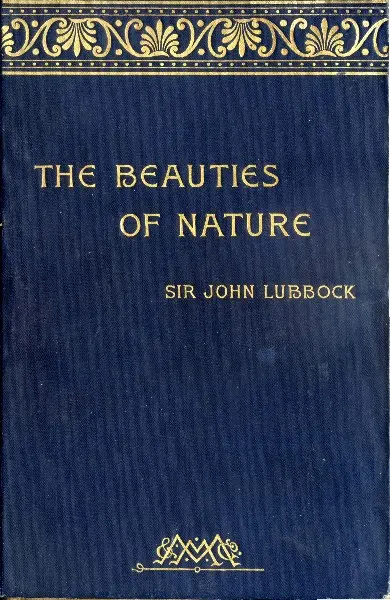
THE CLASSIC COLLECTION · 1892
"The Beauties of Nature, and the Wonders of the World We Live In" by Sir John Lubbock is a philosophical treatise interweaving natural history with reflections on the relationship between humanity and the natural environment, likely written in the late 19th century. The work serves as a celebration of nature's beauty and an exploration of how individuals perceive and appreciate the world around them. It addresses the intricacies of life in various ecosystems, emphasizing the importance of recognizing and valuing the wonders of both flora and fauna. The opening of the text sets a contemplative tone, urging readers to recognize the abundance and magnificence of the natural world that often goes unnoticed in daily life. Sir John Lubbock begins by reflecting on the profound gifts that nature offers—its beauty, resources, and the constants of change that gird human existence. He argues that one's perception shapes the enjoyment of scenery, suggesting that many overlook the richness of their surroundings due to complacency. Employing quotes from figures like Seneca, he posits that embracing and cherishing nature leads to a fuller, more joyful life, touching on themes that blend spirituality with the respect and appreciation of the environment.
Introduction adapted from the source catalogue; source summaries may be automatically generated.
Free to read · English · 67,364 words · No account needed
MAKE TIME FOR A GOOD BOOK
On by default. Untick to stop anonymous reading totals. Each page counts after 10 seconds in view. How this works.
Anonymous counting is on unless you have switched it off.
The strata, moreover, often--indeed generally, as we have seen, for instance, in the case of Switzerland--bear evidence of most violent contortions, and even where the convulsions were less extreme, the valleys thus resulting are sometimes complicated by the existence of older valleys formed under previous conditions.
In the Alps then the present configuration of the surface is mainly the result of denudation. If we look at a map of Switzerland we can trace but little relation between the river courses and the mountain chains.
The rivers, as a rule (Fig. 40), run either S.E. by N.W., or, at right angles to this, N.E. and S.W. The Alps themselves follow a somewhat curved line from the Maritime Alps, commencing with the islands of Hyeres, by Briancon, Martigny, the Valais, Urseren Thal, Vorder Rhein, Innsbruck, Radstadt, and Rottenmann to the Danube, a little below Vienna,--at first nearly north and south, but gradually curving round until it becomes S.W. by N.E.
The central mountains are mainly composed of Gneiss, Granite, and crystalline Schists: the line of junction between these rocks and the secondary and tertiary strata on the north, runs, speaking roughly, from Hyeres to Grenoble, and then by Albertville, Sion, Chur, Inns, bruck, Radstadt, and Hieflau, towards Vienna. It is followed (in some part of their course) by the Isere, the Rhone, the Rhine, the Inn, and the Enns. One of the great folds shortly described in the preceding chapter runs up the Isere, along the Chamouni Valley, up the Rhone, through the Urseren Thal, down the Rhine Valley to Chur, along the Inn nearly to Kufstein, and for some distance along the Enns. Thus, then, five great rivers have taken advantage of this main fold, each of them eventually breaking through into a transverse valley.
The Pusterthal in the Tyrol offers us an interesting case of what is obviously a single valley, which has, however, been slightly raised in the centre, near Toblach, so that from this point the water flows in opposite directions--the Drau eastward, and the Rienz westward. In this case the elevation is single and slight: in the main valley there are several, and they are much loftier, still we may, I think, regard that of the Isere from Chambery to Albertville, of the Rhone from Martigny to its source, of the Urseren Thal, of the Vorder Rhine from its source to Chur, of the Inn from Landeck to below Innsbruck, even perhaps of the Enns from Radstadt to Hieflau as in one sense a single valley, due to one of these longitudinal folds, but interrupted by bosses of gneiss and granite,--one culminating in Mont Blanc, and another in the St. Gotthard,--which have separated the waters of the Isere, the Rhone, the Vorder Rhine, the Inn, and the Enns. That the valley of Chamouni, the Valais, the Urseren Thal, and that of the Vorder Rhine really form part of one great fold is further shown by the presence of a belt of Jurassic strata nipped in, as it were, between the crystalline rocks.
Your reading position is saved on this browser. Take it to another device with a library code. Reading pages adapt to text, rather than matching a printed edition.
BEHIND THE BOOK
This eBook is for the use of anyone anywhere in the United States and most other parts of the world at no cost and with almost no restrictions whatsoever. You may copy it, give it away or re-use it under the terms of the Project Gutenberg License included with this eBook or online at www.gutenberg.org. If you are not located in the United States, you will have to check the laws of the country where you are located before using this eBook. Read the source licence.
The original source file, including credits and licence, is retained by this library. Request an original-format copy at no charge. Please include the book title and Project Gutenberg identifier #28274.
KEEP YOUR CURIOSITY GOING
David Patterson (Spirit) Hatch
Cécile Tormay

Moritz Busch
Coulson Kernahan
John L. Ransom

Ralph Waldo Emerson