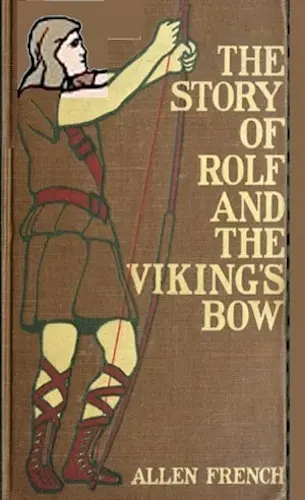
The Story of Rolf and the Viking’s Bow
Allen French

THE CLASSIC COLLECTION · 1904
"The Barrier: A Novel" by Allen French is a work of fiction written in the early 20th century. The novel explores themes of ambition, social class, and personal relationships within a closely-knit community in New England. The narrative primarily revolves around Stephen F. Ellis, a business magnate who seeks recognition in the aristocratic circles of Stirling, and George Mather, a young entrepreneur who has recently faced a downfall. Their interactions, along with those of Judith Blanchard—a strong and ambitious woman—set the stage for a deeper exploration of societal dynamics and personal aspirations. At the start of the novel, the reader is introduced to the small city of Stirling, where excess and exclusivity define the lifestyle of its wealthy inhabitants. George Mather, a former president of the street-railway company, has just lost his position by a manipulative strike from his rival, Ellis. As Mather grapples with his defeat, he encounters Judith Blanchard, whose perceptions and ambitions bring additional complexity to his situation. The opening segments establish the contrasting aspirations of both men as well as Judith's growing awareness of her own desires, laying the groundwork for a narrative that promises to navigate the intricacies of love, power, and societal expectation.
Introduction adapted from the source catalogue; source summaries may be automatically generated.
Free to read · English · 86,407 words · No account needed
MAKE TIME FOR A GOOD BOOK
On by default. Untick to stop anonymous reading totals. Each page counts after 10 seconds in view. How this works.
Anonymous counting is on unless you have switched it off.
The workman whom Mather had been watching kept looking at the clock. It began to strike eleven; at once all eyes were turned on him; all work was suspended during the slow striking. When this ceased, the workman left his place and went to the door of the office; all glances followed him, and the men who were more distant left their stations and crowded to watch. Conscious of the stir he made, the fellow walked with a swagger, but a change came in his manner when, through the screen-door, he saw the quiet manager also eyeing him. He knocked on the door.
"Come in, Stock," said Mather.
Now the main entrance to the office was from outside, through a short passage. At the moment when the workman entered from the mill, Judith and Beth came into the passage; seeing Mather in apparent conference with an employee, they waited until he should be finished. He had wheeled in his chair, and his back was turned to them. "Well, Stock?" he said.
The spokesman of the employees was a lean man, somewhat wolfish, with an eye that moved too much. He seemed a talker rather than a doer, with something of the actor showing as he stood by the door and folded his arms. He spoke with an important air; no voice, Judith thought, can be impressive if it is not clear.
"I've come to say, sir, that we're dissatisfied."
"That means," asked Mather, quietly and without rising, "that you are
dissatisfied?"
The man cleared his throat, but still a characteristic huskiness
remained. "Yes, sir, I am."
"Very well," was the response, and the manager turned to the stenographer. "Miss Jenks, make out a bill of this man's time."
Beth clutched Judith by the sleeve and sought to draw her away. Judith stood still; not for anything would she have lost the sight of those two men as they watched each other.
"You discharge me?" cried the workman with excitement.
"You discharged yourself," answered Mather steadily. "I can't have a man here who is dissatisfied."
"My grievances----" began the other.
Mather cut him short. "Grievance is a word that doesn't apply. You knew the conditions of work when you came; I have changed none of them."
"Then," cried Stock, "let me tell you from the men----"
"Stop!" ordered Mather; "no one speaks for my men who is not in my
employ."
"Just the same----" began Stock, anxiety peering from his eyes. Mather
interrupted him again.
"That will do. How much, Miss Jenks? Thanks." He took the money from his pocket and handed it to the workman. "That is correct, I think. Good day, Stock."
Your reading position is saved on this browser. Take it to another device with a library code. Reading pages adapt to text, rather than matching a printed edition.
BEHIND THE BOOK
This eBook is for the use of anyone anywhere in the United States and most other parts of the world at no cost and with almost no restrictions whatsoever. You may copy it, give it away or re-use it under the terms of the Project Gutenberg License included with this eBook or online at www.gutenberg.org. If you are not located in the United States, you will have to check the laws of the country where you are located before using this eBook. Read the source licence.
The original source file, including credits and licence, is retained by this library. Request an original-format copy at no charge. Please include the book title and Project Gutenberg identifier #41890.
KEEP YOUR CURIOSITY GOING
Coulson Kernahan

Maurice Baring
Frances Wright
Cécile Tormay

Frederic Jesup Stimson

W. H. P. (William Henry Pope) Jarvis