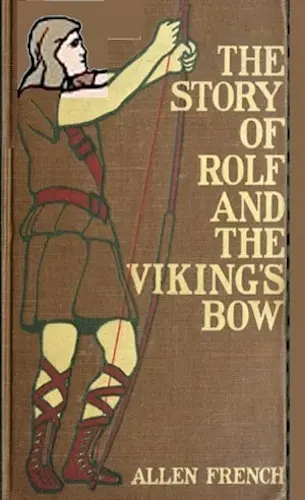
The Story of Rolf and the Viking’s Bow
Allen French

THE CLASSIC COLLECTION · 1904
"The Barrier: A Novel" by Allen French is a work of fiction written in the early 20th century. The novel explores themes of ambition, social class, and personal relationships within a closely-knit community in New England. The narrative primarily revolves around Stephen F. Ellis, a business magnate who seeks recognition in the aristocratic circles of Stirling, and George Mather, a young entrepreneur who has recently faced a downfall. Their interactions, along with those of Judith Blanchard—a strong and ambitious woman—set the stage for a deeper exploration of societal dynamics and personal aspirations. At the start of the novel, the reader is introduced to the small city of Stirling, where excess and exclusivity define the lifestyle of its wealthy inhabitants. George Mather, a former president of the street-railway company, has just lost his position by a manipulative strike from his rival, Ellis. As Mather grapples with his defeat, he encounters Judith Blanchard, whose perceptions and ambitions bring additional complexity to his situation. The opening segments establish the contrasting aspirations of both men as well as Judith's growing awareness of her own desires, laying the groundwork for a narrative that promises to navigate the intricacies of love, power, and societal expectation.
Introduction adapted from the source catalogue; source summaries may be automatically generated.
Free to read · English · 86,407 words · No account needed
MAKE TIME FOR A GOOD BOOK
On by default. Untick to stop anonymous reading totals. Each page counts after 10 seconds in view. How this works.
Anonymous counting is on unless you have switched it off.
And now he knew he would never be the same man again--never could work so free of soul, never forget those high ideals of hers, nor be as mindless of the consequences of his acts. He smiled with scorn of himself as he saw how the tables had been turned on him. Meaning to win the girl, to buy her, he had instead roused a conscience, and learned that there was purity in the world. This was what they meant, then, those hitherto inexplicable fits of his: that a new nature was trying to assert itself, that a terrible discontent was aroused, that his whole life had changed, and that within an unsuspected recess of his nature there was this open wound, unhealing, draining his strength.
Where then was his boast to his enemies, of what worth his threats? Could he ever fight again as before, ever manage and plan? Again he laughed scornfully.
"You needn't laugh," complained Mrs. Harmon. "I do understand it all."
"I wasn't laughing at you," he answered. "--Well, forget all this, Lydia. What is it I can do for you?"
"Will you forget all this?" she asked with meaning. "Then look ahead with me for a while, Stephen. You won't be president."
"And I've lost my mayor," he added.
"Will it mean so much?" she asked, disappointed.
"It's Mather's year," he said decidedly. "Everything's going his way; it happens so every once in a while in New York. Then Tammany lays low; so shall I. But in the end they come in again; so with me."
"Then, planning for the future," she began, but hesitated, stopped, and started differently. "I've suffered a good deal, in this past year. We haven't got anything we wished, either you or I."
He wondered what brought her. "That is true," he said, not intending to
commit himself.
"I've suffered from Judith as well as you," complained Mrs. Harmon. "She insulted me the other day; she isn't what I thought her, Stephen."
"Nor what I thought," he said, waiting.
"And the others," she went on, "turn me down, too. You would suppose that my position, and my loss--but they are colder to me than ever." She looked down.
"Look here," he said, "it isn't like you to be so mild, Lydia. Aren't you just a little mad, underneath?"
"Oh, I hate them all!" she burst out. She looked at him with flashing eyes, then asked directly, "Do you, Stephen?"
"Well, suppose I do; what then?" he asked, wishing her to show her hand.
"I will leave them," said Mrs. Harmon with vigour. "So will you. And we will leave them together."
Your reading position is saved on this browser. Take it to another device with a library code. Reading pages adapt to text, rather than matching a printed edition.
BEHIND THE BOOK
This eBook is for the use of anyone anywhere in the United States and most other parts of the world at no cost and with almost no restrictions whatsoever. You may copy it, give it away or re-use it under the terms of the Project Gutenberg License included with this eBook or online at www.gutenberg.org. If you are not located in the United States, you will have to check the laws of the country where you are located before using this eBook. Read the source licence.
The original source file, including credits and licence, is retained by this library. Request an original-format copy at no charge. Please include the book title and Project Gutenberg identifier #41890.
KEEP YOUR CURIOSITY GOING
Coulson Kernahan

Maurice Baring
Frances Wright
Cécile Tormay

Frederic Jesup Stimson

W. H. P. (William Henry Pope) Jarvis