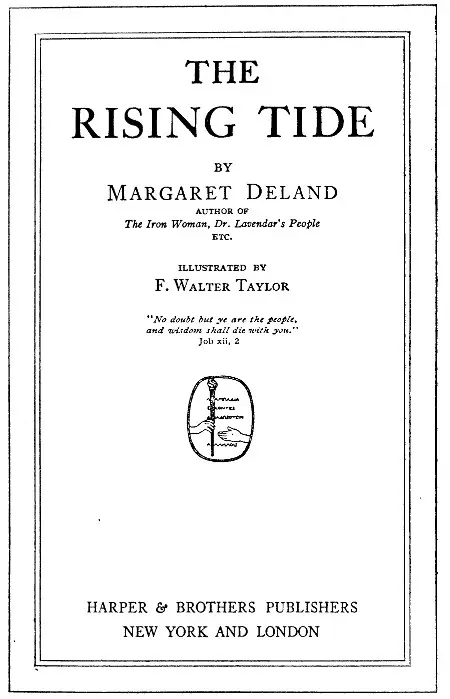
The Rising Tide
Margaret Wade Campbell Deland
THE CLASSIC COLLECTION · 1906
"The Awakening of Helena Richie" by Margaret Wade Campbell Deland is a novel likely written during the early 20th century. The story revolves around the titular character, Helena Richie, a widow navigating her complex emotions and relationships in the small town of Old Chester. The beginning hints at themes of loneliness, societal expectations, and the struggles of motherhood, as well as the possibility of connection through a little boy named David, who is in search of a home. The opening of the novel introduces two main characters, Dr. Lavendar and a local boy named Goliath, as they make pastoral calls on the residents of Old Chester, leading to a reflection on their own lives and the lives of others in the community. During their conversation, the need for a caretaker for the orphaned David arises, bringing attention to Mrs. Richie, who has her own haunting past related to loss. As the narrative unfolds, we witness Helena grappling with her own grief while contemplating the impact of potentially taking David into her home. This premise sets the stage for exploration of emotional healing, societal pressures, and personal awakening amidst the backdrop of small-town life.
Introduction adapted from the source catalogue; source summaries may be automatically generated.
Free to read · English · 95,700 words · No account needed
MAKE TIME FOR A GOOD BOOK
On by default. Untick to stop anonymous reading totals. Each page counts after 10 seconds in view. How this works.
Anonymous counting is on unless you have switched it off.
"When I'm big I'm going to fight Indians. Or else I'll drive fast horses. I don't know which. It's hard to decide, ain't it, sir?"
"Very hard. If you choose the horses, I'll give you Goliath."
David was silent; then he sighed: "I guess I'll fight Indians, sir," he
said.
But a moment later he was cheerfully confidential; he had thirty cents to spend! "Dear, dear," said Dr. Lavendar, "we mustn't do anything rash. Here, let's look in this window."
Oh, how many windows there were, and all of them full of beautiful things! Dr. Lavendar was willing to stop at every one; and he joined in David's game of "mine," with the seriousness that all thoughtful persons give to this diversion.
"That's mine!" David would cry, pointing to a green china toad behind the plate glass; and Dr. Lavendar would say gravely,
"You may have it, David; you may have it."
"Now it's your turn!" David would instruct him.
"Must I take something in this window?" Dr. Lavendar would plead. And David always said firmly that he must. "Well, then, that's mine," Dr. Lavendar would say.
"Why, that's only a teacup! We have thousands of them at our house!" David boasted. "I should think you would rather have the toad. I'll--I'll give you the toad, sir?"
"Oh, dear me, no," Dr. Lavendar protested; "I wouldn't rob you for the world." And so they sauntered on, hand in hand. When they came to a book-store, Dr. Lavendar apologized for breaking in upon their "game." "I'm going to play mine, in here," he said.
David was quite content to wait at the door and watch the people, and the yellow boxes full of windows, drawn by mules with bells jingling on their harness. Sometimes he looked fearfully back into the shop; but Dr. Lavendar was still playing "mine," so all was well. At last, however, he finished his game and came to the door.
"Come along, David; this is the most dangerous place in town!"
David looked at him with interest. "Why did you skip with your eye when you said that, sir?" he demanded.
At which the clerk who walked beside them laughed loudly, and David
grew very red and angry.
But when Dr. Lavendar said, "David, I've got a bone in my arm; won't you carry a book for me?" he was consoled, and immediately began to ask questions. It seemed to Dr. Lavendar that he inquired about everything in heaven and earth and the waters under the earth, and at last the old gentleman was obliged, in self-defence, to resort to the formula which, according to the code of etiquette understood by these two friends, signified "stop talking."
Your reading position is saved on this browser. Take it to another device with a library code. Reading pages adapt to text, rather than matching a printed edition.
Margaret Wade Campbell Deland

Margaret Wade Campbell Deland
Margaret Wade Campbell Deland

Margaret Wade Campbell Deland
BEHIND THE BOOK
This eBook is for the use of anyone anywhere in the United States and most other parts of the world at no cost and with almost no restrictions whatsoever. You may copy it, give it away or re-use it under the terms of the Project Gutenberg License included with this eBook or online at www.gutenberg.org. If you are not located in the United States, you will have to check the laws of the country where you are located before using this eBook. Read the source licence.
The original source file, including credits and licence, is retained by this library. Request an original-format copy at no charge. Please include the book title and Project Gutenberg identifier #6315.
KEEP YOUR CURIOSITY GOING
Coulson Kernahan

Maurice Baring
Frances Wright
Cécile Tormay

Frederic Jesup Stimson

W. H. P. (William Henry Pope) Jarvis