THE CLASSIC COLLECTION✦The spiritual exercises of St. IgnatiusCLASSIC FREE BOOKS
The spiritual exercises of St. Ignatius
of Loyola, Saint Ignatius & Charles Coppens
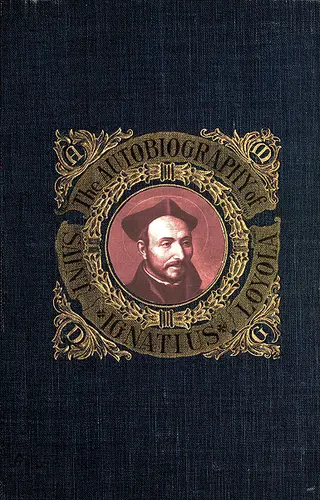
THE CLASSIC COLLECTION · 1900
"The Autobiography of St. Ignatius" by Saint Ignatius of Loyola is a spiritual memoir written in the early 16th century. The book recounts the profound personal transformation of Ignatius, highlighting his military past, intense spiritual experiences, and the founding of the Society of Jesus. The text offers readers an intimate look into his struggles with vanity and ambition, his recovery from a serious injury, and the gradual awakening of his spiritual purpose. The beginning of the autobiography portrays Ignatius as a man enthralled by worldly pursuits, particularly in his military career, until he is injured at the siege of Pampeluna. During his lengthy recovery, he begins reading about the lives of saints, which ignites a deeply spiritual yearning within him. The narrative describes his inner conflict as he grapples with returning to worldly fears versus embracing a life devoted to God. His epiphany leads him to forego his former ways and commit to a path of penance and service, eventually influencing many around him and setting the stage for his future endeavors in forming the Jesuit order.
Introduction adapted from the source catalogue; source summaries may be automatically generated.
Free to read · English · 22,811 words · No account needed
MAKE TIME FOR A GOOD BOOK
On by default. Untick to stop anonymous reading totals. Each page counts after 10 seconds in view. How this works.
Anonymous counting is on unless you have switched it off.
"If we look at the 92 colleges in France, although the University of Paris was in one quarter of the city, and in that sense materially one,--although including 50 colleges,--yet in the formal and essential bond these 92 Jesuit colleges were vastly more of a unit as an identical educational power than any faculty existing. No faculty at Paris, Rome, Salamanca, or Oxford ever preserved the control over its 50, 20, or 8 colleges that each Provincial exercised over his 10, 20, or 30 colleges, or the general of the Order over the 700 colleges, with 22,126 members in the Order."
At the present day we find the Jesuit colleges in almost every part of the known world. In Rome and in China, in South Africa and North America, in the Philippine Islands as well as in Ceylon and Egypt, in Australia and Cuba, as well as in Syria and the city of New York.
We may glance briefly at the colleges scattered over the world, containing to-day 52,692 Jesuit pupils.
This is a larger number than those taught at Oxford and Cambridge and Glasgow and Harvard or Yale or Princeton or in Paris and Edinburgh.
In the Jesuit College at Rome there are 2082 students.
In Brazil, 757
Naples, 960
Denver, 100
Sicily, 376
Turin, 516
California, 850
Rocky Mountains, 72
Venice, 520
Mangalore (India), 483
Austria, 1746
Egypt, 500
Toulouse, 1581
Madura, 1800
Aragon, 1414
Manila
Philippine Islands,
Municipal Atheneum, 1123
Normal School, 680
Chili and Paraguay, 4913
Castile, 2073
Cuba, Havana, and Cienfuegos, 397
Colombia, 766
Portugal, 560
Belgium, 6658
Bengal, 983
Ceylon, 35
Galicia, 474
Germany, 3443
Holland, 613
France, 3384
China, 122
Lyons, 2191
Syria, 608
Mexico, 684
Toledo, 782
Ecuador and Peru, 820
England, 1454
Zambesi, 64
Ireland, 883
Australia, 447
New York and Maryland, 2815
Jamaica, West Indies, 60
Missouri, 2061
B. Honduras, 2122
Canada, 511
New Orleans, 504
Thus the total number of students--studying with professors of the Society of Jesus under one university system in all parts of the known world--is 52,692.
There has been no going back. Fifty years ago, when the groundwork of rebuilding the 700 institutions that had been destroyed by the suppression had to be commenced all over again, there were but 15,000, to-day there are 52,692.
St. Ignatius was born in 1491. The first College of Coimbra was founded in 1542. From 1542 to 1773 is a period of 231 years. The suppression lasted from 1773 to 1814 (41 years). The new work continued from 1814 to 1899, a period of 85 years.
Your reading position is saved on this browser. Take it to another device with a library code. Reading pages adapt to text, rather than matching a printed edition.
of Loyola, Saint Ignatius & Charles Coppens
BEHIND THE BOOK
This eBook is for the use of anyone anywhere in the United States and most other parts of the world at no cost and with almost no restrictions whatsoever. You may copy it, give it away or re-use it under the terms of the Project Gutenberg License included with this eBook or online at www.gutenberg.org. If you are not located in the United States, you will have to check the laws of the country where you are located before using this eBook. Read the source licence.
The original source file, including credits and licence, is retained by this library. Request an original-format copy at no charge. Please include the book title and Project Gutenberg identifier #24534.
KEEP YOUR CURIOSITY GOING

David Patterson (Spirit) Hatch

David Patterson (Spirit) Hatch

David Patterson (Spirit) Hatch
Cécile Tormay

Moritz Busch
John L. Ransom