THE CLASSIC COLLECTION✦Andersonville diaryCLASSIC FREE BOOKS
Andersonville diary
John L. Ransom
THE CLASSIC COLLECTION · 1917
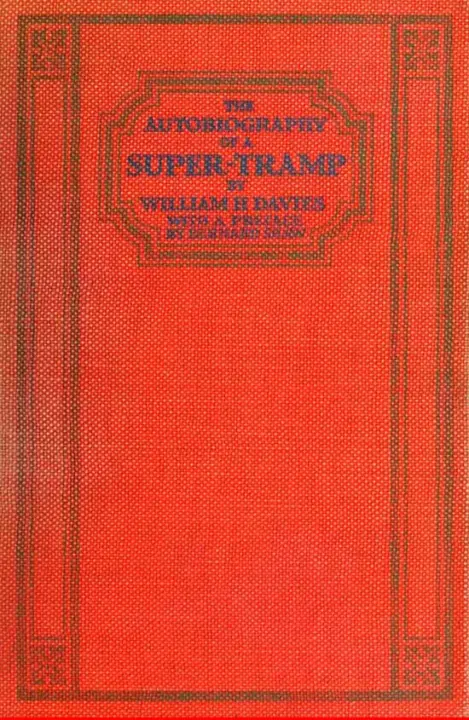
"The Autobiography of a Super-Tramp" by W. H. Davies is an autobiography published in 1908. This remarkable firsthand account chronicles Davies' vagrant years traveling across the United Kingdom, Canada, and the United States during the 1890s. Living among hardened tramps, Davies experienced life on the road through begging, jail schemes, and riding the rails—until a fateful train-hopping accident changed everything. George Bernard Shaw championed this literary unknown's "primitive splendour," helping bring this unconventional life story to the world.
Introduction adapted from the source catalogue; source summaries may be automatically generated.
Free to read · English · 86,950 words · No account needed
MAKE TIME FOR A GOOD BOOK
On by default. Untick to stop anonymous reading totals. Each page counts after 10 seconds in view. How this works.
Anonymous counting is on unless you have switched it off.
We had had no intoxicating liquor for several months, and, though we had passed one or two of these places on our way to St. Joseph, on which he had gazed in a rather too friendly manner, his courage, up to this moment, had not been equal to an invitation. "Well," I said, pleased with the prospect of not only saving my passage money, but also of earning my train fare in England--"it will certainly be cold, taking this deck voyage across the lake in the early hours of morning, and a glass of whiskey will keep some warmth in us." Alas! the usual thing happened--we got full; and what with the dead effects of the drink, and a rough passage across, we arrived in Chicago feeling cold, stiff, and in many other ways uncomfortable.
I have often heard salt water mariners sneer at these fresh water sailors, but, after crossing the Atlantic some eighteen times, and making several passages across the lakes, my opinion is that these vast inland lakes are more dangerous to navigate, and far less safe than the open seas.
Of course, we had to have more whisky, after the voyage, and, having had to sleep, its effect was almost instantaneous. Not altogether losing my senses, I suggested to Red that we should go to some hotel, have breakfast, and then go to bed for an hour or two, say till dinner time, which would refresh us. It was now eight o'clock in the morning, and Red had unfortunately got into conversation with a gentleman who knew something of Australia. "Yes," he said, gravely, after listening to my proposal--"you are young, and you certainly look drunk and sleepy, and had better follow your own advice. The hotel is next door but one to this, and you will find me here when you return." Not liking to take him by the shoulder, and to gently try to force him away from this stranger in whose conversation he evidently seemed to take a great delight, not to mention doing such an action before the landlord's face, I left him, made arrangements at the hotel for two, and then went to bed. Having had a good sleep, and a substantial meal, and feeling thoroughly refreshed, I now returned to Red, whom I found in the centre of half a dozen loafers, besides the gentleman to whom I have already referred. On my appearance, he staggered to his feet and came to meet me, and then, taking me on one side, began in this way: "You have just come in the nick of time, for the glasses, as you see, are empty. Pay for all drinks called for, and I will make it all right with you in the morning." "What is the matter?" I asked. "What have you done with over eighty dollars?" Winking artfully, and with a smile meant to be cunning, he said--"I have hidden my money, as I usually do in these cases. Most likely it is in the lining of my coat; but, wherever it is, you may depend on it as being quite safe." If he had had the assistance of a score of the most inveterate drunkards, I know he could not in this short time have squandered between eighty and ninety dollars. Red had earned ninety-five dollars and a half, and, up to the time of my leaving him, had spent but very little. I came to the conclusion that he had been robbed, and that this befell him in all his sprees. After calling for a round of drinks, I left the house, knowing that Red would soon follow, which he did, and at once. I persuaded him to bed, and the next morning saw the same peculiarities as before--his going into corners, up side streets, to feel the lining of his clothes. He was not satisfied at seeing no tear in the lining of his cap, but must hold it in his hand and feel every inch of it. "Somewhere on my person," he reiterated, "I have secreted three twenty dollar bills. I have a distinct recollection of doing so, but for the life of me I cannot remember what part." "You have been robbed," I answered, with a little disgust. Not willing to leave him in his present circumstances, and only too sorry that I had not done so when he was almost as well off as myself, I shared my dollars with him, saying in an offended manner--"The sooner we squander this stuff the better it will please us." We spent it in one week in Chicago, and were again without a cent. "Again," I said with some exaggeration, "winter is here, and we are in the same position as at the end of last summer. What now?" "We are without money," said Red, "but there is still nothing to prevent us from our first intention of visiting England. We will beat our way to Baltimore without delay. I am known in that port by the cattle foremen and owners, and we are almost sure of a ship as soon as we arrive." After all, I thought, eager for a new experience, one trip will not come amiss.
Your reading position is saved on this browser. Take it to another device with a library code. Reading pages adapt to text, rather than matching a printed edition.
BEHIND THE BOOK
This eBook is for the use of anyone anywhere in the United States and most other parts of the world at no cost and with almost no restrictions whatsoever. You may copy it, give it away or re-use it under the terms of the Project Gutenberg License included with this eBook or online at www.gutenberg.org. If you are not located in the United States, you will have to check the laws of the country where you are located before using this eBook. Read the source licence.
The original source file, including credits and licence, is retained by this library. Request an original-format copy at no charge. Please include the book title and Project Gutenberg identifier #51425.
KEEP YOUR CURIOSITY GOING
John L. Ransom

Herman W. Mudgett

Harriet Monroe
Daniel Dulany Addison
Charles Lanman

Harold Rosher