THE CLASSIC COLLECTION✦In quest of the perfect bookCLASSIC FREE BOOKS
In quest of the perfect book
William Dana Orcutt
THE CLASSIC COLLECTION · 1914
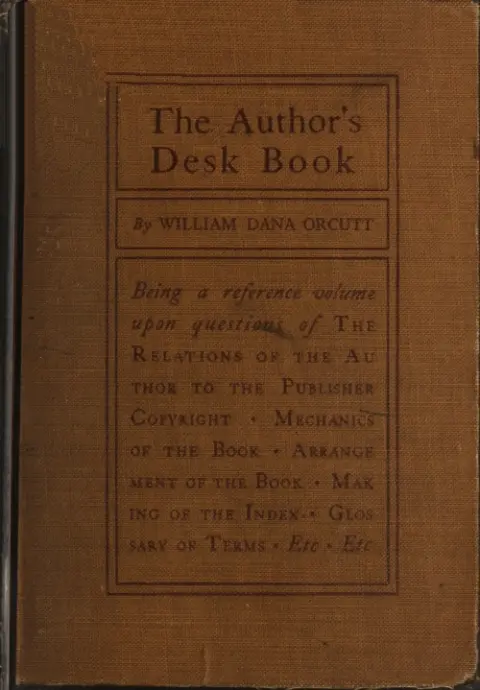
"The Author's Desk Book" by William Dana Orcutt is a reference manual that serves as a comprehensive guide on the relationship between authors and publishers, including aspects of copyright law, manuscript submission, and the mechanics of book production, written in the early 20th century. The book discusses the intricacies involved in publishing, focusing on mutual responsibilities and the importance of cooperation between authors and publishers for successful literary ventures. The opening of this volume introduces the fundamental aspects of the relationships between authors and publishers, highlighting the essential nature of mutual trust and understanding in this often complex interaction. Orcutt emphasizes that while both parties aim for success, misunderstandings can arise due to differences in business acumen, especially since many authors are not well-versed in the intricacies of the publishing industry. He also touches on the role of literary agents and the significance of contracts, underscoring the evolving nature of publishing rights, particularly in light of new media such as film adaptations. Throughout this portion, Orcutt lays the groundwork for a deeper exploration of the practicalities and legalities that govern literary creation and distribution.
Introduction adapted from the source catalogue; source summaries may be automatically generated.
Free to read · English · 39,202 words · No account needed
MAKE TIME FOR A GOOD BOOK
On by default. Untick to stop anonymous reading totals. Each page counts after 10 seconds in view. How this works.
Anonymous counting is on unless you have switched it off.
=Skiver= (b).--The outer or grainside of sheepskin which has been split; much used for binding.
=Slug= (c).--A thick lead.
=Slur= (p).--A blurred impression.
=Small Caps= (c).--Capitals of a smaller size than the regular
capitals of a font.
=Small Pica= (c).--The old name of a size of type equal to 11-point.
=Smooth Calf= (b).--Plain or undecorated calf.
=Sorts= (c).--The letters in the boxes of a case; out of sorts, to be out of any needed letter or character; runs on sorts, when copy calls for more than the usual number of any particular letter.
=Spaces= (c).--The small blanks used to separate words, etc.
=Split Leather= (b).--Leather split by machinery.
=Sprinkled Calf= (b).--Calfskin treated with acid so as to look as if it had been sprinkled with a dye.
=Sprinkled Edges= (b).--Edges of books that are decorated with small dots or specks of color, sprinkled on from a brush.
=Stained Edges= (b).--Edges which are colored by a process of coating or covering which combines with the paper to be colored.
=Stamping Die= (e).--A relief plate engraved on brass or zinc for stamping book covers or similar surfaces.
=Stand= (c).--The common wooden frame with sloping top upon which type cases are placed; the lower part usually has a rack for holding extra cases.
=Steel or Copperplate Engraving= (c).--A method of making plates for printing by cutting, scratching or corroding a plate.
=Stereotype= (g).--The duplicate, cast in one piece of type metal, of the face of types or cuts composed for printing. There are three processes: (a) The plaster process; (b) the clay process; (c) the papier-maché process.
=Stipple= (e).--A method of engraving by which dots or punctures are
used instead of lines.
=Stone Hand= (c).--One who is chiefly employed in imposing, and other
work done on the stone.
=Stone Proof= (e).--(1) An impression taken from an engraved plate or lithographic stone, to prove the condition and progress of the engraving. (2) An impression taken from types or cuts, made up for electrotyping.
=Super= (b).--A thin, loosely woven cotton cloth, glued and starched, which is used for gluing onto the backs of books, to hold the signatures by extending over to the inside of the cover, to hold the book and cover together.
=Super-calendered Paper= (g).--A class of paper to which a glazed surface is given by rolling or calendering.
=Superior Letters or Figures= (c).--Small characters cast on the top of the line, used for footnote references, etc.
=Swash Letters= (c).--The name given to a style of italic capital letters with tails and flourishes, much used in the seventeenth century.
Your reading position is saved on this browser. Take it to another device with a library code. Reading pages adapt to text, rather than matching a printed edition.
William Dana Orcutt
William Dana Orcutt
William Dana Orcutt
William Dana Orcutt
BEHIND THE BOOK
This eBook is for the use of anyone anywhere in the United States and most other parts of the world at no cost and with almost no restrictions whatsoever. You may copy it, give it away or re-use it under the terms of the Project Gutenberg License included with this eBook or online at www.gutenberg.org. If you are not located in the United States, you will have to check the laws of the country where you are located before using this eBook. Read the source licence.
The original source file, including credits and licence, is retained by this library. Request an original-format copy at no charge. Please include the book title and Project Gutenberg identifier #53520.
KEEP YOUR CURIOSITY GOING

Charles G. (Charles Griffith) Ross
Hannah Webster Foster

Emily Lawless
Edwin Hamlin Carr

Charles De Lano Hine
Andrew Ure