THE CLASSIC COLLECTION✦In quest of the perfect bookCLASSIC FREE BOOKS
In quest of the perfect book
William Dana Orcutt
THE CLASSIC COLLECTION · 1914
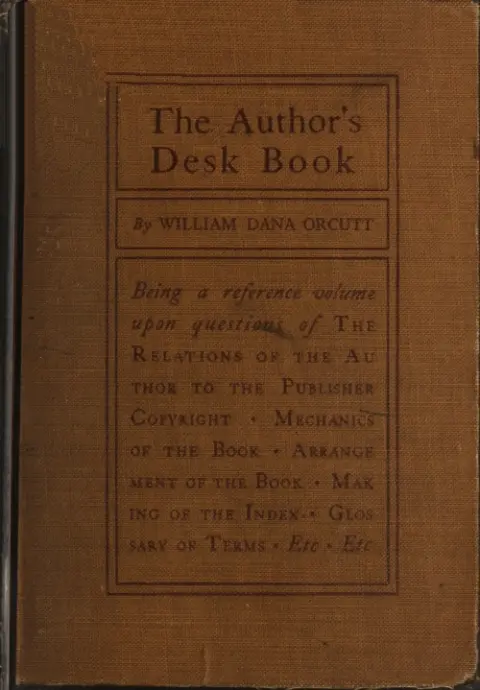
"The Author's Desk Book" by William Dana Orcutt is a reference manual that serves as a comprehensive guide on the relationship between authors and publishers, including aspects of copyright law, manuscript submission, and the mechanics of book production, written in the early 20th century. The book discusses the intricacies involved in publishing, focusing on mutual responsibilities and the importance of cooperation between authors and publishers for successful literary ventures. The opening of this volume introduces the fundamental aspects of the relationships between authors and publishers, highlighting the essential nature of mutual trust and understanding in this often complex interaction. Orcutt emphasizes that while both parties aim for success, misunderstandings can arise due to differences in business acumen, especially since many authors are not well-versed in the intricacies of the publishing industry. He also touches on the role of literary agents and the significance of contracts, underscoring the evolving nature of publishing rights, particularly in light of new media such as film adaptations. Throughout this portion, Orcutt lays the groundwork for a deeper exploration of the practicalities and legalities that govern literary creation and distribution.
Introduction adapted from the source catalogue; source summaries may be automatically generated.
Free to read · English · 39,202 words · No account needed
MAKE TIME FOR A GOOD BOOK
On by default. Untick to stop anonymous reading totals. Each page counts after 10 seconds in view. How this works.
Anonymous counting is on unless you have switched it off.
(f) The title Lady belongs to daughters of all noblemen not lower
than earl.
(g) The title Hon. belongs to daughters of viscounts and barons; also to an untitled woman who becomes a maid-of-honor to the Queen, and this title is retained after she leaves the service. If a woman who has the title Lady becomes maid-of-honor she does not acquire the title Hon.
Index compound names according to the usage of the author's fatherland, though if it is known that his practice differs from this usage, his preference should be followed. Compound names then go:
(a) If English, under the last part of the name, when the first has not been used alone by the author: e.g., Gould, Sabine Baring-; but Halliwell (afterwards Halliwell-Phillipps), J. O., and Locker (afterwards Locker-Lampson), because they are well-known under the first names.
(b) If foreign, under the first part.
Both such compound names as Gentil-Bernard and such as Gentil de Chavagnac. There are various exceptions, when a name has been more known under the last part, as Fénelon, not Salignac de Lamothe Fénelon; Voltaire, not Arouet de Voltaire; Sternberg, not Ungern-Sternberg. Moreover, it is not always easy to determine what is a compound surname in French. Cross-references are necessary whichever way one decides each case, especially when the second part of a foreign compound name has been used alone, as Merle d'Aubigné (index under Merle with a cross-reference from Aubigné).
In French, a forename is sometimes joined to a surname by a hyphen. In such cases make the entry under the family name, with a cross-reference from the forename: e.g., entry, Rochette, Désiré Raoul; cross-reference, Raoul-Rochette, Désiré. See Rochette.
(c) In foreign compound names of women also, although the first part is usually the maiden name and the second the husband's name, the entry should generally be under the first, with a cross-reference from the second[51]: e.g., Rivé-King, with cross-reference from King, born Rivé.
Index surnames preceded by prefixes:
(a) In French and Belgian, under the prefix when it is or contains an article, Le, La, L', Du, Des; under the word following when the prefix is a preposition, de, d': e.g., Des Essarts, Du Cange, La Fontaine, Le Sage, L'Estoille; but Charlevoix, P. F. X. de; Estrées, Mme d'.
La and Le are often, Des is usually, and Les is almost without exception printed as one word with the name following, as Lafontaine, Lesage, Lesdiguières; de and d' are sometimes so printed; when they are, enter under the D: e.g., Debucourt, Decamps, Delisle; but Bucourt, A. de, Camps, C. de, Lisle, J. de.
Your reading position is saved on this browser. Take it to another device with a library code. Reading pages adapt to text, rather than matching a printed edition.
William Dana Orcutt
William Dana Orcutt
William Dana Orcutt
William Dana Orcutt
BEHIND THE BOOK
This eBook is for the use of anyone anywhere in the United States and most other parts of the world at no cost and with almost no restrictions whatsoever. You may copy it, give it away or re-use it under the terms of the Project Gutenberg License included with this eBook or online at www.gutenberg.org. If you are not located in the United States, you will have to check the laws of the country where you are located before using this eBook. Read the source licence.
The original source file, including credits and licence, is retained by this library. Request an original-format copy at no charge. Please include the book title and Project Gutenberg identifier #53520.
KEEP YOUR CURIOSITY GOING

Charles G. (Charles Griffith) Ross
Hannah Webster Foster

Emily Lawless
Edwin Hamlin Carr

Charles De Lano Hine
Andrew Ure