THE CLASSIC COLLECTION✦In quest of the perfect bookCLASSIC FREE BOOKS
In quest of the perfect book
William Dana Orcutt
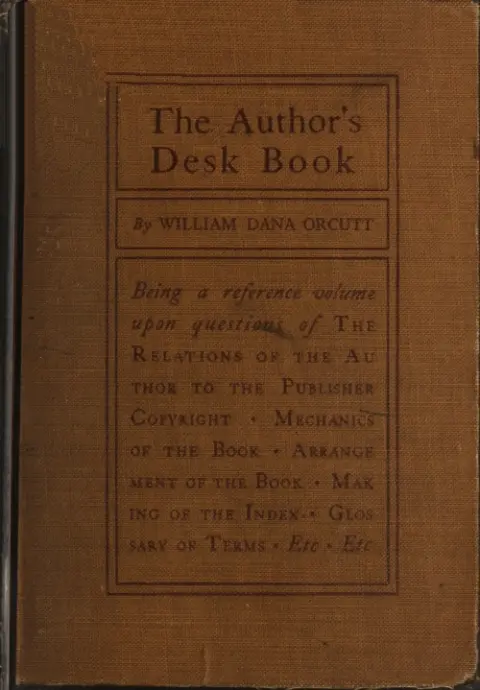
THE CLASSIC COLLECTION · 1914
"The Author's Desk Book" by William Dana Orcutt is a reference manual that serves as a comprehensive guide on the relationship between authors and publishers, including aspects of copyright law, manuscript submission, and the mechanics of book production, written in the early 20th century. The book discusses the intricacies involved in publishing, focusing on mutual responsibilities and the importance of cooperation between authors and publishers for successful literary ventures. The opening of this volume introduces the fundamental aspects of the relationships between authors and publishers, highlighting the essential nature of mutual trust and understanding in this often complex interaction. Orcutt emphasizes that while both parties aim for success, misunderstandings can arise due to differences in business acumen, especially since many authors are not well-versed in the intricacies of the publishing industry. He also touches on the role of literary agents and the significance of contracts, underscoring the evolving nature of publishing rights, particularly in light of new media such as film adaptations. Throughout this portion, Orcutt lays the groundwork for a deeper exploration of the practicalities and legalities that govern literary creation and distribution.
Introduction adapted from the source catalogue; source summaries may be automatically generated.
Free to read · English · 39,202 words · No account needed
MAKE TIME FOR A GOOD BOOK
On by default. Untick to stop anonymous reading totals. Each page counts after 10 seconds in view. How this works.
Anonymous counting is on unless you have switched it off.
=Heading=: the word or words used by the indexer to express the subject or idea. In the examples above, the headings are Boston, Bonnet, Father, Onontio, etc.
=Entry=: the amplification of the Heading, with the addition of the supplementary phrase. In the example above, the entry is Absolutism, contest with liberty, the supplementary phrase being contest with liberty.
=Cross-reference=: a heading referring to an entry: e.g., Michabou.
See Manabozho.
Having settled upon a definite plan, the indexer seats himself at a good-sized table, and lays out his materials in front of him. After testing every possible method, the present writer strongly urges the use of individual slips of paper, about 2½ inches by 4 inches. Arranged within easy reach in front of the indexer, but leaving room for the proof-sheets, should be twenty small pasteboard boxes,[48] a little larger than the slips themselves.[48] On the inside bottom of each box mark a letter of the alphabet, combining O and Q, U and V, and X Y Z. As soon as a slip is written, throw it into its proper box, and continue throughout the work. It is a false economy to search out the slips for subsequent entries, unless they can be easily found, as it is a simple matter at the end to combine the several slips which belong to the same heading.
Here are sample slips, showing a heading which requires full entries and one to which the text contains fewer references. The first shows a slip on which the various entries have been combined:
+-------------------------------------------------------+ | Andastes, the, 5; location and characteristics of, | | 36; synonyms of, 36; plans for converting, 130; | | war with Mohawks, 147; Hurons ask aid from, | | 162; mortal quarrel with Mohawks, 163; promise | | to aid Hurons, 163; Huron fugitives try to reach, | | 240, 250; Mohawks first to bear brunt of war | | with, 268; receive aid from Swedish colonists, 268; | | attack Senecas, 269; courage their only strength | | 270; finally overborne by Senecas, 270. | +-------------------------------------------------------+
This slip shows the method of indexing a work in more than one volume:
+-------------------------------------------------+ | James, Edwin, gives account of Nanabush, i. 67; | | on Indian ideas of another life, ii. 79. | | | | | +-------------------------------------------------+
In the rules which follow, the basis adopted is "Cutter's Rules for a Dictionary Catalogue,"[49] prepared for library cataloguing. Such portion as applies to book indexing has been freely drawn upon, adapted and added to from the present writer's experience.
When, under a single entry, there are both subject-references and references by folios only, place the folio-references together at the end of the entry, following the subject-references.
Arrange entries according to the English alphabet, whatever the order of the alphabet in which a foreign name might have been entered in its original language.
Your reading position is saved on this browser. Take it to another device with a library code. Reading pages adapt to text, rather than matching a printed edition.
William Dana Orcutt
William Dana Orcutt
William Dana Orcutt
William Dana Orcutt
BEHIND THE BOOK
This eBook is for the use of anyone anywhere in the United States and most other parts of the world at no cost and with almost no restrictions whatsoever. You may copy it, give it away or re-use it under the terms of the Project Gutenberg License included with this eBook or online at www.gutenberg.org. If you are not located in the United States, you will have to check the laws of the country where you are located before using this eBook. Read the source licence.
The original source file, including credits and licence, is retained by this library. Request an original-format copy at no charge. Please include the book title and Project Gutenberg identifier #53520.
KEEP YOUR CURIOSITY GOING

Charles G. (Charles Griffith) Ross
Hannah Webster Foster

Emily Lawless
Edwin Hamlin Carr

Charles De Lano Hine
Andrew Ure