THE CLASSIC COLLECTION✦An outlaw’s diary: the CommuneCLASSIC FREE BOOKS
An outlaw’s diary: the Commune
Cécile Tormay
THE CLASSIC COLLECTION · 1916
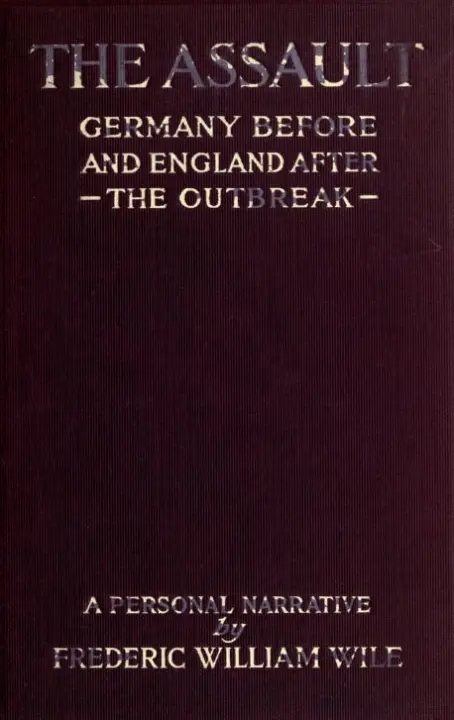
"The Assault: Germany Before the Outbreak and England in War-Time" by Frederic William Wile is a historical account written in the early 20th century. The narrative reflects on Wile's experiences as an American journalist in Germany during the tumultuous period leading up to World War I and his insights into the political climate of Europe during the war. The book explores themes of nationalism, militarism, and the impending conflict from a personal perspective. The opening of the book introduces Wile's intention to document a personal narrative rather than a traditional war account. He details his background as a journalist who has worked in Germany and England, emphasizing his American identity while navigating complex political landscapes. Wile recounts his prior experiences in Berlin and sets the stage for his observations on the relationships and tensions between Germany and the Allies. Through his lens, he reveals the atmosphere of uncertainty and the general sentiment within Germany leading up to the war, hinting at the nuanced perspectives that shaped public opinion and political decisions at the time.
Introduction adapted from the source catalogue; source summaries may be automatically generated.
Free to read · English · 106,041 words · No account needed
MAKE TIME FOR A GOOD BOOK
On by default. Untick to stop anonymous reading totals. Each page counts after 10 seconds in view. How this works.
Anonymous counting is on unless you have switched it off.
The plutocratic peer who ordinarily maintained a "place" at the seashore, an estate in Middlesex or Devon, and a town-house in Berkeley Square had probably long ago handed over the "place" and the estate for military hospital purposes--hardly a mansion or manor-house in England to-day is devoted to any other use--and now retrenchment became for him the order of the day in London, too. His stable of thoroughbreds almost vanished in the early days of the war, for the needs of the cavalry and the artillery were insatiable and undiscriminating, and now his garage was down to a war basis--the most plebeian car he ever drove; the others were in army service either in England or "somewhere in France." Sackville Street and Albemarle Street, Bond Street and Regent Street, where smart clothes and other expensive trinkets for men and women were formerly sold, became deserted. Men's tailors displayed nothing but khaki in their windows, and Paquin's, Redfern's and Worth's languished as if England were famine-blighted. Society faded away as if pestilence had swept Uppertendom into oblivion. Women of Britain's first families were almost ashamed to be seen in anything more chic than the livery of mourning, and by midsummer of 1915 black was pitiably fashionable and omnipresent. "Entertaining" had been a lost art for months. "Going in for it" now seemed and was sacrilege. Indulged at all, it was excusable only if it had the extenuating excuse of having been arranged, and then in the most modest of ways, for one's wounded or recuperating officer friends, back from Hell or on the eve of going there--"somewhere in France." It was war-time in England at last.
If I have seemed to emphasize that the reconstruction of British life, after bitterly hard knocks on land and sea pounded some realization of their task's magnitude into Englishmen's heads, went on chiefly in the upper and upper-middle classes, it is precisely the impression I seek to convey. It is they alone, to date, who have taken the full measure of Britain's terrible emergency and acted accordingly. Even that statement requires qualification, for the fools' paradise is not even to-day inhabited exclusively by the benighted lower strata of the population. Neuve Chapelle, asphyxiating gas and the Lusitania had passed into history a full month before, yet there lingers painfully in my memory the recollection of a country-house week-end party broken up because Englishwomen of "class" objected to hearing a fellow-guest venture the opinion that dear old England would better "wake up" to the fact that calm alone, mighty an asset as it was, could not "march to Berlin" against an enemy like the Germans. These ladies were interesting as types. Their name was legion, and many of them, as an Irishman might say, were men. Common sense, prized of Anglo-Saxon virtues, and tolerance, its twin sister, lost their old-time hold on many millions in these isles during the war. The "Anti-German Union," which was founded by well-meaning noblemen and noblewomen for the purpose of organizing hate of the Teuton and all his works, perhaps set itself an unethical goal, but the psychology at the bottom of the movement was wholesome; it was all to the good, because it was sharpening the bulldog's teeth. It committed uncouth excesses like sending interrupters to the German Church service in Montpelier Place, forgetting that my esteemed friend, the Reverend Mr. Williams, the Anglican chaplain in Berlin, was never prevented from assembling his uninterned flock for worship at St. George's in Montbijou-Platz. Far less excusable than the "Anti-German Union's" super-patriotic eccentricities was the smug intolerance of enormous numbers of British toward elementary questions of the war. They would hear nothing of the Germans unless it was discreditable. I would write in my "Germany Day by Day" column in The Daily Mail that there were growing indications (let us say) that the enemy was still at fighting zenith--his stock of men, materials and provisions still far from exhausted. The next day's post would invariably bring me denunciatory letters from anonymous members of the public. I was "pro-German." I was "a German agent." I was "playing the enemy's game." Englishmen didn't "care to read the twaddle of a man who was still so enamored of the Hun capital where he so long lived." And when I wrote of American exasperation with British shipping practises in war, an English patriot induced my editor to print a letter in retort, "praying passionately for preservation from the candid friend." Other correspondents did not confine their observations to supplication. They were the high privates, these human ostriches, of the Grand Army of Truth-Hiders, who, commanded by great editors in Fleet Street and ably abetted by the Censorship, preferred palatable fiction to iron facts. It is they who kept John Bull lulled in complacent slumber for most of the first year of the war and are doing their diabolical best to administer sleeping-powder even now.
Your reading position is saved on this browser. Take it to another device with a library code. Reading pages adapt to text, rather than matching a printed edition.
BEHIND THE BOOK
This eBook is for the use of anyone anywhere in the United States and most other parts of the world at no cost and with almost no restrictions whatsoever. You may copy it, give it away or re-use it under the terms of the Project Gutenberg License included with this eBook or online at www.gutenberg.org. If you are not located in the United States, you will have to check the laws of the country where you are located before using this eBook. Read the source licence.
The original source file, including credits and licence, is retained by this library. Request an original-format copy at no charge. Please include the book title and Project Gutenberg identifier #41252.
KEEP YOUR CURIOSITY GOING
Cécile Tormay

Moritz Busch
John L. Ransom
Frances Wright
Cécile Tormay

Mabel Potter Daggett