READ · DISCOVER · ENJOYClassic literature · Always free
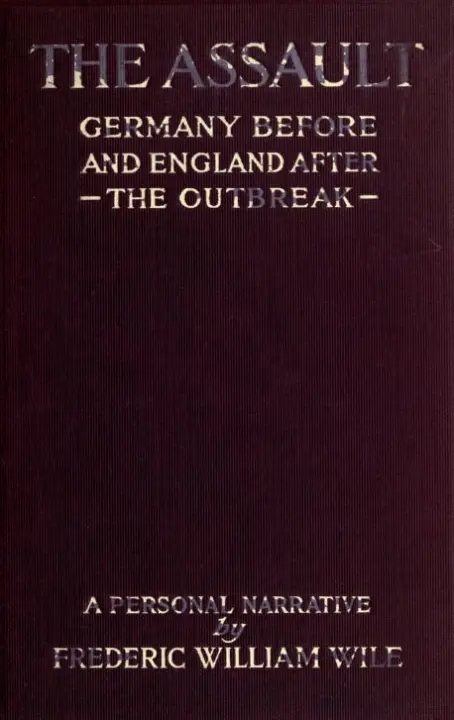
The Assault: Germany Before the Outbreak and England in War-Time — digital edition cover

THE CLASSIC COLLECTION · 1916

The Assault: Germany Before the Outbreak and England in War-Time

"The Assault: Germany Before the Outbreak and England in War-Time" by Frederic William Wile is a historical account written in the early 20th century. The narrative reflects on Wile's experiences as an American journalist in Germany during the tumultuous period leading up to World War I and his insights into the political climate of Europe during the war. The book explores themes of nationalism, militarism, and the impending conflict from a personal perspective. The opening of the book introduces Wile's intention to document a personal narrative rather than a traditional war account. He details his background as a journalist who has worked in Germany and England, emphasizing his American identity while navigating complex political landscapes. Wile recounts his prior experiences in Berlin and sets the stage for his observations on the relationships and tensions between Germany and the Allies. Through his lens, he reveals the atmosphere of uncertainty and the general sentiment within Germany leading up to the war, hinting at the nuanced perspectives that shaped public opinion and political decisions at the time.

Introduction adapted from the source catalogue; source summaries may be automatically generated.

Start reading ↓

Free to read · English · 106,041 words · No account needed

MAKE TIME FOR A GOOD BOOK

The Assault: Germany Before the Outbreak and England in War-Time

On by default. Untick to stop anonymous reading totals. Each page counts after 10 seconds in view. How this works.

Anonymous counting is on unless you have switched it off.

The Assault: Germany Before the Outbreak and England in War-Time

New York was clearly more feverishly interested in the war than London. Nowhere in Fleet Street had I seen such vibrant throngs in front of newspaper-offices, as stood eager and transfixed by day and far into the night in Times and Herald Squares, Columbus Circle and Park Row. America might have been in the fray herself, to judge by the one absorbing topic which dominated men and women's talk and obsessed their thoughts. Detached as we were, it was unmistakable that Europe's agony had eaten deep into our souls, for even the baseball bulletin-boards were now deserted in favor of those which were telling in breathless telegrams of the German cannon-ball plunge through Belgium toward the fatal Marne and of Russia's seemingly irresistible advance into East Prussia. I had heard no Englishman arguing about the issues of Armageddon or the kaleidoscopic events of the battlefield with half the flaming ardor of those Broadway war experts. In fact there were no blackboards at all around which the British could hold curbstone parliaments, for Lord Kitchener's censorship was not parting with news enough, apparently, to make even the chalk worth while. In London I had observed the inexplicable phenomenon that at the moment when hell had broken loose for the British Empire, great journals, instead of deluging the public with news, actually reduced their ordinary size in some cases to four pages, though I believe that fear of a print-paper famine and disappearance of advertising had something to do with those atrophied dimensions. All in all, however, there was no doubt that isolated neutral America was excited about the war to a degree which reduced British interest almost to nonchalance by comparison.

Though I tarried in the East but forty-eight hours, I was conscious of breathing almost exclusively pro-Ally air. President Wilson's neutrality proclamation was being respected in letter, as far as restraining our people from actual breaches in favor of either belligerent group was concerned, but every minute of the day, everywhere, it was being vociferously violated in spirit. Before the war was a month old, Americans already were confessing freely that they were so "neutral" that they didn't care who won as long as Germany was "licked." They resigned themselves to the Chief Magistrate's dictum that the country as such must be guilty of no "un-neutral" acts, but it failed lamentably to still the natural instincts of American hearts which were beating fervently, irresistibly, for the Allies. Bernstorff's hour-by-hour interviews, apologies and explanations, Muensterberg's homilies, The Fatherland's vituperations, the New-Yorker Staatszeitung's editorials in English signed by Ridder and "boiler-plated" to any newspapers which would give them space, "fair play" appeals from obsequious ex-Berlin exchange-professors like Dean Burgess of Columbia--all these things fell on deaf ears. None of them could obliterate the crime of Germany, which loomed ineradicable on the war horizon as Americans scanned it--Belgium. All the instincts of American justice, liberty, humanity and regard for treaty obligations rebelled against "Necessity-knows-no-law" and "scrap of paper" ethics. We had gone to war ourselves, in 1898, to defend the rights of a small nation. The spectacle of Military Germany trampling little Belgium under foot, causelessly, mercilessly, was enough, had there been no other single issue to enlist our sympathy, to vouchsafe it, whole-heartedly, to the nations which were leagued in support of the old-fashioned principle that Right is nobler than Might. Thus was America's mind attuned in August, 1914, and at least in the opinion-molding area of the country which lies between the seaboard and the line where the Middle West begins, that mind was, with American predilection for reaching right conclusions spontaneously, irrevocably made up. The attempts of the Propaganda Steam-Roller to flatten out the anti-German prejudices provoked by the rape of Belgium were frantic, but fruitless. The pre-digested baby food which pedagogues and demagogues, ambassadors, brewers and rabbis now began to ladle out for American consumption did not temper those prejudices. Indeed, it was manifest that it was but aggravating them. Our own General Brooke, attending the German army maneuvers in Silesia eight or nine years ago, was asked by the Kaiser if he had ever been in Germany before. "Never in this part," remarked Brooke. "Where, then?" persisted William II. "In Cincinnati, Chicago and Milwaukee," replied the general. I was about to enter "that part" of Germany now. I was not there long before realizing that pro-Ally sentiment was immeasurably less assertive, at any rate, than in the outspokenly pro-Ally East. Chicago, of course, has more Germans than Duesseldorf, and Cincinnati and Milwaukee, in spots, are as Teutonic as Hamburg or Bremen, so it was natural to find Deutschland, Deutschland ueber Alles more than disputing supremacy with Rule Britannia. In Chicago pro-Germanism was rampant and articulate. An article written by me for the Chicago Tribune in the first fortnight of September, in which I ventured to express my opinion as to where the responsibility for the war lay, how long it would last and who would win it, brought down on me as violent a torrent of abuse as if it had been published in the Berliner Tageblatt. For saying that, in my judgment, the German War Party had made the war; that it would go on till Germany was beaten to her knees, and that eventual exhaustion of the Germanic Powers and the longer resources of the Allies would win the war for the latter, I became forthwith the target of all the forty-two-centimeter guns in the Windy City.

Your reading position is saved on this browser. Take it to another device with a library code. Reading pages adapt to text, rather than matching a printed edition.

BEHIND THE WORDS

About Frederic William Wile

Frederic William Wile (1873–1941). Explore The Assault: Germany Before the Outbreak and England in War-Time in this collection. These books span history.

Explore this author’s books →

THE READERS’ VERDICT

How did this story stay with you?

Not rated yet
Your rating for The Assault: Germany Before the Outbreak and England in War-Time

Be the first to share your verdict.

One rating per browser, which you can change or remove. A necessary browser identifier remembers your vote. How ratings work

A GOOD STORY DESERVES COMPANY

Pass this book along.

A great read is even better when it’s shared.

SEND A LITTLE INSPIRATION

Share this book

BEHIND THE BOOK

Edition & source details.

Title
The Assault: Germany Before the Outbreak and England in War-Time
Author
Frederic William Wile
Publication year
1916
Digital edition publisher
Project Gutenberg
Gutenberg release date
2012-10-31
Language
English
Source edition imprint
Not stated in source catalogue
Source identifier
Project Gutenberg #41252
Contributors
No additional named contributors in source metadata

Public-domain source & licence

This eBook is for the use of anyone anywhere in the United States and most other parts of the world at no cost and with almost no restrictions whatsoever. You may copy it, give it away or re-use it under the terms of the Project Gutenberg License included with this eBook or online at www.gutenberg.org. If you are not located in the United States, you will have to check the laws of the country where you are located before using this eBook. Read the source licence.

Full source licence and obtaining an original copy

The original source file, including credits and licence, is retained by this library. Request an original-format copy at no charge. Please include the book title and Project Gutenberg identifier #41252.

the full Project Gutenberg License must appear
prominently whenever any copy of a Project Gutenberg work (any work
on which the phrase “Project Gutenberg” appears, or with which the
phrase “Project Gutenberg” is associated) is accessed, displayed,
performed, viewed, copied or distributed:

This eBook is for the use of anyone anywhere in the United States and most
other parts of the world at no cost and with almost no restrictions
whatsoever. You may copy it, give it away or re-use it under the terms
of the Project Gutenberg™ License included with this eBook or online
at www.gutenberg.org. If you
are not located in the United States, you will have to check the laws
of the country where you are located before using this eBook.

1.E.2. If an individual Project Gutenberg electronic work is
derived from texts not protected by U.S. copyright law (does not
contain a notice indicating that it is posted with permission of the
copyright holder), the work can be copied and distributed to anyone in
the United States without paying any fees or charges. If you are
redistributing or providing access to a work with the phrase “Project
Gutenberg” associated with or appearing on the work, you must comply
either with the requirements of paragraphs 1.E.1 through 1.E.7 or
obtain permission for the use of the work and the Project Gutenberg
trademark as set forth in paragraphs 1.E.8 or 1.E.9.

1.E.3. If an individual Project Gutenberg electronic work is posted
with the permission of the copyright holder, your use and distribution
must comply with both paragraphs 1.E.1 through 1.E.7 and any
additional terms imposed by the copyright holder. Additional terms
will be linked to the Project Gutenberg License for all works
posted with the permission of the copyright holder found at the
beginning of this work.

1.E.4. Do not unlink or detach or remove the full Project Gutenberg
License terms from this work, or any files containing a part of this
work or any other work associated with Project Gutenberg.

1.E.5. Do not copy, display, perform, distribute or redistribute this
electronic work, or any part of this electronic work, without
prominently displaying the sentence set forth in paragraph 1.E.1 with
active links or immediate access to the full terms of the Project
Gutenberg License.

1.E.6. You may convert to and distribute this work in any binary,
compressed, marked up, nonproprietary or proprietary form, including
any word processing or hypertext form. However, if you provide access
to or distribute copies of a Project Gutenberg work in a format
other than “Plain Vanilla ASCII” or other format used in the official
version posted on the official Project Gutenberg website
(www.gutenberg.org), you must, at no additional cost, fee or expense
to the user, provide a copy, a means of exporting a copy, or a means
of obtaining a copy upon request, of the work in its original “Plain
Vanilla ASCII” or other form. Any alternate format must include the
full Project Gutenberg License as specified in paragraph 1.E.1.

1.E.7. Do not charge a fee for access to, viewing, displaying,
performing, copying or distributing any Project Gutenberg works
unless you comply with paragraph 1.E.8 or 1.E.9.

1.E.8. You may charge a reasonable fee for copies of or providing
access to or distributing Project Gutenberg electronic works
provided that:

• You pay a royalty fee of 20% of the gross profits you derive from
the use of Project Gutenberg works calculated using the method
you already use to calculate your applicable taxes. The fee is owed
to the owner of the Project Gutenberg trademark, but he has
agreed to donate royalties under this paragraph to the Project
Gutenberg Literary Archive Foundation. Royalty payments must be paid
within 60 days following each date on which you prepare (or are
legally required to prepare) your periodic tax returns. Royalty
payments should be clearly marked as such and sent to the Project
Gutenberg Literary Archive Foundation at the address specified in
Section 4, “Information about donations to the Project Gutenberg
Literary Archive Foundation.”

• You provide a full refund of any money paid by a user who notifies
you in writing (or by e-mail) within 30 days of receipt that s/he
does not agree to the terms of the full Project Gutenberg™
License. You must require such a user to return or destroy all
copies of the works possessed in a physical medium and discontinue
all use of and all access to other copies of Project Gutenberg™
works.

• You provide, in accordance with paragraph 1.F.3, a full refund of
any money paid for a work or a replacement copy, if a defect in the
electronic work is discovered and reported to you within 90 days of
receipt of the work.

• You comply with all other terms of this agreement for free
distribution of Project Gutenberg™ works.


1.E.9. If you wish to charge a fee or distribute a Project
Gutenberg™ electronic work or group of works on different terms than
are set forth in this agreement, you must obtain permission in writing
from the Project Gutenberg Literary Archive Foundation, the manager of
the Project Gutenberg™ trademark. Contact the Foundation as set
forth in Section 3 below.

1.F.

1.F.1. Project Gutenberg volunteers and employees expend considerable
effort to identify, do copyright research on, transcribe and proofread
works not protected by U.S. copyright law in creating the Project
Gutenberg™ collection. Despite these efforts, Project Gutenberg™
electronic works, and the medium on which they may be stored, may
contain “Defects,” such as, but not limited to, incomplete, inaccurate
or corrupt data, transcription errors, a copyright or other
intellectual property infringement, a defective or damaged disk or
other medium, a computer virus, or computer codes that damage or
cannot be read by your equipment.

1.F.2. LIMITED WARRANTY, DISCLAIMER OF DAMAGES - Except for the “Right
of Replacement or Refund” described in paragraph 1.F.3, the Project
Gutenberg Literary Archive Foundation, the owner of the Project
Gutenberg™ trademark, and any other party distributing a Project
Gutenberg™ electronic work under this agreement, disclaim all
liability to you for damages, costs and expenses, including legal
fees. YOU AGREE THAT YOU HAVE NO REMEDIES FOR NEGLIGENCE, STRICT
LIABILITY, BREACH OF WARRANTY OR BREACH OF CONTRACT EXCEPT THOSE
PROVIDED IN PARAGRAPH 1.F.3. YOU AGREE THAT THE FOUNDATION, THE
TRADEMARK OWNER, AND ANY DISTRIBUTOR UNDER THIS AGREEMENT WILL NOT BE
LIABLE TO YOU FOR ACTUAL, DIRECT, INDIRECT, CONSEQUENTIAL, PUNITIVE OR
INCIDENTAL DAMAGES EVEN IF YOU GIVE NOTICE OF THE POSSIBILITY OF SUCH
DAMAGE.

1.F.3. LIMITED RIGHT OF REPLACEMENT OR REFUND - If you discover a
defect in this electronic work within 90 days of receiving it, you can
receive a refund of the money (if any) you paid for it by sending a
written explanation to the person you received the work from. If you
received the work on a physical medium, you must return the medium
with your written explanation. The person or entity that provided you
with the defective work may elect to provide a replacement copy in
lieu of a refund. If you received the work electronically, the person
or entity providing it to you may choose to give you a second
opportunity to receive the work electronically in lieu of a refund. If
the second copy is also defective, you may demand a refund in writing
without further opportunities to fix the problem.

1.F.4. Except for the limited right of replacement or refund set forth
in paragraph 1.F.3, this work is provided to you ‘AS-IS’, WITH NO
OTHER WARRANTIES OF ANY KIND, EXPRESS OR IMPLIED, INCLUDING BUT NOT
LIMITED TO WARRANTIES OF MERCHANTABILITY OR FITNESS FOR ANY PURPOSE.

1.F.5. Some states do not allow disclaimers of certain implied
warranties or the exclusion or limitation of certain types of
damages. If any disclaimer or limitation set forth in this agreement
violates the law of the state applicable to this agreement, the
agreement shall be interpreted to make the maximum disclaimer or
limitation permitted by the applicable state law. The invalidity or
unenforceability of any provision of this agreement shall not void the
remaining provisions.

1.F.6. INDEMNITY - You agree to indemnify and hold the Foundation, the
trademark owner, any agent or employee of the Foundation, anyone
providing copies of Project Gutenberg™ electronic works in
accordance with this agreement, and any volunteers associated with the
production, promotion and distribution of Project Gutenberg™
electronic works, harmless from all liability, costs and expenses,
including legal fees, that arise directly or indirectly from any of
the following which you do or cause to occur: (a) distribution of this
or any Project Gutenberg work, (b) alteration, modification, or
additions or deletions to any Project Gutenberg work, and (c) any
Defect you cause.

Section 2. Information about the Mission of Project Gutenberg

Project Gutenberg is synonymous with the free distribution of
electronic works in formats readable by the widest variety of
computers including obsolete, old, middle-aged and new computers. It
exists because of the efforts of hundreds of volunteers and donations
from people in all walks of life.

Volunteers and financial support to provide volunteers with the
assistance they need are critical to reaching Project Gutenberg’s
goals and ensuring that the Project Gutenberg collection will
remain freely available for generations to come. In 2001, the Project
Gutenberg Literary Archive Foundation was created to provide a secure
and permanent future for Project Gutenberg and future
generations. To learn more about the Project Gutenberg Literary
Archive Foundation and how your efforts and donations can help, see
Sections 3 and 4 and the Foundation information page at www.gutenberg.org.

Section 3. Information about the Project Gutenberg Literary Archive Foundation

The Project Gutenberg Literary Archive Foundation is a non-profit
501(c)(3) educational corporation organized under the laws of the
state of Mississippi and granted tax exempt status by the Internal
Revenue Service. The Foundation’s EIN or federal tax identification
number is 64-6221541. Contributions to the Project Gutenberg Literary
Archive Foundation are tax deductible to the full extent permitted by
U.S. federal laws and your state’s laws.

The Foundation’s business office is located at 41 Watchung Plaza #516,
Montclair NJ 07042, USA, +1 (862) 621-9288. Email contact links and up
to date contact information can be found at the Foundation’s website
and official page at www.gutenberg.org/contact

Section 4. Information about Donations to the Project Gutenberg
Literary Archive Foundation

Project Gutenberg™ depends upon and cannot survive without widespread
public support and donations to carry out its mission of
increasing the number of public domain and licensed works that can be
freely distributed in machine-readable form accessible by the widest
array of equipment including outdated equipment. Many small donations
($1 to $5,000) are particularly important to maintaining tax exempt
status with the IRS.

The Foundation is committed to complying with the laws regulating
charities and charitable donations in all 50 states of the United
States. Compliance requirements are not uniform and it takes a
considerable effort, much paperwork and many fees to meet and keep up
with these requirements. We do not solicit donations in locations
where we have not received written confirmation of compliance. To SEND
DONATIONS or determine the status of compliance for any particular state
visit www.gutenberg.org/donate.

While we cannot and do not solicit contributions from states where we
have not met the solicitation requirements, we know of no prohibition
against accepting unsolicited donations from donors in such states who
approach us with offers to donate.

International donations are gratefully accepted, but we cannot make
any statements concerning tax treatment of donations received from
outside the United States. U.S. laws alone swamp our small staff.

Please check the Project Gutenberg web pages for current donation
methods and addresses. Donations are accepted in a number of other
ways including checks, online payments and credit card donations. To
donate, please visit: www.gutenberg.org/donate.

Section 5. General Information About Project Gutenberg electronic works

Professor Michael S. Hart was the originator of the Project
Gutenberg concept of a library of electronic works that could be
freely shared with anyone. For forty years, he produced and
distributed Project Gutenberg eBooks with only a loose network of
volunteer support.

Project Gutenberg eBooks are often created from several printed
editions, all of which are confirmed as not protected by copyright in
the U.S. unless a copyright notice is included. Thus, we do not
necessarily keep eBooks in compliance with any particular paper
edition.

Most people start at our website which has the main PG search
facility: www.gutenberg.org.

This website includes information about Project Gutenberg,
including how to make donations to the Project Gutenberg Literary
Archive Foundation, how to help produce our new eBooks, and how to
subscribe to our email newsletter to hear about new eBooks.


KEEP YOUR CURIOSITY GOING

Your next chapter awaits.