THE CLASSIC COLLECTION✦Military and religious life in the Middle Ages and at the period of the RenaissanceCLASSIC FREE BOOKS
Military and religious life in the Middle Ages and at the period of the Renaissance
P. L. Jacob
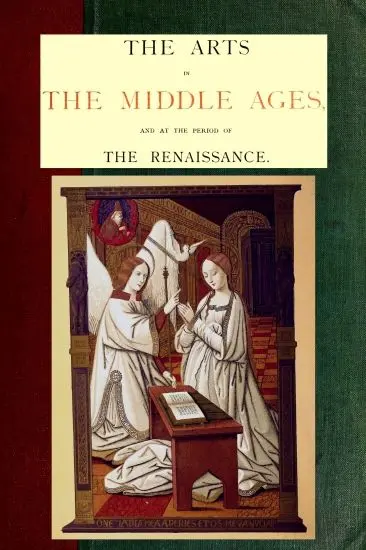
THE CLASSIC COLLECTION · 1870
"The Arts in the Middle Ages and at the Period of the Renaissance" by Paul Lacroix is a historical account written in the mid-19th century. The work explores the evolution and significance of various art forms during the Middle Ages and Renaissance periods, detailing their cultural impacts and the craftsmanship involved. The book aims to present a comprehensive overview of artistic traditions, ranging from architecture to decorative arts. At the start of this book, the author outlines his ambitious project, focusing on the transition of art from the Middle Ages—characterized by a spiritual and often rugged aesthetic—to the flourishing creativity of the Renaissance, which embraced classical ideals of beauty and form. Lacroix delves into the origins of furniture used in this era, discussing the transformation from simple materials to ornate craftsmanship as society evolved from a state of barbarism to one of prosperity and cultural richness. He introduces themes of ornamentation, the influence of various cultures, and the societal changes that prompted new artistic expressions, making it clear that the arts serve as a reflection of historical developments.
Introduction adapted from the source catalogue; source summaries may be automatically generated.
Free to read · English · 138,786 words · No account needed
MAKE TIME FOR A GOOD BOOK
On by default. Untick to stop anonymous reading totals. Each page counts after 10 seconds in view. How this works.
Anonymous counting is on unless you have switched it off.
But although it embraced within its influence a very extended sphere, the school of Burgundy did not fail to find on the ancient Gallic soil very skilful and industrious rivals. The districts of Messin, Lorraine, Alsace, Champagne, Normandy, and the Ile-de-France, in short all the various centres of the South, possessed numerous artists, each of whom impressed on their works their own special character of individuality.
While all this activity was prevailing in France, Italy had as yet taken so insignificant a part in the revival of Art, that in 976 Peter Orseolo, Doge of Venice, having formed the idea of rebuilding the basilica of St. Mark, was compelled to summon from Constantinople both architects and artists.
A period of check to any progress took place in France, however, just as in all the rest of Europe, when, at the approach of the year 1000, the whole population became subject to an ideal dread that the end of the world was at hand; but when this date was once passed, every school of art set vigorously to work, and the most remarkable monuments of Romanesque architecture sprang up throughout Europe in every direction.
Then it was that the artists of Burgundy built and ornamented, among other churches and monasteries, the Abbey of Cluny, the apse of which consisted of a bold cupola, supported by six columns thirty-six feet in height, of
Cipolin and Pentelican marble, with captials, cornices, and friezes, carved painted, and decorated with bronze. In Lorraine they worked at the cathedrals of Toul and Verdun, and the abbey of St. Viton. In the diocese of Metz Gontran and Adélard, celebrated abbots of St. Trudon, covered Hasbaye with new buildings. “Adélard,” says a chronicler, “superintended the construction of fourteen churches, and his outlay was so great that the imperial treasury would scarcely have sufficed for it.” In Alsace, the cathedral at Strasbourg and the two churches of Colmar and Schelestadt simultaneously arose, and in Switzerland the Cathedral of Basle. These magnificent edifices are still standing to show the vigour and majestic simplicity with which the art of sculpture was then able to embody its ideas; and, by lending its aid to architecture, to manifest, so to speak, the faith which actuated it. It was in this century that Fulbert, Bishop of Chartres, who was doubtless a sculptor also, superintended the restoration of his church, the splendour of which is still open to the admiration of all. Art, too, did not less distinguish herself in the decoration of certain additions made at that time to edifices already existing. The doorways of the churches of Laon, Châteaudun, and St. Ayoult of Provins, grand works of the earliest years of the twelfth century, yield the palm only to the splendid external ornamentation of the Abbey of St. Denis, executed between the years 1137 and 1180. The Abbot Suger, who was himself an eminent artist, does not name any of the sculptors to whose care this important task was committed. We are equally ignorant as to the sculptors of the statues of Dagobert and of Queen Nanthilde, his wife; and also as to the artists of a large golden crucifix, the foot of which was enriched with bas-reliefs, and the figure of Christ, that presented, says Suger, “an expression really divine.” The names of the sculptors of the cathedral church of Paris are likewise concealed from our admiration. One might suppose that a body of artists fired with the same inspiration, and with a common sentiment both in thought and action, had there assembled to design their works; some sculpturing in marble the sarcophagus of Philip of France; some peopling the rood-loft and the apse with tall figures and a long gallery of Biblical subjects; others decorating the façade and exterior with statues, all of every diversified character, but yet all appearing to unite in the expression of the same feelings and the same faith (Fig. 279).
Your reading position is saved on this browser. Take it to another device with a library code. Reading pages adapt to text, rather than matching a printed edition.
P. L. Jacob
P. L. Jacob
BEHIND THE BOOK
This eBook is for the use of anyone anywhere in the United States and most other parts of the world at no cost and with almost no restrictions whatsoever. You may copy it, give it away or re-use it under the terms of the Project Gutenberg License included with this eBook or online at www.gutenberg.org. If you are not located in the United States, you will have to check the laws of the country where you are located before using this eBook. Read the source licence.
The original source file, including credits and licence, is retained by this library. Request an original-format copy at no charge. Please include the book title and Project Gutenberg identifier #59924.
KEEP YOUR CURIOSITY GOING
Cécile Tormay

Moritz Busch
John L. Ransom
Frances Wright
Cécile Tormay

Mabel Potter Daggett