THE CLASSIC COLLECTION✦Military and religious life in the Middle Ages and at the period of the RenaissanceCLASSIC FREE BOOKS
Military and religious life in the Middle Ages and at the period of the Renaissance
P. L. Jacob
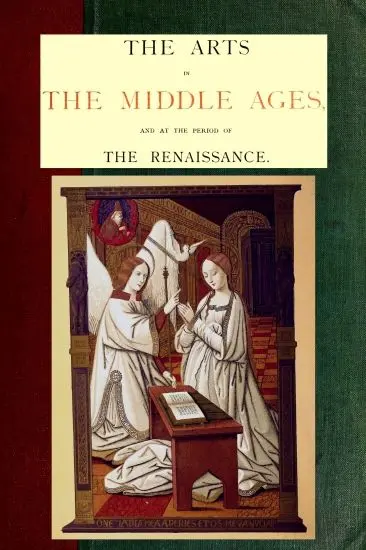
THE CLASSIC COLLECTION · 1870
"The Arts in the Middle Ages and at the Period of the Renaissance" by Paul Lacroix is a historical account written in the mid-19th century. The work explores the evolution and significance of various art forms during the Middle Ages and Renaissance periods, detailing their cultural impacts and the craftsmanship involved. The book aims to present a comprehensive overview of artistic traditions, ranging from architecture to decorative arts. At the start of this book, the author outlines his ambitious project, focusing on the transition of art from the Middle Ages—characterized by a spiritual and often rugged aesthetic—to the flourishing creativity of the Renaissance, which embraced classical ideals of beauty and form. Lacroix delves into the origins of furniture used in this era, discussing the transformation from simple materials to ornate craftsmanship as society evolved from a state of barbarism to one of prosperity and cultural richness. He introduces themes of ornamentation, the influence of various cultures, and the societal changes that prompted new artistic expressions, making it clear that the arts serve as a reflection of historical developments.
Introduction adapted from the source catalogue; source summaries may be automatically generated.
Free to read · English · 138,786 words · No account needed
MAKE TIME FOR A GOOD BOOK
On by default. Untick to stop anonymous reading totals. Each page counts after 10 seconds in view. How this works.
Anonymous counting is on unless you have switched it off.
In truth, Galileo had not yet arrived to observe and formulate the laws of the pendulum, which Huygens was happily to apply to the movements of horology.
Music in the Middle Ages.--Musical Instruments from the Fourth to the Thirteenth Century.--Wind Instruments: the Single and Double Flute, the Pandean Pipes, the Reed-pipe, the Hautboy, the Flageolet, Trumpets, Horns, Olifants, the Hydraulic Organ, the Bellows-Organ.--Instruments of Percussion: the Bell, the Hand-bell, Cymbals, the Timbrel, the Triangle, the Bombulum, Drums.--Stringed Instruments: the Lyre, the Cithern, the Harp, the Psaltery, the Nable, the Chorus, the Organistrum, the Lute and the Guitar, the Crout, the Rote, the Viola, the Gigue, the Monochord.
The history of Music in the Middle Ages would commence about the fourth century of our era. In the sixth century, Isidore of Seville, in his “Sentiments sur la Musique,” writes as follows:--“Music is a modulation of the voice, and also an accordance of several sounds and their simultaneous union.”
About 384, St. Ambrose, who built the Cathedral of Milan, regulated the mode in which psalms, hymns, and anthems should be performed, by selecting from Greek chants those melodies he considered best adapted to the Latin Church.
In 590, Gregory the Great, in order to remedy the disorder which had crept into ecclesiastical singing, collected all that remained of the ancient Greek melodies, with those of St. Ambrose and others, and formed the antiphonary which is called the Centonien, because it is composed of chants of his selection. Henceforward, ecclesiastical chanting obtained the name of Gregorian; it was adopted into the whole of the Western Church, and maintained its position almost unaltered down to the middle of the eleventh century.
It is thought that originally the music of the antiphonary was noted in accordance with Greek and Roman usage--a notation known as the Boethian, from the name of Boethius the philosopher, by whom we are informed that in his time (that is, about the end of the fifth century) the notation was composed of the first fifteen letters of the alphabet.
The sounds of the octave were represented--the major by capital letters, the minor by small letters, as follows:--
Major mode A B C D E F G
Minor mode a b c d e f g
Some fragments of music of the eleventh century are still preserved, in which the notation is represented by letters having above them the signs of another kind of notation called neumes (Fig. 154).
Musical Notation expressed in Modern Signs, the Text and Translation of the Lament on Charlemagne.
Your reading position is saved on this browser. Take it to another device with a library code. Reading pages adapt to text, rather than matching a printed edition.
P. L. Jacob
P. L. Jacob
BEHIND THE BOOK
This eBook is for the use of anyone anywhere in the United States and most other parts of the world at no cost and with almost no restrictions whatsoever. You may copy it, give it away or re-use it under the terms of the Project Gutenberg License included with this eBook or online at www.gutenberg.org. If you are not located in the United States, you will have to check the laws of the country where you are located before using this eBook. Read the source licence.
The original source file, including credits and licence, is retained by this library. Request an original-format copy at no charge. Please include the book title and Project Gutenberg identifier #59924.
KEEP YOUR CURIOSITY GOING
Cécile Tormay

Moritz Busch
John L. Ransom
Frances Wright
Cécile Tormay

Mabel Potter Daggett