THE CLASSIC COLLECTION✦The story of CairoCLASSIC FREE BOOKS
The story of Cairo
Stanley Lane-Poole
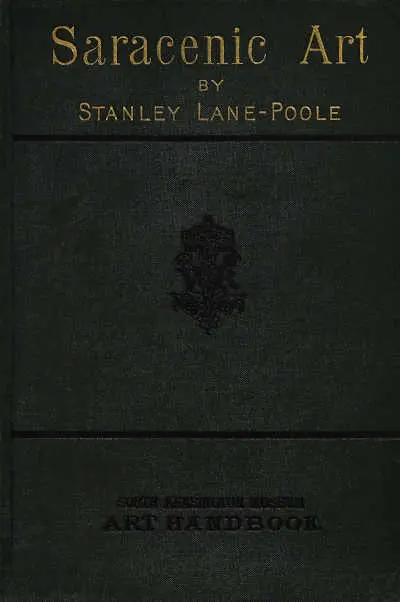
THE CLASSIC COLLECTION · 1888
The art of the Saracens in Egypt by Stanley Lane-Poole. Explore this classic work in a free online edition. Subjects include Art -- Egypt; Islamic civilization; Egypt -- Kings and rulers; Islamic art -- Egypt. Read the locally hosted text below, adjust the reading display, and continue where you left off.
Introduction adapted from the source catalogue; source summaries may be automatically generated.
Free to read · English · 82,515 words · No account needed
MAKE TIME FOR A GOOD BOOK
On by default. Untick to stop anonymous reading totals. Each page counts after 10 seconds in view. How this works.
Anonymous counting is on unless you have switched it off.
As has been already said, there is but one source to which these remarkable carvings can be traced. The artists who engraved the hunting scenes, the water-fowl, the drinking-bouts, of the bowls and other vessels of bronze and brass made at Mōsil or in the neighbouring cities—the artists, in short, who had inherited the traditions of animal design from the workmen of the Sassanians, the Parthians, and the Assyrians, these were the men who inspired, if they did not actually execute the carved panels of Kalaūn. The birds face to face refer no doubt to the cockfights which the Persians included among their favourite sports, and the adoption of the duck instead of the cock has its explanation in the name of the Sultan for whose hospital these panels were carved; for Kalaūn was a slave from Kipchak, and his name means “duck” in his native Tartar tongue. It is strange that so admirable a style of decoration did not find wider acceptance among the founders and architects of mosques in Cairo. No near parallel to these carvings of Kalaūn can be found in any mosque of the period, still less in any of later date. A few pieces carved with parrots and peacocks have been noticed, but these, since they are separated from their original surroundings, may have come from the same source as the panels still remaining at the Māristān of Kalaūn.
It is perhaps rash to speculate upon the causes which led to the sudden adoption and as sudden abandonment of a remarkable and characteristic style of carving; but in the present case there is some evidence that may help us to an explanation. In the chapter on metal-work we shall have to describe a similar sequence of adoption and abandonment with respect to the figured style of Mōsil, which closely resembles the style of Kalaūn’s carvings. The chased bowls and caskets, covered with representations of hunting and drinking scenes, beasts of the chase, and the like, made their appearance in Cairo about the end of the first quarter of the thirteenth century, so far as existing specimens allow us to judge. The style was brought from Mesopotamia by the princes of the family of Ayyūb, of which Saladin was the most celebrated member. The Ayyūbis passed through the country watered by the Tigris and Euphrates before they arrived in Syria, or attempted to worm themselves into the sovereignty of Egypt. Saladin and his kinsmen were the officers of the great Sultan Nūr-ed-dīn, of Aleppo and Damascus, who came of the stock of the Beny Zenky of Mōsil. The Beny Zenky had been among the earliest to adopt the novelty of a figured coinage: they adorned their money with the saints and holy personages of the Byzantine coinage, or with symbols taken from Persian astrology, in place of the sternly simple inscriptions which covered the faces of the coins of the orthodox Khalifate. These innovations were carried into Syria by Nūr-ed-dīn, who entertained as few prejudices on the subject of representations of living things as the rest of the Kurdish and Tartar princes, who now ruled the best provinces of the Khalifs of Baghdād. Saladin (though a very pious and orthodox prince) brought the heretical novelty to Cairo, where he carved his own cognizance, an eagle,[45] on the wall of the Citadel which he built on a spur of Mount Mukattam. There is a brass and silver casket of Saladin’s grandnephew in the South Kensington Museum, covered with figures of huntsmen, &c., which shows that the Ayyūby kings of Egypt continued to patronize the art introduced by their great kinsman. So, too, the earlier Mamlūks found no spiritual injury to result from the representation of men and animals on their cups and perfume-burners, their trays and bowls. Evidence of this will be found in the chapter on metal-work; and the lion, the cognizance of Beybars, the most powerful of the early Mamlūk Sultans, occurring on coins, doors, and walls, shows that this indifference to a minor regulation of the Arabian prophet extended to more forms of art than one. Beybars’ lions or chītahs on his coins and bronze mosque doors, Beysary’s eagles on his perfume-burner, El-Ādil’s hunting-scenes on his coffret, Kalaūn’s centaurs and drinking-bouts on his hospital doors, all point to a general acquiescence for awhile in this flagrant disregard of what had always been held a binding precept in Islām. But with the reign of En- Nāsir, Kalaūn’s son, a new style of metal-work came into fashion: rosettes of flowers and leaves, arabesques, and scrolls, and the rest of the legitimate materials of the Mohammadan artist, obtained a hold on Cairo work in all branches that was never again lost. At precisely the same time, the figured carving, which seemed to promise so fine a field for mosque and palace decoration, was abandoned in favour of the small carved and inlaid arabesque panels, which have already been examined in detail. It is not unreasonable to ascribe the change in the wood-work to the same cause as that which operated in the metal-work; and this seems to have been natural enough. The barbarous Kurds and Tartars, who had swarmed over the lands of the Khalifate, and entered Egypt, might for a while, by dint of sheer imperious insistance, make a form of art popular which was nevertheless unorthodox; but as the barbarians settled down in the cities of the Muslims, which they did so much to beautify, they must have gradually become assimilated to the people they governed, and their first ignorant indifference about so vital a part of religion as the prohibition of images of animate things must have given place to a proper iconoclastic feeling, or at least they must have learned to weigh more accurately the sentiments of the pious on the subject. Thus the imported art of figure carving, which was the temporary protégé of the Tartar princes, before they knew better, gave place to the arabesque and geometrical ornament which had long before been settled upon as most consonant with the letter and spirit of Mohammad’s precept. The figure art was foreign to Cairo; it was heretical; and it was little suited to the small panelling which was a condition of the carver’s art in so hot a climate: the large panels of Kalaūn’s doors have suffered severely from the heat, and the size is against all the precautions of joinery in hot climates. On the other hand, carved panelling, in small sizes, worked into intricate geometrical patterns, formed the native art of Cairo, was exactly adapted to the conditions of climate, and offended no law of God or man. It was clear that the figure carving had no chance against so well accredited a rival.
Your reading position is saved on this browser. Take it to another device with a library code. Reading pages adapt to text, rather than matching a printed edition.
Stanley Lane-Poole
Stanley Lane-Poole
Stanley Lane-Poole & J. D. Jerrold (James Douglas Jerrold) Kelley
BEHIND THE BOOK
This eBook is for the use of anyone anywhere in the United States and most other parts of the world at no cost and with almost no restrictions whatsoever. You may copy it, give it away or re-use it under the terms of the Project Gutenberg License included with this eBook or online at www.gutenberg.org. If you are not located in the United States, you will have to check the laws of the country where you are located before using this eBook. Read the source licence.
The original source file, including credits and licence, is retained by this library. Request an original-format copy at no charge. Please include the book title and Project Gutenberg identifier #78943.
KEEP YOUR CURIOSITY GOING

Charles G. (Charles Griffith) Ross
Hannah Webster Foster

Emily Lawless
Edwin Hamlin Carr

Charles De Lano Hine
Andrew Ure