THE CLASSIC COLLECTION✦Manners and Social UsagesCLASSIC FREE BOOKS
Manners and Social Usages
M. E. W. (Mary Elizabeth Wilson) Sherwood
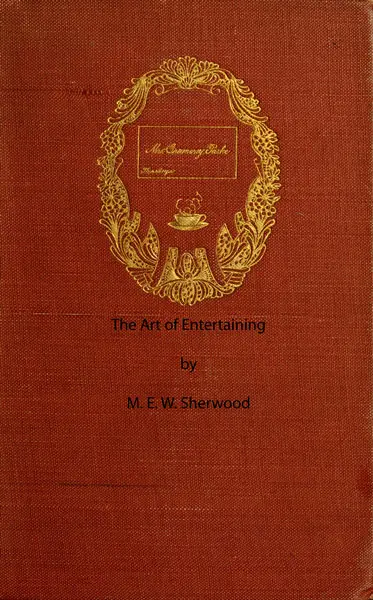
THE CLASSIC COLLECTION · 1892
"The Art of Entertaining" by M. E. W. Sherwood is a guide on the social practice of hospitality written in the late 19th century. This work explores the nuances of hosting and serving guests, focusing on how American styles of entertaining differ from those found in Europe. The book is likely intended for individuals seeking to enhance their skills and knowledge in the art of hosting gatherings, offering practical advice interwoven with cultural observations. At the start of the book, the author introduces the concept of entertaining and reflects on the American approach to hospitality compared to that of other nations, notably Europe. Sherwood notes that while America may be perceived as lacking in refinement, its spirit of generosity and hospitality is unmatched. The opening portion also emphasizes the importance of both the physical aspects of a meal and the intangible components that make for a successful gathering—such as thoughtfulness, atmosphere, and personal touch. Through various anecdotes and historical references, Sherwood sets the stage for discussing the multiple dimensions of entertaining, suggesting that genuine hospitality combines both hearty sustenance and the warmth of human connection.
Introduction adapted from the source catalogue; source summaries may be automatically generated.
Free to read · English · 112,348 words · No account needed
MAKE TIME FOR A GOOD BOOK
On by default. Untick to stop anonymous reading totals. Each page counts after 10 seconds in view. How this works.
Anonymous counting is on unless you have switched it off.
After, or before, lettuce comes the fragrant celery, always an appetizer. Then the tomato, a noble fruit as sweet in smell as Araby the blest, which makes an illustrious salad. Its medicinal virtue is as great as its gastronomical goodness. It is the friend of the well, for it keeps them well, and the friend of the sick, for it brings them back to the lost sheep-folds of hygeia.
There are water-cress and dandelion, common mustard, boiled asparagus, and beet root, potato salad, beloved of the Germans, the cucumber, most fragrant and delicate of salads, a salad of eggs, of lobsters, of chickens, sausages, herrings, and sardines. Anything that is edible can be made into a salad, and a vegetable mixture of cold French beans, boiled peas, carrots and potato, onion, green peppers, and cucumber, covered with fresh mayonnaise dressing, is served ice cold in France, to admiration.
To learn to make a salad is the most important of qualifications for one who would master the art of entertaining.
Here is a good recipe for the dressing:--
Two yolks of eggs, a teaspoonful of salt, and three of mustard,--it should have been mixed with hot water before using,--a little cayenne pepper, a spoonful of vinegar; pound the eggs and mix well. Common vinegar is preferred by many, but some like tarragon vinegar better. Stir this gently for a minute, then add two full spoonfuls of best oil of Lucca.
"A sage for the mustard, a miser for the vinegar, a spendthrift for the oil, and a madman to stir" is the old saw. Add a teaspoonful of brown sugar, half a dozen little spring onions cut fine, three or four slices of beet root, the white of the egg, not cut too small, and then the lettuce itself, which should be torn from the head stock by the fingers.
Some French salad dressers say fatiguez la salade, which means, shake it, mix it, and bruise it; but the modern arrangement is to delicately cover the leaves with the dressing, and not to bruise them. This is an old-fashioned salad.
An excellent salad of cold boiled potatoes cut into slices about an inch thick, may be made with thin slices of fresh beet root, and onions cut very thin, and very little of them, with the same dressing, minus the sugar.
Francatelli speaks of a Russian salad with lobster, a German salad with herrings, and an Italian salad with potatoes; but these come more under the head of the mayonnaises than of the simpler salads.
Your reading position is saved on this browser. Take it to another device with a library code. Reading pages adapt to text, rather than matching a printed edition.
M. E. W. (Mary Elizabeth Wilson) Sherwood
BEHIND THE BOOK
This eBook is for the use of anyone anywhere in the United States and most other parts of the world at no cost and with almost no restrictions whatsoever. You may copy it, give it away or re-use it under the terms of the Project Gutenberg License included with this eBook or online at www.gutenberg.org. If you are not located in the United States, you will have to check the laws of the country where you are located before using this eBook. Read the source licence.
The original source file, including credits and licence, is retained by this library. Request an original-format copy at no charge. Please include the book title and Project Gutenberg identifier #41632.
KEEP YOUR CURIOSITY GOING

Charles G. (Charles Griffith) Ross
Hannah Webster Foster

Emily Lawless
Edwin Hamlin Carr

Charles De Lano Hine
Andrew Ure