THE CLASSIC COLLECTION✦Manners and Social UsagesCLASSIC FREE BOOKS
Manners and Social Usages
M. E. W. (Mary Elizabeth Wilson) Sherwood
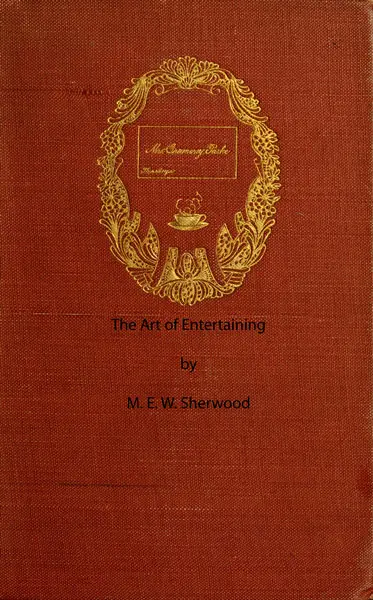
THE CLASSIC COLLECTION · 1892
"The Art of Entertaining" by M. E. W. Sherwood is a guide on the social practice of hospitality written in the late 19th century. This work explores the nuances of hosting and serving guests, focusing on how American styles of entertaining differ from those found in Europe. The book is likely intended for individuals seeking to enhance their skills and knowledge in the art of hosting gatherings, offering practical advice interwoven with cultural observations. At the start of the book, the author introduces the concept of entertaining and reflects on the American approach to hospitality compared to that of other nations, notably Europe. Sherwood notes that while America may be perceived as lacking in refinement, its spirit of generosity and hospitality is unmatched. The opening portion also emphasizes the importance of both the physical aspects of a meal and the intangible components that make for a successful gathering—such as thoughtfulness, atmosphere, and personal touch. Through various anecdotes and historical references, Sherwood sets the stage for discussing the multiple dimensions of entertaining, suggesting that genuine hospitality combines both hearty sustenance and the warmth of human connection.
Introduction adapted from the source catalogue; source summaries may be automatically generated.
Free to read · English · 112,348 words · No account needed
MAKE TIME FOR A GOOD BOOK
On by default. Untick to stop anonymous reading totals. Each page counts after 10 seconds in view. How this works.
Anonymous counting is on unless you have switched it off.
Golf has its poetic and humoristic literature; and as we began with its poetic side we may end with its broadest, latest joke:--
Two well-known professional golfers were playing a match. We will call them Sandy and Jock. On one side of the golf course was a railway, over which Jock drove his ball, landing it in some long grass. They both hunted for a long while for the missing ball. Sandy wanted Jock to give in and say that the ball was lost; but Jock would not consent, as a lost ball meant a lost hole. They continued to look round, and Jock slyly dropped another ball, and then came back and cried, "I've found the ba', Sandy."
"Ye're a leear," said Sandy, "for here it's in ma pooch."
We commend also "Famous Golf Links," by Hutchinson as clear and
agreeable reading.
Come, thou complaisant cards, and cheat me
Of a bad night, and miserable dreams.
SHAKSPEARE.
'Tis pleasant, through the loopholes of retreat, To peep at such a world,--to see the stir Of the great Babel, and not feel the crowd. COWPER.
There is no amusement for a town or country-house, where people like to stay at home, so perfectly innocent and amusing as games which require a little brain.
It is a delightful feature of our modern civilization that books are cheap, and that the poets are read by every one. That would be a barren house where we did not find Scott, Byron, Goldsmith, Longfellow, Tennyson, Browning, Bret Harte, and Jean Ingelow.
Therefore, there would be little embarrassment should we ask the members of the circle around the evening lamp to write a parody on "Evangeline," "Lady Clara Vere de Vere," "Hervé Riel," or "The Heathen Chinee." The result is amusing.
Amongst games requiring memory and attention, we may mention Cross Purposes, The Horned Ambassador, I Love my Love with an A, the Game of the Ring, which is arithmetical, The Deaf Man, The Goose's History, Story Play, which consists in putting a word into a narrative so cleverly that it will not readily be guessed, although several may tell different stories with the word repeated. The best way to play this is to have some word which is not the word, like "ambassador," if the word be "banana" for instance, so by thus repeating "ambassador" the listener maybe baffled. The Dutch Conceit, My Lady's Toilette, Scheherazade's Ransom are also very good. This last deserves a description. Three of the company sustain the parts of the Sultan, the Vizier, and the Princess. The Sultan takes his seat at the end of the room, and the Vizier then leads the Princess before him with her hands bound behind her. The Vizier then makes an absurd proclamation that the Princess, having exhausted all her stories is about to be punished, unless a sufficient ransom be offered. All the rest of the company then advance in turn, and propose enigmas which must be solved by the Sultan or Vizier; sing the first verse of a song, to which the Vizier must answer with the second verse; or recite any well-known piece of poetry in alternate lines with the Vizier. Forfeits must be paid, either by the company when successfully encountered by the Sultan and Vizier, or by the Vizier when unable to respond to his opponents; and the game goes on till the forfeits amount to any specified number on either side. Should the company be victorious and obtain the greater number of forfeits, the Princess is released and the Vizier has to execute all the penalties that may be imposed upon him. If otherwise, the Princess is led to execution. For this purpose she is seated on a low stool. The penalties for the forfeits, which should be previously prepared, are written on slips of paper and put in a basket, which she holds in her hands, tied behind her. The owners of the forfeits advance, and draw each a slip of paper. As each person comes forward the Princess guesses who it is, and if right, the person must pay an additional forfeit, the penalty for which is to be exacted by the Princess herself. When all the penalties have been distributed, the hands and eyes of the Princess are released, and she then superintends the execution of the various punishments that have been allotted to the company.
Your reading position is saved on this browser. Take it to another device with a library code. Reading pages adapt to text, rather than matching a printed edition.
M. E. W. (Mary Elizabeth Wilson) Sherwood
BEHIND THE BOOK
This eBook is for the use of anyone anywhere in the United States and most other parts of the world at no cost and with almost no restrictions whatsoever. You may copy it, give it away or re-use it under the terms of the Project Gutenberg License included with this eBook or online at www.gutenberg.org. If you are not located in the United States, you will have to check the laws of the country where you are located before using this eBook. Read the source licence.
The original source file, including credits and licence, is retained by this library. Request an original-format copy at no charge. Please include the book title and Project Gutenberg identifier #41632.
KEEP YOUR CURIOSITY GOING

Charles G. (Charles Griffith) Ross
Hannah Webster Foster

Emily Lawless
Edwin Hamlin Carr

Charles De Lano Hine
Andrew Ure