
The Writing of News A Handbook with Chapters on Newspaper Correspondence and Copy Reading
Charles G. (Charles Griffith) Ross
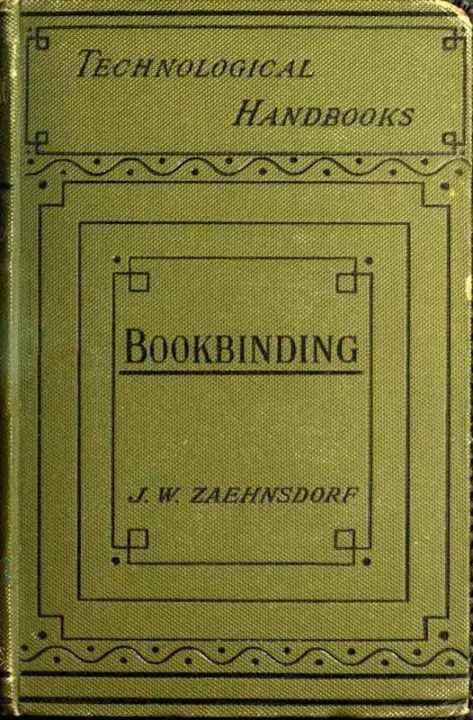
THE CLASSIC COLLECTION · 1879
"The Art of Bookbinding: A Practical Treatise" by Joseph W. Zaehnsdorf is a technological handbook written in the late 19th century. This work serves as a comprehensive guide for both amateurs and professionals in the craft of bookbinding, detailing the techniques and tools required to create beautifully bound books. The treatise discusses various methods and materials involved in the art, illustrating the evolution and practices of bookbinding from ancient to modern times, as well as providing practical advice for executing each stage of the process. The opening of the book introduces the reader to the significance and historical context of bookbinding, tracing its roots back to ancient times when early forms of binding were used to protect and preserve written materials. Zaehnsdorf highlights the transition of bookbinding into an established craft and art form, particularly emphasizing its importance during the Renaissance. He expresses gratitude to those who contributed their knowledge to the craft, illustrating his dedication to sharing valuable insights with both novice binders and seasoned professionals. The initial chapters focus on the practical aspects of the bookbinding process, beginning with essential techniques such as folding, beating, collating, and gathering, thereby laying a solid groundwork for readers to understand the detailed procedures that follow in later sections.
Introduction adapted from the source catalogue; source summaries may be automatically generated.
Free to read · English · 56,255 words · No account needed
MAKE TIME FOR A GOOD BOOK
On by default. Untick to stop anonymous reading totals. Each page counts after 10 seconds in view. How this works.
Anonymous counting is on unless you have switched it off.
TRIMMING.—Shaving the rough edge of the leaves of a book that is not to
be cut.
TRINDLE.—A thin strip of wood or iron.
TURNING-UP.—The process of cutting the foredge in such a manner as to throw the round out of the back until the edge is cut. All books that are cut in boards have a pair of trindles thrust between the boards and across the back to assist the operation.
TYING-UP.—The tying of a volume after the cover has been drawn on, so as to make the leather adhere better to the sides of the bands; also for setting the head-band.
TYPE.—Metal letters used in printing and lettering.
TYPE-HOLDER.—An instrument for holding the type when used for lettering.
VARNISH.—Used as a protection to the glaire when polished on the covers
of books.
WHIPPING.—Another term for overcasting, but when longer stitches are
made.
WITNESS.—When a volume is cut so as to show that it has not been so cut down, but that some of the leaves have still rough edges. These uncut leaves are called “Witness” (see PROOF).
WRINKLE.—The uneven surface in a volume, caused by not being properly pressed or by dampness, also caused by improper backing.
Acids, effect of, on leather, 133.
Advantage, comparative, of paste and glue, 93.
—— of flexible binding, 28.
—— of graining calf, 144.
—— of vinegar over paste water when finishing, 127.
Albumen, 171.
Antique finishing, 122.
—— tools, method of working, 122.
Arming press, 117.
Artificial heat, 46.
Artists’ vellum, 147.
Athenæum letter on trimming, 43.
Azuré tools, 113.
Back, calf, polishing a, 140.
—— finishing a (cut), 130.
—— full gilt, 129.
—— mitred, 129–139.
—— run up, 129–140.
Backs, flat, 48.
—— suitable for calf work (cut), 138.
Backing, 48.
—— (cut), 49.
—— boards (cut), 48, 50.
—— flexible work, 50.
—— hammer (cut), 49.
—— machines, 50.
Band nippers (cut), 93.
Bands, putting on, 88.
Bar roll, 133.
Bath, effect upon stains of wrong, 158.
Beating, 9.
—— hammer (cut), 9.
—— gold books, 10.
Beating stone, 9.
Bibles, etc., edges of, 122.
—— end papers for, 33.
—— finishing of, 122.
Bindings, monastic, 111.
Blind finishing, 122.
—— —— beauty of, 125.
—— —— colour of, 122.
Blocking, 149.
—— calf, 153.
—— cloth, 153.
—— in gold, 153.
—— morocco, 153.
—— old method of, 116.
—— press, 150.
—— sides, 151.
—— silk, 146.
—— velvet, 146.
Blocks, 151.
Blood stains, removing, 163.
Board, backing, 48.
—— cutting, 54.
—— trimming, 41.
Boards, cutting in, 64.
—— cutting out of, 64.
—— made, 55.
—— for photographs, 170.
Bolt knife (cut), 61.
Books, enemies of, 166.
Book-worms, 167.
—— to keep away, 168.
Brass type, 129.
Bread, cleaning with, 161.
Bronze end paper, 34.
Brush, finger, 68.
—— sprinkling, 68.
Burnishers, 79.
—— edge (cuts), 81.
Burnishing edges, 81.
—— marbled paper, 73.
Burnt documents, deciphering, 166.
Burr on knife, 79.
Calf, back polishing, 137.
—— blocking, 153.
—— Cambridge, 104.
—— colouring, 100.
—— colouring, preparing for, 102.
—— colouring, black, 101.
—— colouring, brown, 102.
—— colouring, yellow, 102.
—— covering in, 94.
—— dabbing, 106.
—— effect of glue on, 89.
—— extra, 142.
—— finishing, 135.
—— graining, 144.
—— graining, advantage of, 144.
—— green and light, 139–141.
—— handling, 94.
—— lettering, 140.
—— marbling, 105.
—— marbling, preparing for, 104.
—— neat, 137.
—— pasting down, 99.
—— sides, finishing, 141.
—— sides, polishing, 142.
—— work, backs suitable for (cut), 138.
—— sprinkling, 103.
—— sprinkling, emblematic, 103.
—— sprinkling, preparing for, 103.
Cambridge calf, 104.
Capping up edges, 82.
Cat’s paw, 106.
Charcoal fire for finishing, 121.
Your reading position is saved on this browser. Take it to another device with a library code. Reading pages adapt to text, rather than matching a printed edition.
BEHIND THE BOOK
This eBook is for the use of anyone anywhere in the United States and most other parts of the world at no cost and with almost no restrictions whatsoever. You may copy it, give it away or re-use it under the terms of the Project Gutenberg License included with this eBook or online at www.gutenberg.org. If you are not located in the United States, you will have to check the laws of the country where you are located before using this eBook. Read the source licence.
The original source file, including credits and licence, is retained by this library. Request an original-format copy at no charge. Please include the book title and Project Gutenberg identifier #51213.
KEEP YOUR CURIOSITY GOING
Charles G. (Charles Griffith) Ross
Hannah Webster Foster

Emily Lawless
Edwin Hamlin Carr

Charles De Lano Hine
Andrew Ure