
The Writing of News A Handbook with Chapters on Newspaper Correspondence and Copy Reading
Charles G. (Charles Griffith) Ross
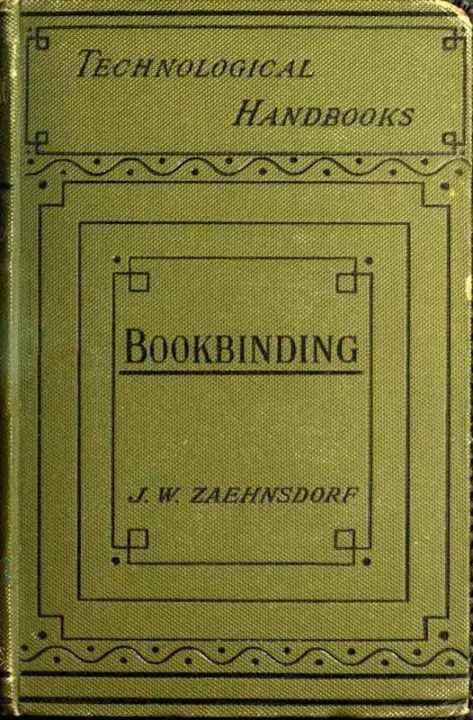
THE CLASSIC COLLECTION · 1879
"The Art of Bookbinding: A Practical Treatise" by Joseph W. Zaehnsdorf is a technological handbook written in the late 19th century. This work serves as a comprehensive guide for both amateurs and professionals in the craft of bookbinding, detailing the techniques and tools required to create beautifully bound books. The treatise discusses various methods and materials involved in the art, illustrating the evolution and practices of bookbinding from ancient to modern times, as well as providing practical advice for executing each stage of the process. The opening of the book introduces the reader to the significance and historical context of bookbinding, tracing its roots back to ancient times when early forms of binding were used to protect and preserve written materials. Zaehnsdorf highlights the transition of bookbinding into an established craft and art form, particularly emphasizing its importance during the Renaissance. He expresses gratitude to those who contributed their knowledge to the craft, illustrating his dedication to sharing valuable insights with both novice binders and seasoned professionals. The initial chapters focus on the practical aspects of the bookbinding process, beginning with essential techniques such as folding, beating, collating, and gathering, thereby laying a solid groundwork for readers to understand the detailed procedures that follow in later sections.
Introduction adapted from the source catalogue; source summaries may be automatically generated.
Free to read · English · 56,255 words · No account needed
MAKE TIME FOR A GOOD BOOK
On by default. Untick to stop anonymous reading totals. Each page counts after 10 seconds in view. How this works.
Anonymous counting is on unless you have switched it off.
MITRED.—When the lines in finishing meet each other at right angles without overrunning each other, they are said to be mitred. Joined at an angle of 45°.
MUTTON-THUMPING.—A term used in bygone days, indicating the common binding of school books in sheep-skin.
MUTTON-THUMPER.—An old term indicating a bad workman.
OFF-SET.—The impression made by the print against the opposite page, when a book has been rolled or beaten before the ink be dried. (Also SET-OFF.)
OUT OF BOARDS.—When a volume is cut before the boards are affixed, it is done out of boards. Nearly the whole of common work is done out of boards.
OUT OF TRUTH.—When a book is not cut square.
OVERCASTING.—An operation in sewing, when the work consists of single leaves or plates. Over-sewing.
PALLET.—The tools used for finishing across backs.
PANEL.—The space between the bands.
PAPERING-UP.—Covering the edges after they are gilt, to protect them while the volume is being covered and finished (see CAP).
PARING.—Reducing the edges of the leather by forming a gradual slope.
PARING KNIFE.—The knife used for paring.
PASTE-WASH.—Paste diluted with water.
PEEL.—A wooden instrument used to hang up damp sheets for drying.
PENCIL.—A small brush of camel’s hair used for glairing.
PIECED.—Any space that has another leather upon it, as a lettering
piece.
PLOUGH.—The instrument used for cutting the edges when the book is in
the lying press.
PLOUGH KNIFE.—The knife attached to the plough. |178|
POLISHER.—A steel instrument for giving a gloss to the leather after
finishing.
PRESS.—Of various kinds, viz.: lying, cutting, standing, blocking,
finishing, etc.
PRESS PIN.—A bar of iron used as a lever for standing presses; a smaller kind for lying presses.
PRESSING BLOCKS.—Blocks of wood used for filling up a standing press when there are not enough books.
PRESSING BOARDS.—Boards used for pressing books between.
PROOF.—The rough edges of certain leaves left uncut by the plough, are “proof” that the book is not cut down (see also WITNESS).
RASPED.—The sharp edge taken off mill-boards.
REGISTER.—The ribbon placed in a volume for a marker. A list of signatures attached to the end of early-printed books for the use of the binder. In printing—when on looking through a leaf the print on the recto and verso is not exactly opposite, it is said to be out of register.
ROLLING MACHINE.—A machine introduced to save the labour of beating, the sheets being passed between two revolving cylinders.
ROLLS.—Cylindrical ornamental tools used in finishing.
RUNNER.—The front board used in cutting edges.
Your reading position is saved on this browser. Take it to another device with a library code. Reading pages adapt to text, rather than matching a printed edition.
BEHIND THE BOOK
This eBook is for the use of anyone anywhere in the United States and most other parts of the world at no cost and with almost no restrictions whatsoever. You may copy it, give it away or re-use it under the terms of the Project Gutenberg License included with this eBook or online at www.gutenberg.org. If you are not located in the United States, you will have to check the laws of the country where you are located before using this eBook. Read the source licence.
The original source file, including credits and licence, is retained by this library. Request an original-format copy at no charge. Please include the book title and Project Gutenberg identifier #51213.
KEEP YOUR CURIOSITY GOING
Charles G. (Charles Griffith) Ross
Hannah Webster Foster

Emily Lawless
Edwin Hamlin Carr

Charles De Lano Hine
Andrew Ure