
The Writing of News A Handbook with Chapters on Newspaper Correspondence and Copy Reading
Charles G. (Charles Griffith) Ross
THE CLASSIC COLLECTION · 1879
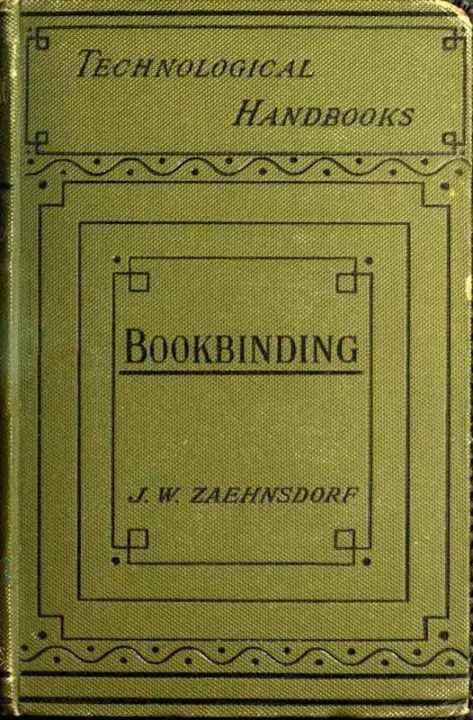
"The Art of Bookbinding: A Practical Treatise" by Joseph W. Zaehnsdorf is a technological handbook written in the late 19th century. This work serves as a comprehensive guide for both amateurs and professionals in the craft of bookbinding, detailing the techniques and tools required to create beautifully bound books. The treatise discusses various methods and materials involved in the art, illustrating the evolution and practices of bookbinding from ancient to modern times, as well as providing practical advice for executing each stage of the process. The opening of the book introduces the reader to the significance and historical context of bookbinding, tracing its roots back to ancient times when early forms of binding were used to protect and preserve written materials. Zaehnsdorf highlights the transition of bookbinding into an established craft and art form, particularly emphasizing its importance during the Renaissance. He expresses gratitude to those who contributed their knowledge to the craft, illustrating his dedication to sharing valuable insights with both novice binders and seasoned professionals. The initial chapters focus on the practical aspects of the bookbinding process, beginning with essential techniques such as folding, beating, collating, and gathering, thereby laying a solid groundwork for readers to understand the detailed procedures that follow in later sections.
Introduction adapted from the source catalogue; source summaries may be automatically generated.
Free to read · English · 56,255 words · No account needed
MAKE TIME FOR A GOOD BOOK
On by default. Untick to stop anonymous reading totals. Each page counts after 10 seconds in view. How this works.
Anonymous counting is on unless you have switched it off.
(4.) A mixture of 1 part nitric acid, 10 parts water, is useful in many instances for oil stains. When erased, plunge the whole sheet or leaf into water, changing the water several times. Dry and size.
Ink.—When the writing-paper has been made from inferior rags bleached with excess of chlorine the best ink becomes discoloured.
Reviving old writings.—(1.) Brush the paper over carefully with a solution of sulpho-cyanide of potassium (1 in 20). Then, while still damp, hold over a dish containing hot muriatic acid; the writing will develop deep red. |165|
(2.) Wash the writing with a very weak solution of hydrochloric acid, then carefully apply infusion of galls.
(3.) For letters that have been in sea water, wash with warm water to remove the salt, then soak in weak solution of gallic acid, about 3 grains to the ounce. If this does not make the writing legible enough, wash thoroughly in clean water, and soak in a solution of protosulphate of iron, 10 grains to the ounce.
To restore writing effaced by chlorine.—(1.) Expose the writing to the vapour of sulphuret of ammonia, or dip it into a solution of the sulphuret.
(2.) Ferro-cyanide of potassium, 5 parts.
Water, 85 parts.
Dissolve and immerse the paper in the fluid, then slightly acidulate the solution with sulphuric acid.
Guitaud discovered that sulphuret of ammonia and prussiate of potash revives writing effaced by oxymuriatic acid.
To restore MSS. faded by time.—A moderately concentrated solution of tannin washed over the paper. The MS. to be carefully dried.
To preserve drawings or manuscripts.—Mix with every 100 parts of collodion 2 parts of sterine. Place the paper in question on a perfectly level and even surface, such as a marble table or large slab of glass. Give the paper a thin coat of this collodion, and in about twenty minutes it will be protected by a transparent, brilliant, and imperishable envelope.
To fix drawings or pencil marks.—Pass the paper through a bath of
thin size, made either from gelatine or isinglass; or a bath of skim
milk.
To render paper waterproof.—Take of borax 100 parts, water 2,250 parts; boil, and while stirring, gradually add powdered shellac 300 parts. When the whole is dissolved, strain through muslin. This will keep a long time and may be bottled. |166|
To render paper incombustible.—Pass the paper through a strong solution of alum, and hang up to dry.
The following, taken from the “English Mechanic,” June 19th, 1874, is, I think, of great use to the professional restorer of old books, and will give the binder an idea of what has to be done sometimes:—
Your reading position is saved on this browser. Take it to another device with a library code. Reading pages adapt to text, rather than matching a printed edition.
BEHIND THE BOOK
This eBook is for the use of anyone anywhere in the United States and most other parts of the world at no cost and with almost no restrictions whatsoever. You may copy it, give it away or re-use it under the terms of the Project Gutenberg License included with this eBook or online at www.gutenberg.org. If you are not located in the United States, you will have to check the laws of the country where you are located before using this eBook. Read the source licence.
The original source file, including credits and licence, is retained by this library. Request an original-format copy at no charge. Please include the book title and Project Gutenberg identifier #51213.
KEEP YOUR CURIOSITY GOING
Charles G. (Charles Griffith) Ross
Hannah Webster Foster

Emily Lawless
Edwin Hamlin Carr

Charles De Lano Hine
Andrew Ure