THE CLASSIC COLLECTION✦Lost DiariesCLASSIC FREE BOOKS
Lost Diaries
Maurice Baring
THE CLASSIC COLLECTION · 1920
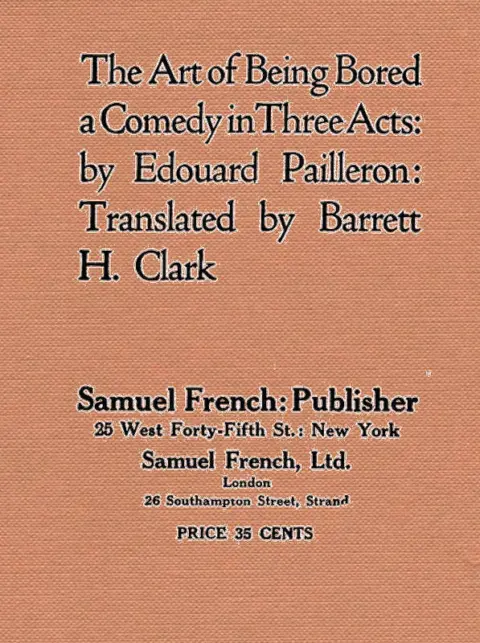
"The Art of Being Bored: A Comedy in Three Acts" by Edouard Pailleron is a play written in the late 19th century. The story is set within the social circles of Parisian life, highlighting the interactions among characters who embody various societal roles and aspirations. The central characters include Paul and Jeanne, a newlywed couple navigating the complexities of social expectations and the artifice of high society. The beginning of the play introduces the audience to a drawing-room at Madame de Céran's château, where the dynamics of social interactions unfold. Paul, a sub-prefect, advises his wife Jeanne on how to comport herself in this influential circle, emphasizing the need for decorum and subtlety. As various guests arrive, including their host and a collection of socialites, themes of political ambition, societal expectations, and the struggle against ennui begin to emerge. The opening sets a humorous yet critical tone toward the superficiality of their interactions, suggesting that the art of being bored is a central concern of the characters' lives.
Introduction adapted from the source catalogue; source summaries may be automatically generated.
Free to read · English · 27,398 words · No account needed
MAKE TIME FOR A GOOD BOOK
On by default. Untick to stop anonymous reading totals. Each page counts after 10 seconds in view. How this works.
Anonymous counting is on unless you have switched it off.
PAUL. (Seating himself, and rising again as before) And the lectures and the Literature! And Revel’s candidacy! Clever old fox who keeps dying every evening and coming back to life every morning! (He starts to sit down, then he pauses) And Saint-Réault! Ah! Saint-Réault! And the Ramas-Ravanas and all the clap-trap about Buddha!
MME. DE CÉRAN. (Indignantly) Oh!
DUCHESS. (Laughing to herself) Oh, he’s so funny!
PAUL. And the other one, he’s a wonder! Bellac of the many conquests,
with his Platonic love!!
JEANNE. (Dropping her eyes) He’s silly!
PAUL. (Sitting) Don’t you think so? And that tragedy! Oh, that
tragedy!
JEANNE. But, Paul, what is it?
PAUL. And old Phillippe-Auguste with his beautiful verse! Why, everybody has written verse! That’s no reason why he should read it! I’ve done it myself!
JEANNE. You, dear?
PAUL. Yes, I! When I was a poor student I even used to sell it!
JEANNE. To a publisher?
PAUL. No, to a dentist! “Fill-iad, Or the Art of Filling Teeth.”—Poem in three hundred lines!—Thirty Francs—Listen!
JEANNE. Oh, no!
PAUL. “O Muse, be there an ill, to man the greatest curse, Which Heaven in its wrath spreads o’er the universe, And sorely, you’ll admit, O Muse, good taste offends, It is that one which oftentimes upon the teeth descends!—
JEANNE. Oh, Paul!
PAUL. “Ah, to tear out that tooth, my cup of joy were full! Nay, friend, it can be cured, stop! do not let them pull! Oh, never pull a tooth, e’en when it rots—you’ll rue it! Let it be filled; but choose a clever man to do it! Protect that little tooth, bi-cuspéd or incisor, ’Twill sweeten every meal—’twill make your smile seem nicer!”
DUCHESS. (Laughing) Isn’t he amusing!
JEANNE. What nonsense you talk! Who would ever believe it to see you in the drawing-room! (Imitating him) Ah, yes, Monsieur le sénateur, the tide of democracy—the treaties of 1815—Oh! Oh! OH!
PAUL. And you, dear! You certainly have made an impression on the
hostess!
MME. DE CÉRAN. Hmmm?
PAUL. My compliments!
JEANNE. But, dearie, I only did what you suggested!
PAUL. (Imitating her) “I only did what you suggested!”—Ah, little Miss Saintliness with her little voice! Oh, you filled the Countess full—of Joubert and Latin and Tocqueville—your own manufacture, too!
MME. DE CÉRAN. What, her own manufacture?
DUCHESS. She is lovely! I like her all the more!
JEANNE. Well, I don’t feel any remorse—A woman who puts us in separate
rooms!
MME. DE CÉRAN. (Rising) And suppose I tell her to leave!
Your reading position is saved on this browser. Take it to another device with a library code. Reading pages adapt to text, rather than matching a printed edition.
BEHIND THE BOOK
This eBook is for the use of anyone anywhere in the United States and most other parts of the world at no cost and with almost no restrictions whatsoever. You may copy it, give it away or re-use it under the terms of the Project Gutenberg License included with this eBook or online at www.gutenberg.org. If you are not located in the United States, you will have to check the laws of the country where you are located before using this eBook. Read the source licence.
The original source file, including credits and licence, is retained by this library. Request an original-format copy at no charge. Please include the book title and Project Gutenberg identifier #53334.
KEEP YOUR CURIOSITY GOING
Maurice Baring
W. B. (William Butler) Yeats
Edward Martyn

John Brougham & Charlotte Brontë
Marguerite Merington
Leonid Andreyev