THE CLASSIC COLLECTION✦Lost DiariesCLASSIC FREE BOOKS
Lost Diaries
Maurice Baring
THE CLASSIC COLLECTION · 1920
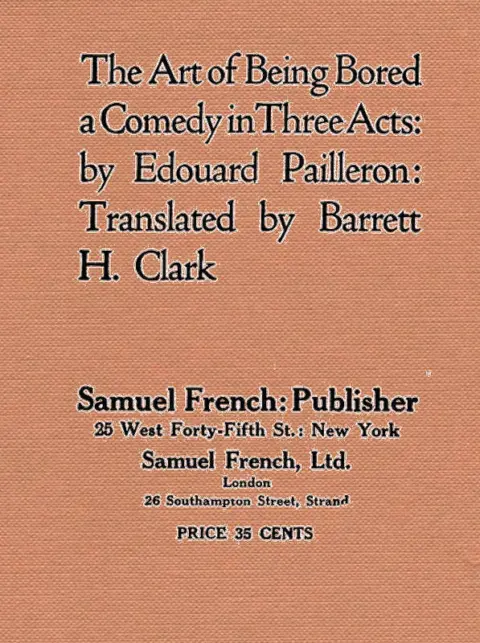
"The Art of Being Bored: A Comedy in Three Acts" by Edouard Pailleron is a play written in the late 19th century. The story is set within the social circles of Parisian life, highlighting the interactions among characters who embody various societal roles and aspirations. The central characters include Paul and Jeanne, a newlywed couple navigating the complexities of social expectations and the artifice of high society. The beginning of the play introduces the audience to a drawing-room at Madame de Céran's château, where the dynamics of social interactions unfold. Paul, a sub-prefect, advises his wife Jeanne on how to comport herself in this influential circle, emphasizing the need for decorum and subtlety. As various guests arrive, including their host and a collection of socialites, themes of political ambition, societal expectations, and the struggle against ennui begin to emerge. The opening sets a humorous yet critical tone toward the superficiality of their interactions, suggesting that the art of being bored is a central concern of the characters' lives.
Introduction adapted from the source catalogue; source summaries may be automatically generated.
Free to read · English · 27,398 words · No account needed
MAKE TIME FOR A GOOD BOOK
On by default. Untick to stop anonymous reading totals. Each page counts after 10 seconds in view. How this works.
Anonymous counting is on unless you have switched it off.
MME. DE LOUDAN. (To the BARONESS) Ah, the wings, my dear—the wings!
BELLAC. I spoke this morning—in the course of my lecture on German Literature at the Princess’s—of a certain philosopher who made instinct the basis and the rule of all our actions and all our thoughts.
LADIES. (Protesting) Oh!—Oh!—Oh!
BELLAC. And now, ladies, I take occasion emphatically to declare that that opinion is not my opinion, and that I deny the theory with every fiber of my soul and being!
LADIES. Good! Excellent!
BARONESS. (Aside to MME. DE LOUDAN) What pretty hands!
BELLAC. No, ladies, no! Love is not, as the German philosopher has it, a purely specific passion; a deceitful illusion shackling mankind in order to work its own ends! No, a hundred times no! if we have souls!
LADIES. Yes!—Yes—
SUZANNE. Bravo!
DUCHESS. (Aside to ROGER) She is certainly doing that on purpose!
BELLAC. Leave to the Sophists and to vulgar natures such soul-stunting theories; do not even consider them; answer them with silence, the language of the outcast!
LADIES. Charming!—Charming!——
BELLAC. God forbid I should go so far as to deny the sovereign influence of beauty over the uncertain wills of men! (Looking about him) I see too much about me by way of refutation to that argument!
LADIES. Ah!—Ah!
ROGER. (To the DUCHESS) He looked at her!
DUCHESS. Yes.
BELLAC. But above this material and mortal beauty, there is another, time-defying, invisible to the naked eye, which the soul of purity serenely contemplates and cherishes with an unearthly love. That love, ladies, is the true Love, the mingling of two spirits, their flight far from the terrestrial mire—into the infinite blue of the ideal!
LADIES. Bravo!
DUCHESS. (To herself, rather loudly) Nonsense!
BELLAC. (Looking at her) That love, mocked at by some, unknown to most,—I declare, my hand on my heart, that it does exist! In the souls of the elect, as Proudhon says——
VOICES. (Protesting) Oh, Proudhon——!
MME. DE LOUDAN. Oh, Bellac!
BELLAC. A writer whom I am astonished to find myself quoting—I beg your pardons! In the souls of the elect, there is nothing of earth.
LADIES. How delicate! Charming!
DUCHESS. (Bursting forth) Nonsense!
LADIES. Oh, Duchess!
BELLAC. (Bowing to the DUCHESS) And yet, it exists. Noble spirits have felt it, great poets sung its praises, and in the seats of Heaven, the apotheosis of our dreams, we see, enshrined about with haloes of ethereal brightness, those immortal figures, everlasting proof of an undying and psychic love: Beatrice, Laura——
DUCHESS. Laura, the mother of eleven, my dear Monsieur!
LADIES. Duchess!
DUCHESS. Eleven! And you call her love psychic!
Your reading position is saved on this browser. Take it to another device with a library code. Reading pages adapt to text, rather than matching a printed edition.
BEHIND THE BOOK
This eBook is for the use of anyone anywhere in the United States and most other parts of the world at no cost and with almost no restrictions whatsoever. You may copy it, give it away or re-use it under the terms of the Project Gutenberg License included with this eBook or online at www.gutenberg.org. If you are not located in the United States, you will have to check the laws of the country where you are located before using this eBook. Read the source licence.
The original source file, including credits and licence, is retained by this library. Request an original-format copy at no charge. Please include the book title and Project Gutenberg identifier #53334.
KEEP YOUR CURIOSITY GOING
Maurice Baring
W. B. (William Butler) Yeats
Edward Martyn

John Brougham & Charlotte Brontë
Marguerite Merington
Leonid Andreyev