THE CLASSIC COLLECTION✦Lost DiariesCLASSIC FREE BOOKS
Lost Diaries
Maurice Baring
THE CLASSIC COLLECTION · 1920
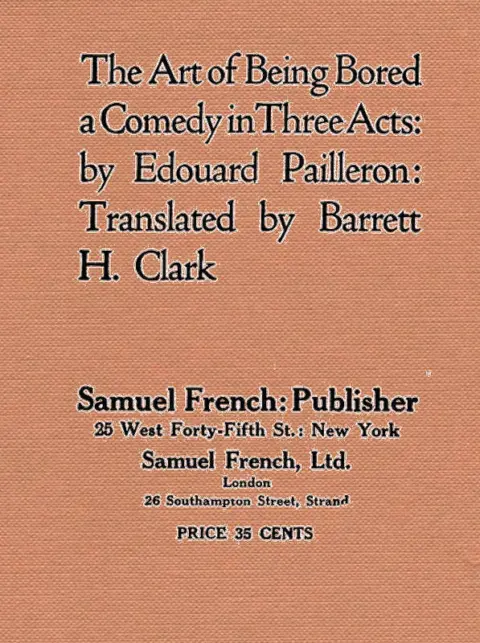
"The Art of Being Bored: A Comedy in Three Acts" by Edouard Pailleron is a play written in the late 19th century. The story is set within the social circles of Parisian life, highlighting the interactions among characters who embody various societal roles and aspirations. The central characters include Paul and Jeanne, a newlywed couple navigating the complexities of social expectations and the artifice of high society. The beginning of the play introduces the audience to a drawing-room at Madame de Céran's château, where the dynamics of social interactions unfold. Paul, a sub-prefect, advises his wife Jeanne on how to comport herself in this influential circle, emphasizing the need for decorum and subtlety. As various guests arrive, including their host and a collection of socialites, themes of political ambition, societal expectations, and the struggle against ennui begin to emerge. The opening sets a humorous yet critical tone toward the superficiality of their interactions, suggesting that the art of being bored is a central concern of the characters' lives.
Introduction adapted from the source catalogue; source summaries may be automatically generated.
Free to read · English · 27,398 words · No account needed
MAKE TIME FOR A GOOD BOOK
On by default. Untick to stop anonymous reading totals. Each page counts after 10 seconds in view. How this works.
Anonymous counting is on unless you have switched it off.
MME. DE LOUDAN. I see that your excuse was a good one—but Lucy?
LUCY. I was busy here.
MME. DE LOUDAN. How could you stay away, his Muse?
BELLAC. (Gallantly) Ah, Marquise, I can only say that you were
there!
MME. DE LOUDAN. He is charming! (To LUCY) You don’t know what you
missed.
LUCY. Oh, I know——
MME. ARRIÉGO. No, she can have no idea! It was a burning flame, a fire
of passion!
MME. DE LOUDAN. What flowing eloquence! What delicacy of imagination!
BELLAC. With such an audience, who could not be eloquent?
DUCHESS. And what was the subject to-day?
DUCHESS. (To ROGER) Of course!
MME. ARRIÉGO. So poetic!
MME. DE LOUDAN. And so scientific! He is half psychologist, half dreamer; he plays with the scalpel as well as the lyre! It was—there was only one thing I couldn’t agree with: that the basis of love is instinct.
BELLAC. But, Marquise, I was speaking of——
MME. DE LOUDAN. Oh, no, no!
BELLAC. I was speaking of love in Nature!
MME. DE LOUDAN. Instinct! The idea! Ladies, come, we must defend ourselves! Help me. Come to the rescue, Lucy!
BELLAC. She will not help you, Marquise; she agrees with me.
MME. DE SAINT-RÉAULT. Is it possible, Lucy?
LUCY. Instinct?
MME. DE SAINT-RÉAULT. In love?
MME. DE LOUDAN. That would be robbing the soul of its most precious possession: according to you, then, Lucy, nothing is good, or bad.
LUCY. (Coldly) There is no question about good or bad, Madame, it is merely a question of the existence of the species.
LADIES. (Protesting) Oh!
DUCHESS. (Aside) She’s prosaic enough about it!
MME. DE LOUDAN. (Indignantly) Why, you’re stripping love of all its
romance!
LUCY. Hunter and Darwin——
MME. DE LOUDAN. No one better than I knows the weaknesses of the flesh. Matter dominates and masters us! I know it, I feel it! But leave us at least the psychic refuge of pure ecstasy!
BELLAC. But, Marquise——
MME. DE LOUDAN. Be quiet, you’re a villain! I will not deny my god; that would be sacrilege. I’m very angry with you!
DUCHESS. (Aside) Little fool!
BELLAC. I hope we shall be reconciled, after you read my book.
MME. DE LOUDAN. But when will that be? The entire world is waiting for that book! And you don’t say a word about it! You won’t even tell us the title!
LADIES. Tell us the title! At least the title!
MME. ARRIÉGO. Lucy, you make him tell us.
LUCY. Well, what is the title?
BELLAC. (To LUCY, after a moment’s hesitation) “Miscellanies.”
Your reading position is saved on this browser. Take it to another device with a library code. Reading pages adapt to text, rather than matching a printed edition.
BEHIND THE BOOK
This eBook is for the use of anyone anywhere in the United States and most other parts of the world at no cost and with almost no restrictions whatsoever. You may copy it, give it away or re-use it under the terms of the Project Gutenberg License included with this eBook or online at www.gutenberg.org. If you are not located in the United States, you will have to check the laws of the country where you are located before using this eBook. Read the source licence.
The original source file, including credits and licence, is retained by this library. Request an original-format copy at no charge. Please include the book title and Project Gutenberg identifier #53334.
KEEP YOUR CURIOSITY GOING
Maurice Baring
W. B. (William Butler) Yeats
Edward Martyn

John Brougham & Charlotte Brontë
Marguerite Merington
Leonid Andreyev