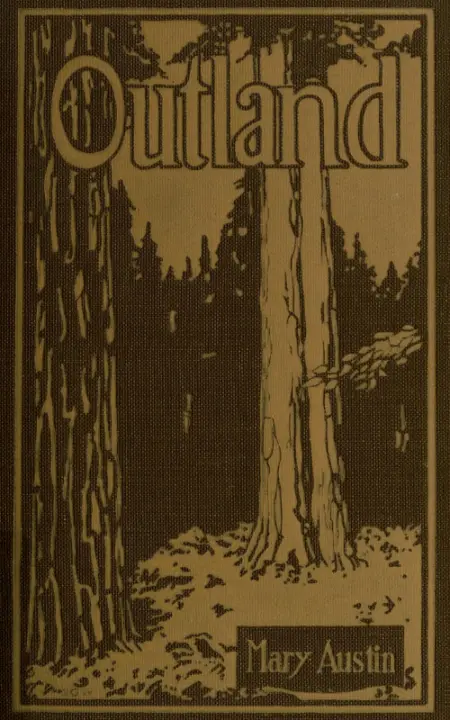
Outland
Mary Austin
THE CLASSIC COLLECTION · 1911
"The Arrow-Maker: A Drama in Three Acts" by Mary Austin is a play first performed in 1911. Set among the Paiutes in the Sierra Nevada, it centers on The Chisera, a Medicine Woman who serves as intermediary between her people and the gods. When she abandons her sacred role for forbidden love with Simwa, the Arrow Maker, her choice triggers a chain of tribal conflict, betrayal, and tragedy. Austin crafted the work with archaeological precision, drawing on authentic Native American ceremonies, music, and customs.
Introduction adapted from the source catalogue; source summaries may be automatically generated.
Free to read · English · 22,289 words · No account needed
MAKE TIME FOR A GOOD BOOK
On by default. Untick to stop anonymous reading totals. Each page counts after 10 seconds in view. How this works.
Anonymous counting is on unless you have switched it off.
We meant the best--we judged you companioned by the gods.
Did ever a woman serve them the less because she had dealt with a man? Nay, all the power of woman comes from loving and being loved, and now the bitterest of all my loss is to know that I have never had it.
(She draws up her blanket.)
And not you only--
You--?
(She turns away confounded.)
Wife--wife--if she finds the gods again, they will surely kill me.
Let them. Though I am your wife, I am the Chief's daughter, and the tribe is still something to me. I will save them if I can. Chisera--
(The CHISERA listens and turns slowly.)
Is that my daughter?
Hush! Perhaps she will move her!
Do you think yourself aggrieved so much, Chisera? Come, I will match sorrow with you, I and all these (the women surge forward), and the stakes shall be the people. Here is my pride that I throw down, in my bride year to know my husband an impostor. Have you any sorrow to match with that?
Since you wish a man so much, Chisera, here is mine whom the vultures
seek.
(The women part to show the dead man stark in his blanket.)
Would you have a child at your breast, Chisera, here is mine, for my
milk is dried with hunger.
(She holds up her swaddled child which BRIGHT WATER takes and holds toward the CHISERA, who stands confused, for the first time acutely aware of their misery.)
(Measuring the effect of her words.) Chisera, my breast is as fruitless as yours--but you ... you have ... good medicine.
Lay hold on the gods, Chisera, these are ills from which man cannot
save us!
(The CHISERA throws out her hands to signify the loss of her power, her blanket slips to the ground and she covers her face with her hands.)
Gone--gone! It is gone from me!
(Signing to the women to hide the blanket.)
By dancing you shall bring it back again--for the sake of the women and children--dance, Chisera!
(Her voice has a kindling sound, and the women echo it with a
breath.)
Oh, I have danced until the earth under me is beaten to dust, and my heart is as dry as the dust, and all my songs have fallen to the ground. (She begins to walk up and down excitedly.) With what cry shall I call on the gods, now my songs are departed? (She begins to chant.)
And my heart is emptied of all
But the grief of women.
Your reading position is saved on this browser. Take it to another device with a library code. Reading pages adapt to text, rather than matching a printed edition.
Mary Austin
Mary Austin
Mary Austin
Mary Austin
BEHIND THE BOOK
This eBook is for the use of anyone anywhere in the United States and most other parts of the world at no cost and with almost no restrictions whatsoever. You may copy it, give it away or re-use it under the terms of the Project Gutenberg License included with this eBook or online at www.gutenberg.org. If you are not located in the United States, you will have to check the laws of the country where you are located before using this eBook. Read the source licence.
The original source file, including credits and licence, is retained by this library. Request an original-format copy at no charge. Please include the book title and Project Gutenberg identifier #27792.
KEEP YOUR CURIOSITY GOING
Maurice Baring
W. B. (William Butler) Yeats
Edward Martyn

John Brougham & Charlotte Brontë
Marguerite Merington
Leonid Andreyev