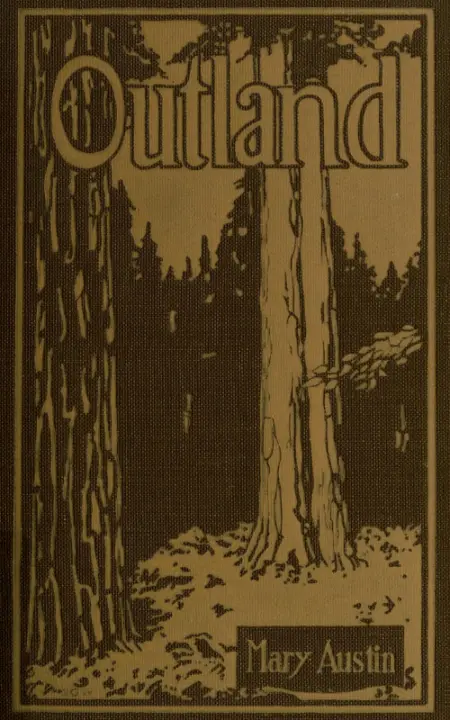
Outland
Mary Austin
THE CLASSIC COLLECTION · 1911
"The Arrow-Maker: A Drama in Three Acts" by Mary Austin is a play first performed in 1911. Set among the Paiutes in the Sierra Nevada, it centers on The Chisera, a Medicine Woman who serves as intermediary between her people and the gods. When she abandons her sacred role for forbidden love with Simwa, the Arrow Maker, her choice triggers a chain of tribal conflict, betrayal, and tragedy. Austin crafted the work with archaeological precision, drawing on authentic Native American ceremonies, music, and customs.
Introduction adapted from the source catalogue; source summaries may be automatically generated.
Free to read · English · 22,289 words · No account needed
MAKE TIME FOR A GOOD BOOK
On by default. Untick to stop anonymous reading totals. Each page counts after 10 seconds in view. How this works.
Anonymous counting is on unless you have switched it off.
Am I not also a tribeswoman? Would not I do so much for my people? But your gifts and your prayers will be acceptable to the gods, for of myself I can do nothing. (She stoops to the gifts, but hesitates.) Who is this that comes?
(The young girls steal up noiselessly through the bushes, led by the Chief's daughter. BRIGHT WATER is lovely and young; her hair, flowing loosely over her shoulders and breast, is mingled with strings of beads and bright berries. Her dress of fringed buckskin is heavily beaded, her arms are weighted with armlets of silver and carved beads of turquoise; about her neck hangs a disk of glittering shell. She walks proudly, a little in advance of the others, who bunch up timidly like quail on the trail, behind her. The women, catching sight of the girls, spring up, frightened, and stand half protectingly between them and the CHISERA.)
It is the Chief's daughter.
What do you here? You have neither sons nor husbands that you should
ask spells and charms.
How, then, shall we have husbands or sons, if the battle goes against
us?
Well answered, Chief's daughter.
(Surprised.) You know me?
I have heard that the loveliest maiden of Sagharawite is called Bright Water, daughter of Rain Wind, Chief of the Paiutes.
(Going over to BRIGHT WATER.) You should have stayed in the wickiup, my daughter; you are too young to go seeking magic medicine.
The more need because we are young, mother. If the loss of battle come to you, at least you have had the love of a man and the lips of children at the breast. But we, if the battle goes against us, what have we?
Ay, truly, Seegooche, there are no joys so hard to do without as
those we have not had.
Therefore, we ask a charm, Chisera, for our sweethearts; and, in the mean time, may this remind you--
(She drops a bracelet in the CHISERA'S basket.)
(Going forward.) The scarlet beads from me, Chisera. I am to be married in the time of tasseling corn.
The shells from me, Chisera. Good medicine!
Strong Bow is my lover, Chisera. Bring him safe home again.
(The girls retire after dropping their gifts in the CHISERA'S
basket.)
(A little stiffly.) You have no need of gifts. Am I not young, even as you? Should you pray for your lover any more or less for the sake of a few beads?
Your reading position is saved on this browser. Take it to another device with a library code. Reading pages adapt to text, rather than matching a printed edition.
Mary Austin
Mary Austin
Mary Austin
Mary Austin
BEHIND THE BOOK
This eBook is for the use of anyone anywhere in the United States and most other parts of the world at no cost and with almost no restrictions whatsoever. You may copy it, give it away or re-use it under the terms of the Project Gutenberg License included with this eBook or online at www.gutenberg.org. If you are not located in the United States, you will have to check the laws of the country where you are located before using this eBook. Read the source licence.
The original source file, including credits and licence, is retained by this library. Request an original-format copy at no charge. Please include the book title and Project Gutenberg identifier #27792.
KEEP YOUR CURIOSITY GOING
Maurice Baring
W. B. (William Butler) Yeats
Edward Martyn

John Brougham & Charlotte Brontë
Marguerite Merington
Leonid Andreyev