
The lost dirigible
Ralph Henry Barbour
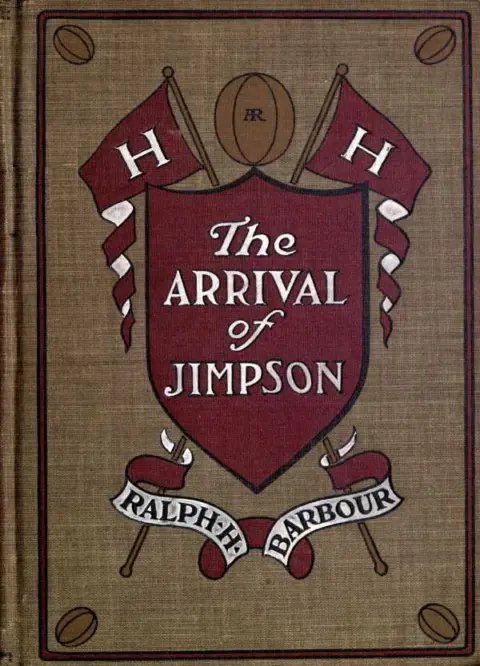
THE CLASSIC COLLECTION · 1904
"The Arrival of Jimpson, and Other Stories for Boys about Boys" by Ralph Henry Barbour is a collection of short stories written in the early 20th century. The book addresses themes relevant to young boys, particularly focusing on school life, sports, and the challenges of adolescence. The opening story features the character Jimpson, who is a freshman football player trying to make his mark amid the excitement and pressures of a college football game. The opening of the book sets the stage for the story of Jimpson and his battle for recognition in a team dominated by more experienced players. Amid a fervent atmosphere filled with cheers and anticipation, the narrative explores Jimpson's feelings of exclusion as he prepares for a pivotal game against Yale. Despite being overlooked by his peers, Jimpson's determination and potential are highlighted, foreshadowing his chance to prove himself. The story captures the spirit of youthful camaraderie, the thrill of competition, and the internal struggles of a young boy seeking acceptance.
Introduction adapted from the source catalogue; source summaries may be automatically generated.
Free to read · English · 47,166 words · No account needed
MAKE TIME FOR A GOOD BOOK
On by default. Untick to stop anonymous reading totals. Each page counts after 10 seconds in view. How this works.
Anonymous counting is on unless you have switched it off.
Peter had gone to school with him at St. Matthew’s, but their acquaintance was only of the nodding kind. Armitage had told Peter that Morris was “good for a hundred at least.” Fortune had apparently played into the collector’s hands at the very beginning of his canvassing, for, crossing the yard in the morning he had encountered Morris, and had, not without a struggle with his diffidence, stopped him and asked for a subscription.
“We, that is, Armitage and the others, you know, thought that about one hundred dollars would be--er--enough,” he had announced. Whereupon Morris, who was plainly in a hurry to reach the square, had grinned and replied:
“Really? That’s very modest of them, isn’t it? Don’t you think they’d rather have a thousand?”
The tone had made Peter feel a bit uncomfortable, but he had managed to give audible expression to the belief that a hundred would do very nicely; upon which Morris had again grinned down upon him from his six feet two inches, and had started away.
But Peter had trotted after him. “Then we--then I may look for one
hundred, Morris?”
“You may,” the other had answered. “Oh, yes, you may look for it.
There’s my car.”
It was a hard race to the square, but Peter sprinted desperately and swung himself up on the rear platform a second after Morris.
“You--you promise?” gasped Peter.
“Oh, yes, confound you! Get off or you’ll break your neck!”
Peter did not break his neck, but he afforded much amusement to a group of students by rolling riotously over the street for several yards. To-day, as he skirted the yard toward Morris’s room, he recalled that hard-bought promise and was comforted. Another hundred would bring his list up to the sum of three hundred and sixty-four dollars, far removed from the fabulous amount predicted by Armitage, but, after the ill success of the past four days, something over which to rejoice. During the bitterest moments of his laboring, Peter had comforted his soul with thoughts of that one hundred dollars.
Peter found Morris alone, lying at ease in a big, hospitable armchair,
and in good humor.
“Hello!” Morris held forth a big, brown hand. “Glad to see you. Sit
down.”
Peter made known the object of his visit, and finally Morris yawned and stretched a hand toward his desk.
“All right; toss me my check-book.”
Peter eagerly brought book and pen, ink and blotter, and the big freshman, using the arm of the chair for support, scrawled illegible characters. Then he tore off the little strip of pale-green paper and handed it to Peter.
Your reading position is saved on this browser. Take it to another device with a library code. Reading pages adapt to text, rather than matching a printed edition.
Ralph Henry Barbour
Ralph Henry Barbour

Ralph Henry Barbour

Ralph Henry Barbour
BEHIND THE BOOK
This eBook is for the use of anyone anywhere in the United States and most other parts of the world at no cost and with almost no restrictions whatsoever. You may copy it, give it away or re-use it under the terms of the Project Gutenberg License included with this eBook or online at www.gutenberg.org. If you are not located in the United States, you will have to check the laws of the country where you are located before using this eBook. Read the source licence.
The original source file, including credits and licence, is retained by this library. Request an original-format copy at no charge. Please include the book title and Project Gutenberg identifier #45689.
KEEP YOUR CURIOSITY GOING
Coulson Kernahan

Maurice Baring
Frances Wright
Cécile Tormay

Frederic Jesup Stimson

W. H. P. (William Henry Pope) Jarvis