
The lost dirigible
Ralph Henry Barbour
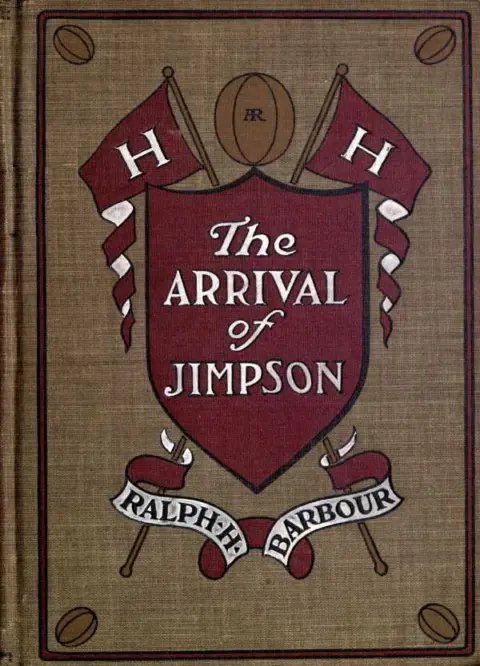
THE CLASSIC COLLECTION · 1904
"The Arrival of Jimpson, and Other Stories for Boys about Boys" by Ralph Henry Barbour is a collection of short stories written in the early 20th century. The book addresses themes relevant to young boys, particularly focusing on school life, sports, and the challenges of adolescence. The opening story features the character Jimpson, who is a freshman football player trying to make his mark amid the excitement and pressures of a college football game. The opening of the book sets the stage for the story of Jimpson and his battle for recognition in a team dominated by more experienced players. Amid a fervent atmosphere filled with cheers and anticipation, the narrative explores Jimpson's feelings of exclusion as he prepares for a pivotal game against Yale. Despite being overlooked by his peers, Jimpson's determination and potential are highlighted, foreshadowing his chance to prove himself. The story captures the spirit of youthful camaraderie, the thrill of competition, and the internal struggles of a young boy seeking acceptance.
Introduction adapted from the source catalogue; source summaries may be automatically generated.
Free to read · English · 47,166 words · No account needed
MAKE TIME FOR A GOOD BOOK
On by default. Untick to stop anonymous reading totals. Each page counts after 10 seconds in view. How this works.
Anonymous counting is on unless you have switched it off.
“We--we’re not new acquaintances, Mr. Schuyler,” he said.
“Ah!” The older man watched while the two shook hands constrainedly. “Ah!” he repeated. It was a very expressive word as he uttered it, and Parmelee, glancing at his face, saw that he understood the situation. The two unclasped their hands, and for a moment viewed each other doubtfully.
“If you know each other, that makes simpler the request I was about to make,” said Parmelee’s guest. “I want Mr. Parmelee to come and make us a visit for a week or so, Phil. I think the North Shore sunshine will take some of that white out of his face. Just see if you can’t persuade him, won’t you?” He turned away toward the window. The two at the doorway looked at each other for an instant in silence. Then Philip Schuyler put out his hand, and Parmelee grasped it.
“You’ll come?” asked Philip, softly. Parmelee nodded.
“If you want me.”
“Of course I do! And, I say, Jack, it’s--it’s all right now, isn’t it?”
“Yes, Phil; it was never anything else,” answered Parmelee, a trifle huskily. The two gripped hands silently, smilingly, and turned to Mr. Schuyler.
“Are you ready, dad?”
“Eh? Oh, yes. And, Mr. Parmelee, perhaps you wouldn’t mind joining us? I’d like you to meet Phil’s mother and sister. It--it might be a good chance to test the value of my advice, eh?” Parmelee hesitated for a moment, then took up his gown.
“Thank you, sir, I think it might,” he said.
The captain, the head coach and the trainer of the Hillton Academy football team sat about the table in the head coach’s room. It was the evening of November 27th, and on the morrow, Thanksgiving day, the wearers of the crimson were to meet on the gridiron their old-time rivals of St. Eustace Academy, in the final and most important contest of the year.
The drop-light illumined three thoughtful faces. Bob Syddington, captain, a broad-shouldered and fine-looking lad of eighteen, traced figures on the green-leather table-covering and scowled intently. Gardiner, the head coach, a man of thirty, wrote on a sheet of paper with a scratching pen. The trainer and the school’s physical director, Mr. Beck, leaned back in his chair, his eyes from behind the gold-rimmed glasses fixed speculatively upon Syddington. Gardiner looked up.
“Cantrell at left half, of course?”
Syddington nodded.
“He won’t last the game,” said the trainer, “but he’s good for the
first half.”
The coach’s pen scratched again. Syddington scowled more darkly and his hand trembled a little over the leather.
Your reading position is saved on this browser. Take it to another device with a library code. Reading pages adapt to text, rather than matching a printed edition.
Ralph Henry Barbour
Ralph Henry Barbour

Ralph Henry Barbour

Ralph Henry Barbour
BEHIND THE BOOK
This eBook is for the use of anyone anywhere in the United States and most other parts of the world at no cost and with almost no restrictions whatsoever. You may copy it, give it away or re-use it under the terms of the Project Gutenberg License included with this eBook or online at www.gutenberg.org. If you are not located in the United States, you will have to check the laws of the country where you are located before using this eBook. Read the source licence.
The original source file, including credits and licence, is retained by this library. Request an original-format copy at no charge. Please include the book title and Project Gutenberg identifier #45689.
KEEP YOUR CURIOSITY GOING
Coulson Kernahan

Maurice Baring
Frances Wright
Cécile Tormay

Frederic Jesup Stimson

W. H. P. (William Henry Pope) Jarvis