Transplanted
Gertrude Franklin Horn Atherton
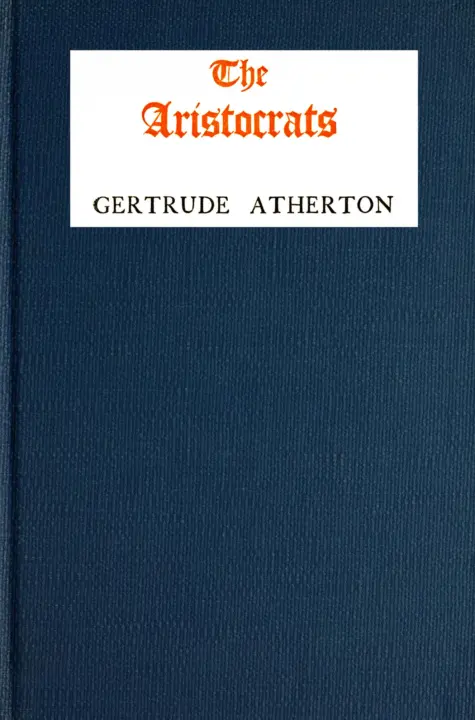
THE CLASSIC COLLECTION · 1901
"The Aristocrats" by Gertrude Atherton is a fictional narrative written in the early 20th century. The story centers around Lady Helen Pole and her observations during her time spent in the Great North Woods of New York, as conveyed through her letters to her friend, the Countess of Edge and Ross. The book likely delves into social themes, the contrasts between American and European cultures, and the personal struggles of its characters against the backdrop of nature. The opening portion introduces Lady Helen Pole as she navigates the stunning yet wild landscape of the Adirondacks. Through her letters, we see her grappling with the beauty and rawness of the wilderness, reflecting on her brother Bertie's illness, and contrasting her own aristocratic lifestyle with the frontier spirit of America. Her interactions with her companions, particularly Bertie and Agatha, reveal her concern for their well-being, while her musings about the local people demonstrate an appreciation for the simplicity and authenticity of life closer to nature. Helen's sharp observations on society, culture, and human nature set the tone for a work that promises both introspection and vibrant descriptions of the natural world.
Introduction adapted from the source catalogue; source summaries may be automatically generated.
Free to read · English · 52,702 words · No account needed
MAKE TIME FOR A GOOD BOOK
On by default. Untick to stop anonymous reading totals. Each page counts after 10 seconds in view. How this works.
Anonymous counting is on unless you have switched it off.
“Do sit and talk to me a moment,” she said. “I have been longing to see more of you. I am glad you were so kind to Miss Simpson. I think she is a type that should be encouraged and I am doing all I can for her. Of course she is what is called self-made, she has no family tree, but, as Junot said, ‘Some of us must be ancestors’--you remember that is quoted in the Rémusat Memoirs; delightful reading, whether they are authentic or not. I thought I would tell you just how Miss Simpson stands, lest you should wonder a little at her accent and stiffness; but she is so estimable and capable and altogether superior--and bound to go so far--I am sure you will think I am right to take her up.”
“I don’t see any reason in the world why you shouldn’t,” I replied, “and it certainly has interested me very much to meet her. I really must go, if you don’t mind. I am so very tired.”
On the way back I told Mr. Rogers of my conversation with Miss Simpson and of my disgust. He smiled good naturedly.
“Oh, that is only the zeal of the amateur,” he said. “They get less
shoppy every year.”
“But don’t they lose a good deal meanwhile?” I asked.
“Well, perhaps,” he admitted.
The children are making such a racket with firecrackers I can scarcely think, but I send you much love and sympathy.
Letter V
From the Lady HELEN POLE to the Countess of EDGE and ROSS.
Boulder Lake,
July 10th
Do not imagine, Polly, that I have given up my solitary ramblings in the forest. I enjoy them more than ever; and their soundlessness after the eternal babble which pervades the lake--I am afraid I am not grateful for all the kind attentions I receive--is simply delicious. Leaves, green leaves everywhere, rioting to my knees and hanging in the air. You never notice the slender branches, only the delicate fairy curtain they hang between the dark stems of the trees. And the ferns, and the ground pine, and the green stars of that moss that covers ground and rock, and the rich velvet moss, shading from a dark green to one that is almost white, that covers the fallen trees, and the incomparable solitude. Best of all I have discovered a gorge, sloping gently on one side, the other a huge boulder covered with moss; in the bottom of the gorge a brook pushing its tortuous way over rocks; and alders and ferns close to the banks. Overhead there is a rift of sky, and the sunlight flickers about generously, and the woods I have come through look so dark and impenetrable. There is a fine dry rock with the alders meeting like an arbour above it, and I sit there by the hour and wonder why the forest ever made me feel over-civilised. Beside these people I feel a pure child of Nature. They have reached a pitch of correctness I never can hope to attain. They never use slang, they punctuate their sentences so beautifully, they would not drop a final g in our careless fashion for worlds; they pronounce all their syllables so distinctly! Oh, this is “culture,” Polly mine. If poor dear Matthew Arnold could only come back and live among them! Perhaps he does in spirit and that is his idea of Heaven. (It would be mine of Hell). And we have so misjudged the Americans, believing them to be crass and exaggerated. I assure you there is nothing exaggerated about the true aristocrats except their virtues; those are superlative, but in all other things they aim at simple perfection only, and from their enunciation to their boots--they have the dearest little feet--I can tell you, Polly, they have attained it. I feel so crude--and so happy. I come out here to my brook--I am writing to you with its baby roar and lap in my ears--and I say all sorts of dreadful things quite loud. I forget that I ever have sizzled in London drawing-rooms, proud and happy in my court and interested in nothing in life but gowns and conquests. I forget the whole atmosphere of flirtation and intrigue and gay recklessness and heartbreak. I can tell you, Polly, that when you have stood as close to death as I have done during the last two years, with your heart-strings on the rack and the tears never far from your eyes, you are well prepared to retreat into the arms of Nature and cower there. I have no desire left to return to the world, and if Bertie can live comfortably here I should be glad and happy to remain for an indefinite number of years. My prince can find me here as well as anywhere. He is not Mr. Rogers, charming as he is. He never could stir up my great emotions--and I have them! I wonder if these people ever have suffered as I have, or if they ever have loved passionately? I cannot imagine it. They are too well-regulated, and that discontent which gently agitates them is merely the result of living in a country where nothing is unattainable, and, consequently, where ambition never sleeps, even when it takes no form.
Your reading position is saved on this browser. Take it to another device with a library code. Reading pages adapt to text, rather than matching a printed edition.
Gertrude Franklin Horn Atherton
Gertrude Franklin Horn Atherton
Gertrude Franklin Horn Atherton
Gertrude Franklin Horn Atherton
BEHIND THE BOOK
This eBook is for the use of anyone anywhere in the United States and most other parts of the world at no cost and with almost no restrictions whatsoever. You may copy it, give it away or re-use it under the terms of the Project Gutenberg License included with this eBook or online at www.gutenberg.org. If you are not located in the United States, you will have to check the laws of the country where you are located before using this eBook. Read the source licence.
The original source file, including credits and licence, is retained by this library. Request an original-format copy at no charge. Please include the book title and Project Gutenberg identifier #72957.
KEEP YOUR CURIOSITY GOING
Coulson Kernahan

Maurice Baring
Frances Wright
Cécile Tormay

Frederic Jesup Stimson

W. H. P. (William Henry Pope) Jarvis