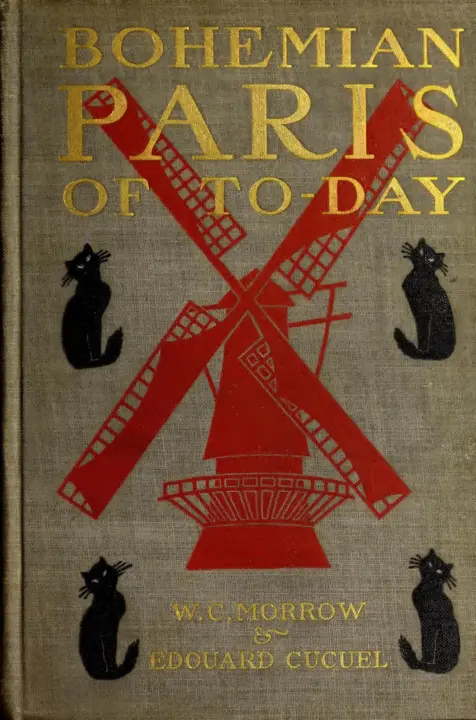
Bohemian Paris of To-day Second Edition
W. C. Morrow & Edward Cucuel
THE CLASSIC COLLECTION · 1897
"The Ape, the Idiot & Other People" by W. C. Morrow is a collection of short stories written in the late 19th century. The stories explore themes of freedom, companionship, and the human condition, often through the lens of unusual relationships, as exemplified by the interactions between an escaped ape and an idiot in the first tale. At the start of the first story, "The Resurrection of Little Wang Tai," we are introduced to Romulus, an anthropoid ape who escapes from a circus train, experiencing the thrill and confusion of newfound freedom for the first time. As Romulus explores the world around him, he encounters a gentle, child-like inmate of an idiot asylum named Moses. Drawn together by their shared desire for freedom and connection, Romulus and Moses embark on a whimsical adventure that eventually leads them to a graveyard, where a poignant scene plays out involving the burial of a young girl named Wang Tai. This encounter deepens their bond, illustrating the complexities of companionship across species and mental capacities, setting a tone for the themes that will unfold throughout the collection.
Introduction adapted from the source catalogue; source summaries may be automatically generated.
Free to read · English · 56,360 words · No account needed
MAKE TIME FOR A GOOD BOOK
On by default. Untick to stop anonymous reading totals. Each page counts after 10 seconds in view. How this works.
Anonymous counting is on unless you have switched it off.
One day he entered the museum between exhibitions and sought the Wild Man of Milo. That worthy was leisurely smoking a cigarette in a quiet corner, and was making the smoke curl up gracefully over the hairy tuft on his nose. Sampey was paler than usual and a little nervous, for the business of his visit was tinged with hazard. Bat, who happened to feel good-natured, gave the first greeting.
"Hey!" he called out.
Sampey went straight to him.
"You lika da show, ha, Samp? You come effery day. Gooda place, ha,
Samp?"
"A very good place, Bat," quietly answered Sampey, who tried hard to appear indifferent as he fumbled nervously in his pocket.
"Signor Castellani, he biga mon, reecha mon, gooda mon. You like 'im?"
"Very much." Sampey was acting strangely.
Bat's eyes twinkled a little dangerously.
"You lika da gal, too, ha, Samp?"
"The--ah--the tattooed woman? Yes, very well, indeed."
"Ha, you sly Samp! I spik about da leetle ploompa gal--da Mug."
"Oh! Muggie? Castellani's daughter?"
"Ha."
"Well, I don't know her so very well."
"You don' know da Mugga?" Bat's look was becoming dangerously fierce. He straightened himself up from his lounging posture, and his big muscles swelled. "You don' know da Mugga! You tink I no see. You loafa da Mugga! You wanta marry her! You tink 'er reecha, pooty. You miseraba sneaka!" Here Bat, who had worked himself into a fury, swore an eloquent Italian oath.
Sampey's time had come. The two men were alone,--Bat furious and desperate with jealousy; Sampey fearful, but determined; brutality against wit, strength against cunning, fury against patience, a bulldog matched with a mink, a game-cock pitted against an owl.
Sampey pretended to have dropped something accidentally. He stooped to pick it up, and some seconds elapsed before he pretended to have found it. While he was searching for it he approached nearer to Bat, and when he straightened up he brought his face very close to Bat's, and suddenly raised his eyes and stared steadily into those of the Wild Man of Milo.
Bat meanwhile had kept up an insulting tirade, his evident purpose being to force the gentle writer into a fight. But when Sampey raised his eyes and fixed them in a peculiar stare, Bat regarded him a moment in speechless wonder, and then sprang back with a livid face, and in terror cried out:
"Santa Maria!"
Your reading position is saved on this browser. Take it to another device with a library code. Reading pages adapt to text, rather than matching a printed edition.
BEHIND THE BOOK
This eBook is for the use of anyone anywhere in the United States and most other parts of the world at no cost and with almost no restrictions whatsoever. You may copy it, give it away or re-use it under the terms of the Project Gutenberg License included with this eBook or online at www.gutenberg.org. If you are not located in the United States, you will have to check the laws of the country where you are located before using this eBook. Read the source licence.
The original source file, including credits and licence, is retained by this library. Request an original-format copy at no charge. Please include the book title and Project Gutenberg identifier #21616.
KEEP YOUR CURIOSITY GOING
Coulson Kernahan

Maurice Baring
Frances Wright
Cécile Tormay

Frederic Jesup Stimson

W. H. P. (William Henry Pope) Jarvis